 Margen
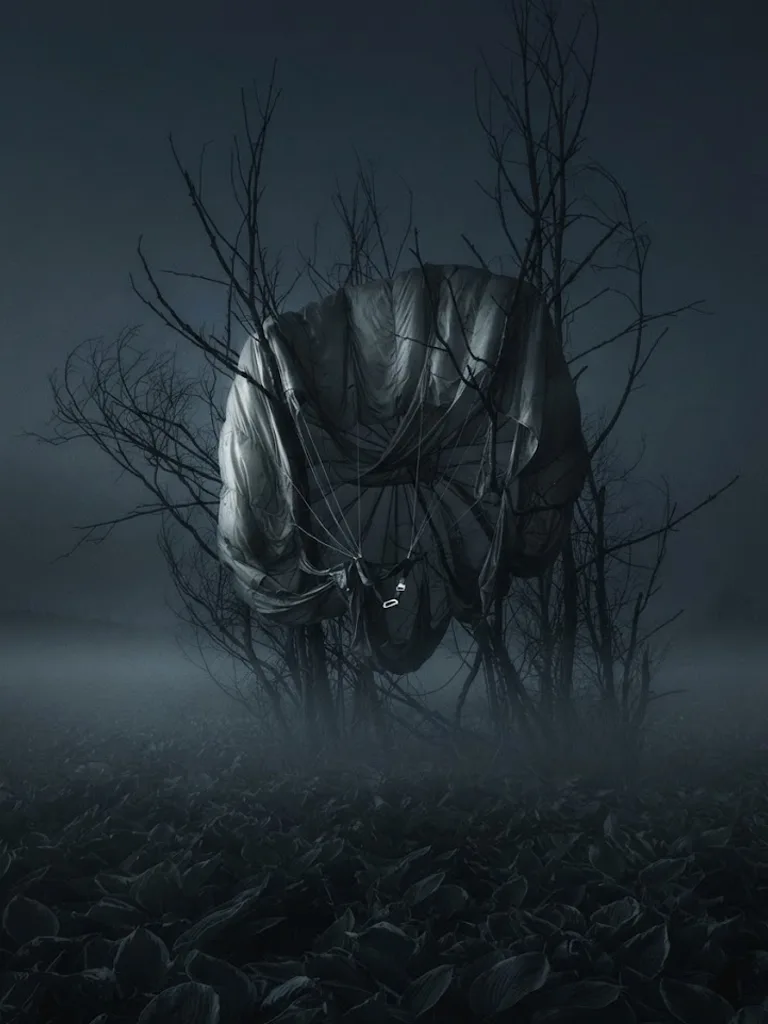
Faro is a tobacco hamlet in Wayne County, North Carolina, and at half past midnight on 24 January 1961 an entire bomber came down on top of it with two hydrogen bombs inside. One of the two worked through the steps of its firing sequence on the way down, one after another, and stopped one short. That one was an arm/safe switch, low voltage, that nobody had thrown.
The aircraft was a B-52G of the 4241st Strategic Wing, based at Seymour Johnson, twenty kilometres away. It was flying an airborne alert mission — a patrol flown with the bombs already loaded — when the boom operator of the tanker radioed to say it was losing fuel from the right wing. In three minutes 17,000 kilos of kerosene were gone. The wing gave way. Six of the eight crew got out of the aircraft at around 2,700 metres, before the machine broke up in the air; the other two died in the crash. Of the six who jumped, one did not survive the descent.
Inside were two Mark 39 Mod 2 thermonuclear bombs. Each had a yield of 3.8 megatons, roughly 250 times Hiroshima.
The first one behaved as though somebody had released it on purpose. As it left the disintegrating aircraft, its mechanism read the fall as a normal drop and worked through the sequence: the arming wires pulled free, the barometric switches closed at the set altitude, the timer ran, and the thirty-metre retarding parachute opened. The bomb came down hanging, the parachute tangled in a tree beside a farm at Faro, and the weapon ended up standing upright, its nose driven some forty-five centimetres into the ground and barely scratched. The disposal team that arrived before dawn found it like that, charge intact, and took two days to take it apart where it stood.
None of that left the laboratories for half a century. In 1969 Parker F. Jones, head of the nuclear weapons safety department at Sandia Laboratories, wrote an internal report and titled it "Goldsboro Revisited, or: How I Learned to Mistrust the H-Bomb". Classified and typewritten, it said the Mark 39 Mod 2 did not have adequate safety for the airborne alert role, and that on that night "one simple, dynamo-technology, low voltage switch stood between the United States and a major catastrophe". The report came to light in 2013: the journalist Eric Schlosser requested it under freedom-of-information law and the National Security Archive at George Washington University published it.
The second bomb fell worse and ended better. It came down with no parachute, entered a waterlogged field at around 1,100 kilometres per hour and broke apart under the mud. Crews dug in the bog, got past twenty metres, brought up pieces, and never reached the second stage, the uranium one.
So the matter was settled on paper: the Army Corps of Engineers bought over that spot a circular easement some hundred and twenty metres across, and nobody digs there without permission. In 2012 the state of North Carolina planted a historical marker by the road to tell the story. The second stage, the uranium one, is still down there: the University of North Carolina put it at around fifty-five metres, give or take three.