 Margen
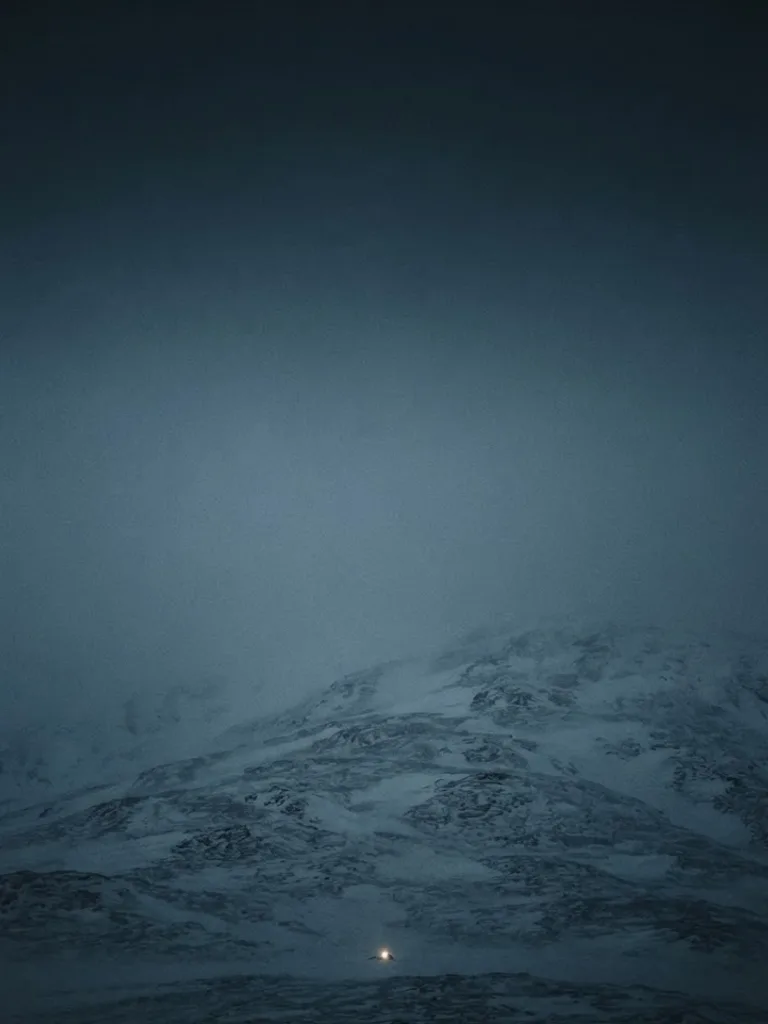
Previously: they shut the generator down on the ninth day to stop breathing 121 ppm. There are 95.7 litres left and two batteries for the radio.
The tenth day dawned with three on the count and with ninety-five point seven litres of diesel in a padlocked tank, which is the first time at Iratxeta that there is fuel to spare and something else missing. Firewood was missing. Nobody knew it yet at seven in the morning, because in nine days nobody had counted it.
The nine had slept in the dining room, on the east side, with the sleeping bags piled against the west partition and another bag rolled up at the foot of the corridor door. Idoia Bergara, thirty-nine, warden of Iratxeta and an emergency nurse until 2019, got up at twenty past five to feed the stove, which is what she had been doing every two hours since twenty past one in the morning. Fani's logger sat on the long table, switched on, its little screen reading nine parts per million: smoke from the stove, which goes out through the other pitch of the roof and not through the cracked flue. Nine, not a hundred and twenty-one. In that much, the ninth day's decision was working.
What was not working was the rest of the house. Fani Quiroga, twenty-eight, a geologist who had come up to change the sensors on the slope the day before the avalanche, read the night's temperature channels at a quarter past seven and called them out without dressing them up.
"Dining room, six and a half at four in the morning, which is the worst moment. Corridor, one below. Small dormitory, three below, and dropping a tenth of a degree an hour."
"It is going the way you said," said Idoia.
"It is going the way I said. At a tenth an hour, the dormitory hits eight below on the third night, the one from the eleventh to the twelfth. Not before and not after."
Aitor Sein, seventeen, a trainee warden that season, was writing that down in his notebook when he looked up and did the sum out loud. He did it slowly, like someone expecting to be corrected.
"Yesterday we said four nights without the engine. From the ninth to the twelfth there are three. Last night was the first."
Nobody corrected him. Mercedes Arriaga, fifty-five, a retired justice of the peace who has kept the diesel accounts on the inside back cover of the visitors' book since the third day, ran a finger down her own column and said nothing for a moment.
"The boy is right," she said. "There are three in my column."
"The one who wrote four was me," said Idoia. "Yesterday, at ten past one, in the visitors' book and in front of all nine. I counted the days we had left: the ninth, the tenth, the eleventh and the twelfth. Four days, but three nights. Three left."
"Better three than four," said Ramiro Bouzas, forty-four, a mountaineer and boat carpenter, who had been asking to go down since the day of the avalanche.
"Better three," said Idoia, "and we still have to get there."
At nine she sent Casimiro and Aitor to the woodshed. Not for the wood itself: she wanted to know how much was left so she could say a number out loud, because in nine days she had learned that in that house arguments only ended when somebody put a number on the long table.
Casimiro Lete, seventy-one, a member of the club since before the new refuge existed, has come up to Iratxeta for thirty winters and has loaded that woodshed almost every autumn. They came back at half past nine. Casimiro had his cap on, as always indoors, and his hands black with bark.
"Nineteen armfuls," said Aitor. "Counted in twos and counted twice."
"Nineteen good ones," said Casimiro. "There are two more rows underneath, but those are the ones on the woodshed floor and they are wet from below. Those do not heat: they smoke."
Idoia sat down and asked Mercedes for the pencil.
"And how much burned yesterday?"
Aitor had it written down, because he had been writing it down since the first morning without anyone telling him to, the same way he wrote down the engine starting and stopping.
"Eleven. From seven yesterday morning to seven this morning, eleven armfuls."
Mercedes did the division on the back cover and showed it without comment, which is how she shows her sums.
"Nineteen divided by eleven is forty-one and a half hours. Counting from seven this morning, we run out at half past midnight on the night of the eleventh. The helicopter window is the eleventh onwards, which may be the eleventh or may be the twelfth."
"And the two rows underneath," said Ramiro.
"The two rows underneath are half an armful of heat and a chimney full of tar," said Idoia. "If you tar up the stovepipe on me, I lose the only thing heating this room and I cannot light it again until somebody comes up with a chimney brush. I am not going to do that."
Nine days of numbers, and that was the first one that could not be fixed by tightening a clamp or rationing a litre. It was Lena Bouzas who said so, forty-one, a mountaineer and anaesthetist, Ramiro's sister, who has slept on the east bench since the seventh day's measurement and who that morning was talking in her own voice again.
"Then yesterday's question has an answer. We can take three nights without the engine, yes. Without wood, no."
Idoia laid out what there was, which was three things and none of them good, and she said them in full so nobody would have to ask afterwards.
The first: light the generator again in the small hours of the twelfth, when the wood runs out, and keep all nine in the dining room. The dining room measures forty-one with the engine running; Fani measured it on the ninth day, after the patch.
"Forty-one is twice the eight-hour limit in a workplace, which is twenty," said Lena. "It does not pass the fifteen-minute peak, which is a hundred. Half a night at forty-one does not kill a healthy person. I have here a man of seventy-one and another of sixty-six who has spent seven days coming out of moderate hypothermia, and both of them would have to sleep inside it. And I am not going to sign that it is safe, because it is not."
The second: the wood of the bunks in the upper dormitory, eight of them, pine, in place since the new refuge was built.
"They are varnished," said Sabino Amantegui, sixty-six, warden of this refuge from 1991 to 2022, from the corner bench. "I varnished them myself in 2016, with whatever there was. In a wood stove that is exactly the same as the wet rows, only faster."
"And the slats?"
"The slats are plywood."
Ramiro stood up and went to the third before Idoia said it.
"The third is that somebody goes down. I have been saying it for nine days."
"The third is that somebody goes down," Idoia repeated, "and it is the first time I have said it."
Txomin Elordi, sixty-two, a shepherd who has carried the club's post up to Iratxeta since 1994 and brings down whatever has to come down, had been standing by the hearth since seven in the morning with his hands in his pockets. He had said no to the Larrondo couloir on the first day, on the sixth and on the ninth, and all three times without explaining why.
"No."
"Yesterday you said you would look at the couloir today and that you would look at it first," said Idoia. "I am not asking anyone to go down: I am asking you for that. Go out and look at it and be back before the light goes. If you tell me there is no way through, the argument is over and tomorrow I start the engine and I carry what Lena said. But I want you to tell me having seen it today, not remembering how it was on Tuesday."
Txomin took his hands out of his pockets.
"If I go out, I go with one. You cannot mark it alone."
"I will go," said Ramiro.
"You will, yes," said Txomin, "because if I do not take you today you will go off tomorrow behind our backs."
They left at twenty past ten with six of the club's marker poles, a shovel, thirty metres of eight-millimetre rope and Txomin's probe, which is one of the old ones, aluminium, and which he has carried for more years than the new refuge has been standing. Idoia gave them four and a half hours, counting the last one of poor light, and told them that if they were not at the door by three she would go out herself.
Inside it turned into a long day.
At one Idoia made the day's call. Since the second day the refuge radio has spoken to the club at thirteen hundred sharp and at twenty hundred sharp, seven minutes each time, which is what she decided in order to stretch the batteries. The same man as always answered, the mountain officer, and he said the same as on the ninth day with one word changed: that the forecast still gave the eleventh as the first day with wind below forty kilometres an hour at the col, that the unit's helicopter was committed until the eleventh on a rescue in the next valley, and that if the eleventh could not be done, it would be the twelfth.
"And if the twelfth cannot either?" asked Idoia.
"Then we come up on foot, and on foot it is eight hours from the forest track."
Aitor noted the seven minutes. Fani then measured both batteries with the multimeter and said the numbers out loud, because in that house numbers are said out loud: the one in use, twelve point one; the spare, which has spent three days on the north window ledge, eleven point four.
"With those two there is enough to talk until the twelfth if we stay at seven minutes," she said. "For more, no."
Fani put the logger at floor level, next to the bag against the corridor door, because she wanted to know whether the stove was putting carbon monoxide in at the height where people were sleeping; it came out at seven, two less than on the table. Mercedes made a fair copy of file 47/2021 and the two pink sheets, by hand, on three sheets of paper, because she said that a document that has spent four winters in a sheet-metal cupboard should not come down the mountain in a single copy. Sabino helped her read his own 2021 handwriting in the two places where the ink had run. Casimiro and Aitor brought up the two wet rows from the woodshed, split them fine with the axe and stood them against the stove wall to dry, which was not going to dry them in a day but was the only thing that could be done with them.
They came back at ten to three, with light still in the sky.
They came back without any of the six poles and with Ramiro's trousers torn from the knee. Txomin took the probe off his shoulder, left it on the floor propped against the wall and sat down on the bench before speaking, which is something they had not seen him do in ten days.
"There is a way through," he said.
He told it in the order he had walked it. You cannot go down by the spring gully: Tuesday's avalanche left it loaded with blocks up to the second step and half the cornice that did not go is still hanging above it. Nor through the northern beech wood, because to get into the beeches you have to cross the slab that hangs below the north gully, and that slab is live, and it was live on the first day and on the sixth and yesterday. That leaves the Larrondo couloir, which starts a hundred metres below the refuge, at the Larrondo gap, and which he did not want.
"The top third has a slab. I probed it in three places: forty centimetres thick over a layer of loose grains that does not hold. You cross that one at a time, roped, and you cross it on the left hugging the rock, which is where I have put four poles. The other two stayed down at the elbow, which is where you have to drop into the narrows."
"And below?" asked Idoia.
"Below it is live ice all the way to the beeches. Real ice, not hard snow: you go down facing in, with crampons and both hands taken. From the gap to the forest track is four hours if nothing breaks, and if something breaks, there are no four hours."
Nobody said anything. Fani noted the time, out of habit.
"It is marked," said Txomin. "And now the other thing."
He sat looking at the long table, not at the people, the way people do when they are about to say something they have gone ten days without saying.
"On the twenty-first of February 2003 I brought my brother down that way. Fermín Elordi, forty-one, a shepherd like me. The slab broke on him in the top third, in the exact place where I have put the poles, and it took me nine hours to get him down to the track. That is why I have been saying no since the first day, and I had not told it because it was beside the point while there was diesel."
Casimiro took off his cap, which was the first time in ten days.
"I was on the club committee in 2003," he said. "We put a plaque with his name at the Larrondo gap."
"It is under the snow," said Txomin. "I saw it today, because I had to dig to get the first pole in."
He got up, picked the probe off the floor and left it propped beside the door, with his gloves on top of it, in the place where he leaves it every time he comes back from outside.
"Now you know where you go down, and I have marked it so that whoever has to go down can. I am not going down there again, and I do not want anybody going down."