 Margen
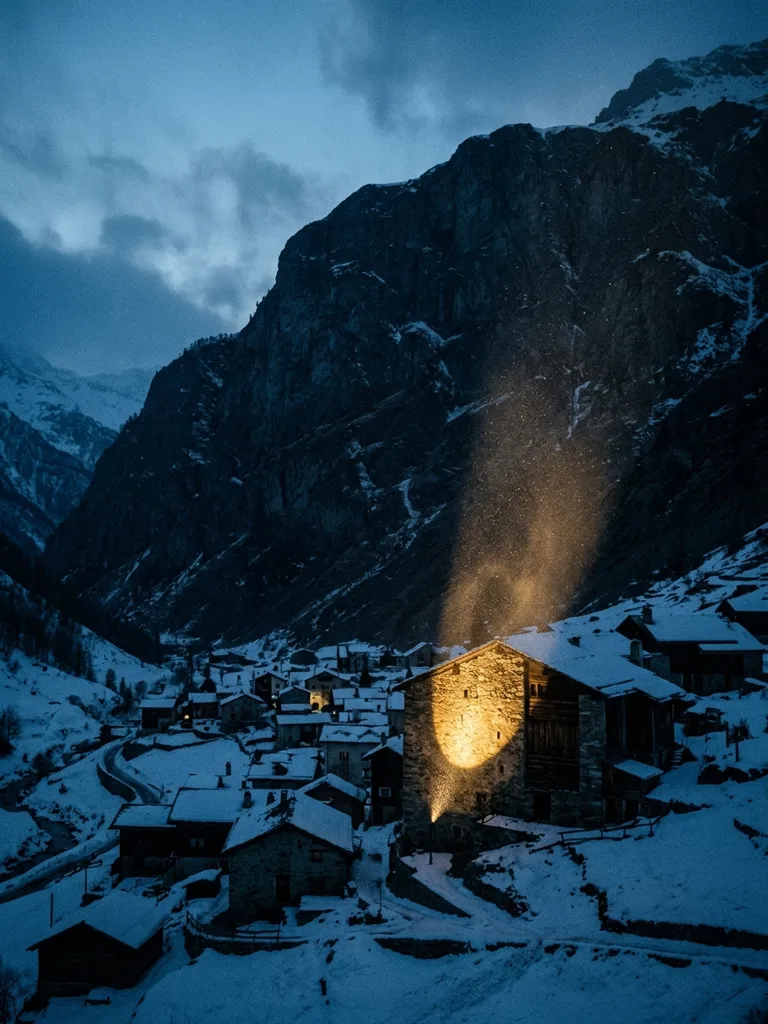
At 12:43 on December 8, 2031, Inés Valcárcel, the municipal technician in charge of the heliostats, blocked the sale of eleven minutes of sun. The bid glowed red on her tablet while Andrés Montalvo, owner of the bar on the square, held his phone aloft among twenty neighbors. The patch of light was already grazing the first table of his terrace.
—Two hundred forty euros, Andrés announced.
The figure appeared on the town hall screen. Inés pressed SUSPEND before the regulation ten seconds ran out. A collective groan crossed the square of Valdebruna, a village wedged beneath the mountain's north slope. The sun vanished behind the ridge from November to February, even when the sky stayed clean.
Three heliostats, large steerable mirrors, had occupied the opposite ridge for two winters. Each tracked the sun's path with a motor and sent the reflection down toward the village center. Together they formed a patch of about two hundred square meters, an area the size of two mid-sized apartments, which could travel across the square without touching the windows.
Inés steered the mirrors from a console installed in the old clinic. She defended the weekly draw because the project had been approved on one condition: every neighbor would get the same chance to enjoy the light. Andrés wanted to lock up every midday slot to fill his terrace through the slowest quarter of the year.
In the first week of November, the system had awarded twenty-eight minutes to each winner. Then came twenty-two. By month's end they had dropped to seventeen, because the mountain kept trimming the usable arc. That December week, only eleven minutes came with each ticket.
The shrinking had changed the village's behavior. With twenty-eight minutes, a family would set two chairs in the square and still have time to spare for calling another one over. With eleven, every second acquired an owner. Turns were checked on a public screen that showed the name, the coordinates and the time remaining.
At first, free swaps were allowed. One neighbor gave up a Tuesday in exchange for a Saturday; the repair shop traded a morning slot for one near closing time. Then came a bidding option designed for those who couldn't use their turn. The money was logged and the town hall kept a small maintenance fee.
Andrés was the first to grasp the whole business. He bought three loose turns for the terrace of La Brújula, the bar facing the fountain, and confirmed that the sunlit tables filled up first. The following week he acquired seven. By December he already controlled thirty-nine minutes around midday, spread across different days.
He forced no one to sell. He offered twenty euros for a slot many retirees never planned to use and raised the offer when competition appeared. He also took trades: a month of breakfasts for eight minutes; a family lunch for fifteen. The municipal app showed each result, but not the accumulating pattern.
Inés did see the pattern. On her console, the slots Andrés had bought composed a yellow line around the terrace. If it kept growing, the square would keep a draw in name only while the best spot ended up controlled by a single business.
The suspended eleven minutes belonged to Eusebia Roda, a neighbor who kept a small henhouse on the outskirts. She had drawn the 12:43 turn and put it up for sale because she was expecting the veterinarian at that hour. The opening price was twelve euros. Two buyers bid it up to thirty-six; Andrés jumped straight to two hundred forty.
—The app allows bidding, he said, putting his phone away. You can't stop it because you don't like the price.
Inés came down to the square with the tablet pressed against her coat. The patch of light advanced along that day's program. It crossed a bench and climbed the rim of the fountain before reaching the tables. On the public screen, four minutes remained of the previous turn.
—I can halt a transaction for anomalous concentration, she replied. Article seven.
—Anomalous concentration would be buying the mirror. I'm buying time.
Andrés had set nine tables inside the rectangle marked with golden tape. The ones outside it were folded. His goal was to string together enough turns to serve lunches under the reflection without moving the terrace every few minutes. He had even designed a menu called Sol de Invierno, served only while the counter was running.
—You've bought minutes from forty-three people, said Inés.
—From forty-three people who wanted to sell them.
The screen reached zero. The motors on the ridge issued the next order and the patch moved two meters toward the pharmacy. The customers gathered up their glasses with practiced ease. Andrés looked at his darkened tables and pointed to the frozen auction.
—Eusebia wants the money. I want the turn. The town hall wants its fee. Who loses?
Inés opened the map of awards. During the installation she had calculated trajectories so the reflection would never heat the same pane twice. Now she had to calculate another kind of trajectory: the one the minutes followed after the draw.
—The loser is whoever wins a Tuesday at nine and discovers that Saturday noon already has a permanent owner.
—Then raffle off money, not sun.
The line drew a few short laughs. Andrés seized the moment to display the accepted contracts on his phone. None exceeded the weekly maximum per seller. No individual purchase broke the rules. The concentration existed only when Inés added them up.
Eusebia appeared from the washhouse street in rubber boots. She asked why her sale had been frozen. When she heard the figure, her eyes went wide: two hundred forty euros meant several weeks of feed for her hens. She wanted to accept, and showed no interest in the municipal debate.
Inés could not defend fair distribution by making her carry its cost. She reactivated the auction, but added a condition reserved for incidents: the buyer had to declare the slot's intended use before confirming. Andrés typed TERRACE and offered the same amount again.
Then the other bidder raised the figure to two hundred fifty.
The square looked for the rival. The profile belonged to Cooperativa Umbría, a group founded that very morning. Fourteen neighbors had pooled money to buy turns and keep them open for common use. Their representative raised a blue card from the bench by the pharmacy.
Andrés offered three hundred. The cooperative answered with three hundred ten. The counter fell from ten to four as the patch drifted back toward the fountain to begin another turn. On her map, Inés watched two colors growing around the same rectangle: private yellow and collective blue.
Three seconds from closing, Andrés typed five hundred euros. Eusebia burst out laughing and asked that nobody touch a thing. The cooperative had no funds left. Several hands lowered at once.
The counter hit zero, the app moved on to award the slot and, instead of confirming, spat out a rejection.
Andrés looked at Inés. She enlarged the message: CONCENTRATION LIMIT EXCEEDED. Article seven did not forbid buying many slots, but the original program prevented any one account from controlling more than forty percent of a week's usable minutes, and the check ran at the moment of award, not at the moment of bidding. The afternoon's offers had died before winning; the five-hundred bid was the first of Andrés's to reach the close alive, and as it was about to win, the program measured it. No one had ever reached the limit before.
—I'll spread it across my waiters' accounts, said Andrés.
—They work for the same declared use.
—I'll start a cooperative.
—They've already beaten you to the name.
Eusebia's turn was left without a buyer, because the cooperative's earlier offer had expired as well. The rules required returning it to an immediate draw. Inés held her tablet up to the public screen and confirmed the return just as the band of light touched the leg of the first table.
One hundred six neighbors received the alert. Phones lit up one by one around the square. Andrés raised his, ready to enter the new draw, but the system barred for one week any account whose last award had been rejected for concentration.
Inés angled the central mirror six degrees toward the open zone marked out beside the fountain. The eleven minutes reappeared in green, available for a fresh ticket. She looked at the bar's owner and said, out loud:
—The eleven minutes of 12:43 go back into the draw, Andrés.