 Margen
Did you know? · From the Margen catalogue
Your Stomach Thinks a Book Is Poison in the Car
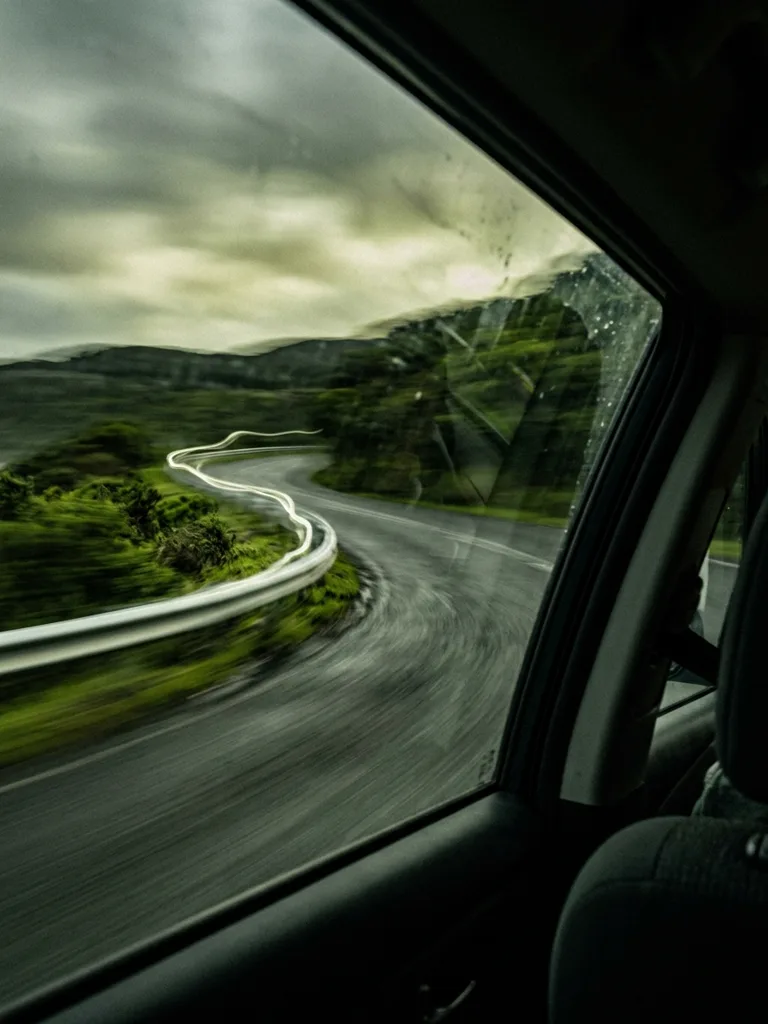
Inside a car, the page you hold stays fixed before your eyes while your body accelerates and turns. Your sight reports that you are still, but your vestibular system, the sensory network of the inner ear, registers the motion. Faced with that contradiction, your brain can read a signal much like the one a poison produces and trigger the reflex that empties your stomach.
That is why reading on a trip can make you nauseous. The book doesn't need to bounce and the letters don't need to slide. It's enough to fix your gaze on a stable frame while the vehicle brakes, takes a curve or changes speed beneath your seat.
If you get carsick often, you'll know this sequence by heart. Three pages go fine, a lukewarm warning arrives at the back of your neck, you glance sideways at the window and bargain with yourself: one more paragraph and I'll stop. That bonus paragraph never improves anything. By the time you finally lift your head you're already late: the argument between your senses has been running for minutes, and your stomach has started to take sides.
Your inner ear is acting, in that moment, like an accelerometer housed in your skull, that is, a bodily detector of displacement. It senses forces your eyes do not confirm, because the page fills nearly all of your useful field of vision. You receive two incompatible accounts of what is happening and hold no immediate proof that would let you dismiss either one.
That disagreement goes by the name of sensory conflict, a clash between motion signals. When it grows intense enough, you may feel heat, sweating or a rising discomfort in your stomach. Motion sickness, the dizziness brought on by movement, is not born of faulty digestion: it begins in the comparison you make between senses.
The link with nausea inspired, in 1977, a very specific evolutionary explanation. Michel Treisman was studying human perception at the University of Oxford when he published in the journal Science a hypothesis that is still cited today: an intense discord between senses could resemble, to your defensive mechanisms, the effect of a toxic substance.
If you swallow a poison capable of altering your perception, you may start receiving bodily signals that no longer agree. Your most useful protective response would be to expel what you swallowed before absorbing any more. According to Treisman's hypothesis, you still carry that ancient mechanism and can trigger it by mistake on a perfectly normal trip.
That is how the dizziness ends in nausea instead of settling, say, for a headache. Your body does not conclude in words that a book has poisoned you. It reacts with a defensive program that links sensory disorientation to the urge to empty your stomach.
It also makes better sense of why you can ride comfortably at the wheel and get sick in the seat beside it. When you drive, you anticipate the curve because you are the one turning the wheel. You know when you're about to brake because your foot starts the maneuver. That foresight lets your brain prepare for each change before it arrives from the inner ear.
As a passenger, by contrast, a roundabout can catch you staring at a sentence. Even if you know the route, you don't control the exact instant the acceleration lands. And if you're reading, you cut down the outside visual cues that might have warned you. Your body receives the turn; your gaze stays locked between the motionless edges of a page. That's why the same book that lasts you hours at home survives three pages on a winding two-lane road.
Nor does your susceptibility stay the same throughout life. Between the ages of two and twelve you are more likely to get carsick, and the tendency usually eases as you grow. You may keep it as an adult or feel it only on certain roads, but age changes how easily it appears.
Perhaps you've lived it in reverse. As a child you got queasy in the back seat just by opening a comic; today you last half a highway answering messages. The car is the same; you are not: most brains, over the years, learn to live better with that disagreement between what they see and what they feel.
Roughly one person in three is highly susceptible. That proportion doesn't mean the rest are immune: given enough motion, many will end up sick too. In your case, what matters is the intensity of the ride, the predictability of the curves and how long you keep your eyes away from the outside.
What shuts the argument down is giving your eyes the same trip your ear is feeling. Lift your gaze and find the road or the horizon: the outside world moves at the car's rhythm, and as soon as you look at it, your two sources go back to telling a similar story. Looking into the distance doesn't remove the curves, but it lets you see them coming, which was exactly what your brain was asking for.
With a screen twenty centimeters away, the opposite happens: it captures your attention and hides the motion, so every slam of the brakes arrives as a surprise. The front seat plays in your favor because it gives you back the road ahead: you see the roundabout approaching, you feel the traffic's braking coming, and every surprise turns into a scheduled appointment. If you're fit to drive, taking the wheel finishes the job: the person driving is almost never surprised by a maneuver their own foot has decided.
Nor is it strictly a car problem. The same standoff flares up on a bus weaving through curves or in a ship's windowless cabin: wherever the body travels while the gaze rests on something still, the argument is ready to begin. The page is just the most treacherous case, because it also claims your eyes entirely.
If the discomfort is already upon you, open the window a little. Fresh air doesn't fix the disagreement between your senses, but it makes the nausea easier to bear while you apply what does fix it: letting go of the text and looking outside. And let go early. Holding out for one more chapter out of pride keeps the signal that is making you sick switched on; stopping at the first warning deals you a better hand than waiting for your stomach to take charge.
The other way out is training it. Spend several days sailing and your brain ends up treating the rolling as part of the scenery: those are the famous sea legs, which arrive on their own once repetition convinces your alarm system that this particular swaying announces nothing.
On the road it works the same way, no training plan required: every trip that ends well teaches your brain that this particular sway announces nothing, and the comparison between what it predicts and what it receives slowly loses its drama.
Next time you travel, put the book away as soon as you notice the first warning, watch the road from the front seat and let in some fresh air. Keep your eyes outside until your stomach stops believing a curve has just poisoned you.