 Margen
Short story · From the Margen catalogue
Celia points at Polaris and Ekain loses his photograph
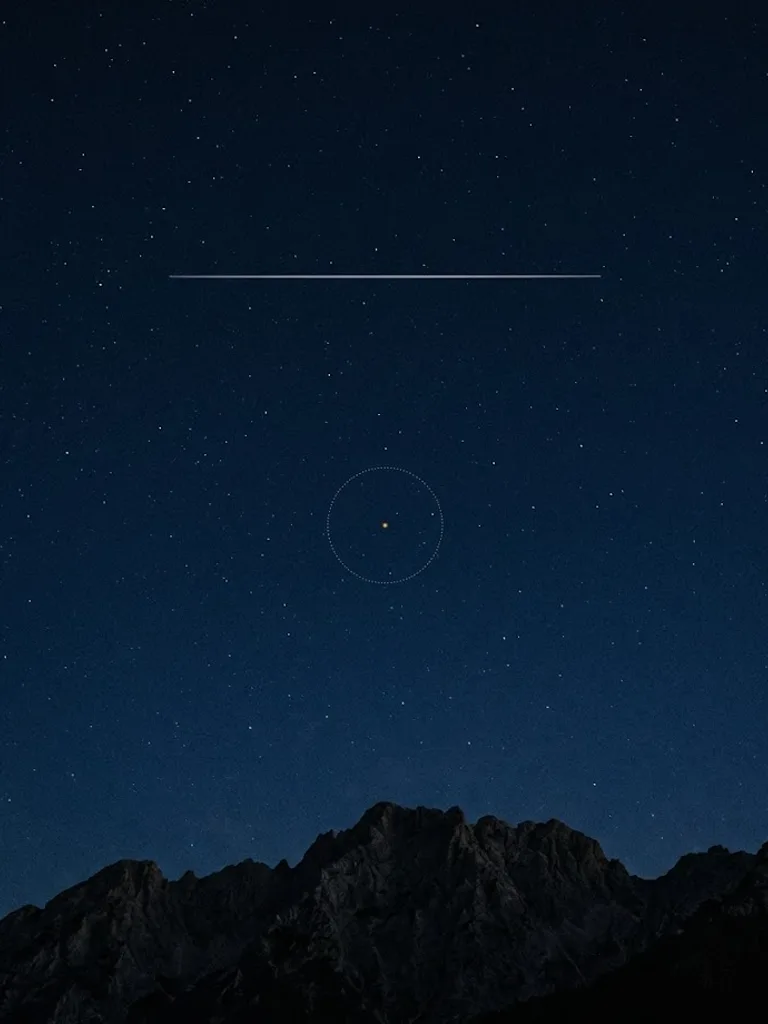
Forty-six people were queuing up on the Beortegi hill at twenty past eleven at night, and the telescope was still not pointing anywhere.
The poster for the village fiestas had been written by Celia Amunárriz, school bus driver, in green marker and without consulting anybody: SATURN AND ITS RINGS. BEORTEGI HILL, 11 P.M. FREE. BRING A COAT. Celia bought the telescope and its mount second-hand in 2019, for four hundred and eighty euros, from a man in Tudela who kept them in a garage under a blanket, and since then she has run the group's public nights because she is the only one willing to spend four hours on her feet at nine degrees explaining the same thing forty times over.
Ekain Arakama, twenty-four, delivery driver by day and the one who runs the group's accounts online, was on his knees behind the tube with a camera screwed in where the eyepiece should be.
"Celia, it isn't set."
"It's set."
"It's set by eye."
"It's set the way it gets set."
An equatorial mount —the support with two axes on which the tube rests— is good for exactly one thing: turning at the same speed as the Earth turns, but the other way, so that a star stays still in the eyepiece instead of sliding off the edge. And for that, its axis has to point at the Earth's axis extended up into the sky, which is a point and is called the celestial pole. What almost everybody believes, and it is what makes these arguments last until one in the morning, is that this point is the North Star.
It is not. Polaris sits two thirds of a degree from the pole and goes round it once a day, like everything else; what sets it apart is that its circle is so small that to the naked eye it looks nailed in place. Two thirds of a degree is forty minutes of arc, a little more than the width of the full Moon. At a hundred and twenty times magnification you do not notice that. In a ninety-second photograph you notice it so much that the stars come out as little dashes.
"My app says the pole is here." Ekain held up his phone.
"The group's atlas says it's here." Celia pulled a laminated sheet out of her inside pocket, torn from an Atlas of the Sky of 1979, with a cross drawn in biro and a date beside it.
They were both right, and that was the beauty of the thing, although neither of them could see it at twenty past eleven.
The Earth's axis is tilted twenty-three and a half degrees and it does not hold still: it traces an extremely slow cone and takes some twenty-five thousand seven hundred and seventy-two years to close it. Seen from down here: the celestial pole shifts across the sky by one degree every seventy-two years. Celia's atlas is forty-seven years old. The biro cross is where the pole was when it was printed, and today the pole is two thirds of a degree away from there. Exactly the same error Ekain would make by pointing at Polaris and thinking himself clever.
"We've been here half an hour," said a woman from the queue, with no intention of causing trouble. "Is it going to be long?"
"Two minutes," said Celia.
"You said two minutes twenty minutes ago."
Behind her, a man in a supporters'-club anorak announced out loud that his father used to set the telescope looking at the North Star and that it did the job. He was entirely right, and Celia told him so: for looking, it does the job. For looking it does the job even with nothing aligned at all, because you nudge the tube by hand and recentre it every half minute. The man was satisfied and went quiet, which was the only thing Celia wanted from him.
At twenty-five to midnight Ekain still had the phone in one hand and the Allen key in the other.
"If I set it properly, in an hour I've got a photo you can publish."
"If you set it properly, in an hour thirty people have gone home and next year four turn up."
"More will turn up if they see the photo."
"More will turn up if they look down the tube tonight." Celia took the key out of his hand, not unkindly. "Look, let's do this. I'll set it on Polaris now, which is what I need to get these people looking, and the queue moves. When the queue is done, you align it however you like and take your photo."
"Around one o’clock the dew closes the tube on me. I have measured it: nine degrees and falling."
"Then you know how much queue we've got left."
She set it on Polaris in forty seconds, cheek against the finder. Then she brought the tube down to the south-east, found the planet without hesitating, put in the twelve-millimetre eyepiece, focused, stepped aside and said what she always says:
"There it is. Don't touch anything, and look with your left eye if you're right-handed, you'll see it better."
The first was the woman who had asked. She bent down, looked for four seconds and said:
"That's it?"
Ekain marked a little dash on the back of his hand, which is what he had decided to mark every time somebody said "that’s it?". That was the first of the night, and the count was not malice: it was the one subject the two of them agreed on, and they had already argued about it in June, when the poster was printed.
Because Saturn's rings, this season, are a line.
The plane of the rings is extremely thin —about ten metres thick for two hundred and eighty thousand kilometres across— and it is tilted with respect to the planet's orbit. Twice in each of Saturn's trips round the Sun, which is to say twice every twenty-nine and a half years, that plane turns edge-on in exactly our direction and the rings vanish from a small telescope. The last time was in March 2025. They have been opening up again since then, but slowly, and what you see now is a straight line crossing the disc and two points sticking out a little at the sides.
It happened to Galileo too, which is the best way to tell it to somebody who has just said "that's it?". In 1610 he pointed his tube at Saturn and wrote that the planet had two companions stuck to its sides, one on each side, like two ears. In 1612 he looked again and the ears were gone. He understood nothing and he wrote it down.
"It's just that I came for the rings," said a boy of about ten, with an honesty that allowed no answer.
"I know. And you've seen them." Celia made room for him at the eyepiece again. "What you're looking at is the edge. If you come back when you're sixteen you'll see them wide open and you'll remember tonight and be furious."
At twenty to one the last person in the queue went through, and it was the man in the supporters' anorak, having a second go. On the back of Ekain’s hand there were thirty-eight dashes. At nineteen minutes to one he ran that hand over the corrector plate and brought it away wet, the dashes smeared, and he had never got as far as unscrewing the camera.
"I didn't have time."
"No."
"Next year I align it at nine and the queue starts at eleven."
"Next year you align it at nine." Celia was already folding the tripod. "And you put the bit about the line on the poster."
She took the chalk out of her coat pocket and wrote on the little green board the group hangs off the folding table, underneath where it still said SATURN AND ITS RINGS, the three figures of the night: 46 people, 1 planet, 0 rings. Then she rubbed out the zero with her thumb and wrote, in its place, a line.