 Margen
Did you know? · From the Margen catalogue
Lightning does not fall: it climbs from the ground
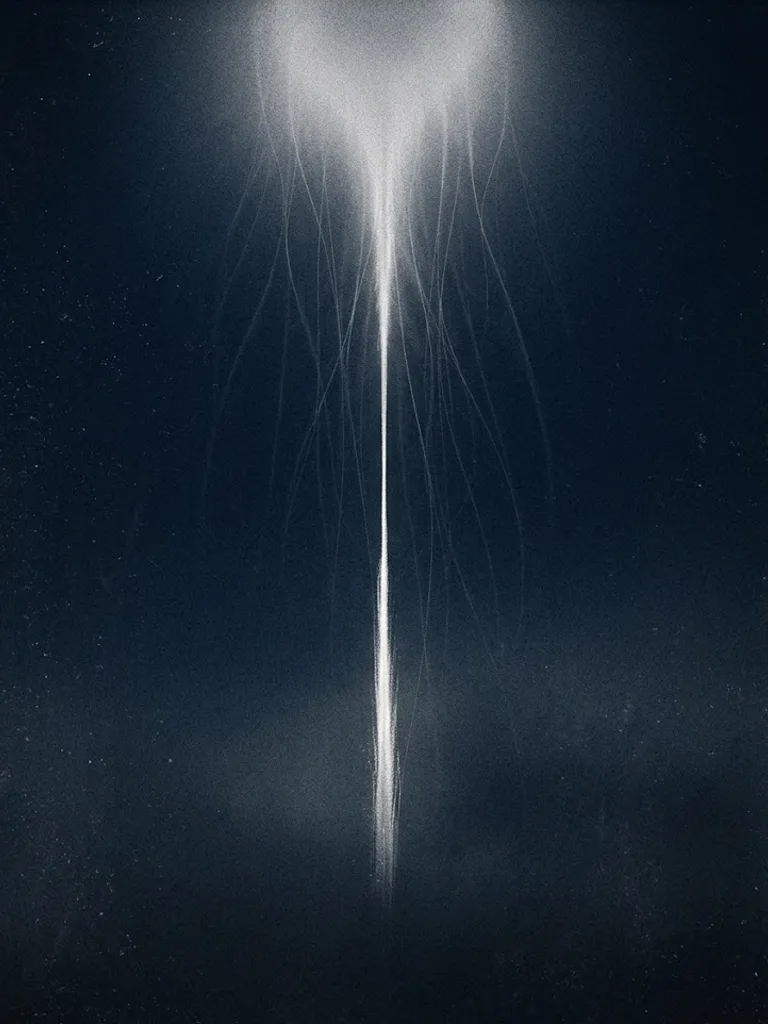
A whole lightning flash is over in less than half a second and the eye receives it as a single blaze. Inside that half second there is an order, it has been clocked since 1934, and the stretch you actually see did not come down from the cloud: it left the ground and climbed. The sequence only makes sense told from the end backwards.
Last of all comes the flicker. A cloud-to-ground flash is not one flash: it is three or four strokes in a row down the same channel, about forty thousandths of a second apart. That tremor which looks like a fault in your eyes is the real count of strokes, and it is the only part of the sequence your sight does resolve.
One stroke, from the inside. When the channel touches ground, the charge in the ground climbs up it towards the cloud at about 100,000 kilometres per second, a third of the speed of light, with a peak current around 30,000 amperes. At that speed, the two kilometres of channel are covered in twenty millionths of a second, and the pulse of light it leaves at any one point lasts about seventy. It is called the return stroke, it carries almost all the current and almost all the light, and it goes upwards.
One thousandth of a second earlier, the attachment. A few tens of metres above the ground the electric field becomes so brutal that objects below start firing their own threads of ionised air upwards: a post, a lamp-post, the tip of a poplar, a person's shoulder. The first one to reach the thread coming down from the cloud —the next episode of this countdown— closes the circuit, and that object is the one that gets struck. The lightning did not pick it from far away: it won the race over the last few dozen metres.
Before that, the descent, which is the part nobody sees. Out of the cloud comes the stepped leader, a faint, heavily branched thread that advances in jumps of about fifty metres and gives off almost no light. The photographs measure its average speed at some 150 kilometres per second: it takes a little over a hundredth of a second to cover the two kilometres that the return stroke will then climb in twenty millionths. Seven hundred times slower, and in the dark. No eye separates that thread from the flash that comes behind it.
And earlier still, inside the cloud, one loose electron accelerated by the field hit an air molecule, tore off another electron, and the two of them tore off two more. That is the first thing that happens and nobody has ever photographed it.
The man who built the instrument to check the order was Charles Vernon Boys, an English physicist, in 1900: a camera with two lenses fixed to a spinning disc. If the thing photographed moves, the spin smears it across the negative and each phase lands in a different place; if it does not move, you get one clean streak. Boys pointed it at storms for three decades and had bad luck almost every time. The luck went to Basil Schonland and H. Collens in Johannesburg, where the southern summer brings a storm almost every afternoon. In 1934 they published in the Proceedings of the Royal Society the first images in which the two things can be told apart: the leader coming down in steps and, behind it, the return stroke going up. The paper is titled "Progressive lightning". The following year, now with D. J. Malan, they published part two with the timings measured one by one.
It has been settled for ninety years and we still say lightning falls. The eye cannot separate two events less than two hundredths of a second apart, and the upward flash lasts three hundred times less than that threshold. And language, which is older than Boys's camera, pushes one way only: lightning falls, it came down on the bell tower.
A lightning rod, by the same token, attracts nothing from the cloud; its job is to be the place where the upward thread starts, sooner and better than the roof beside it, which is why it protects a cone around itself and not some magic radius. On very tall structures the extreme case also occurs: the flash begins entirely in the steel and climbs towards the cloud with nothing having come down first. These are called upward flashes, and the Säntis tower in the Swiss Alps, instrumented since 2010 at 2,500 metres to measure them, records the vast majority of its strikes in that direction: they leave the tower.