 Margen
Did you know? · From the Margen catalogue
The Mary Celeste's intact boats were put there by Conan Doyle
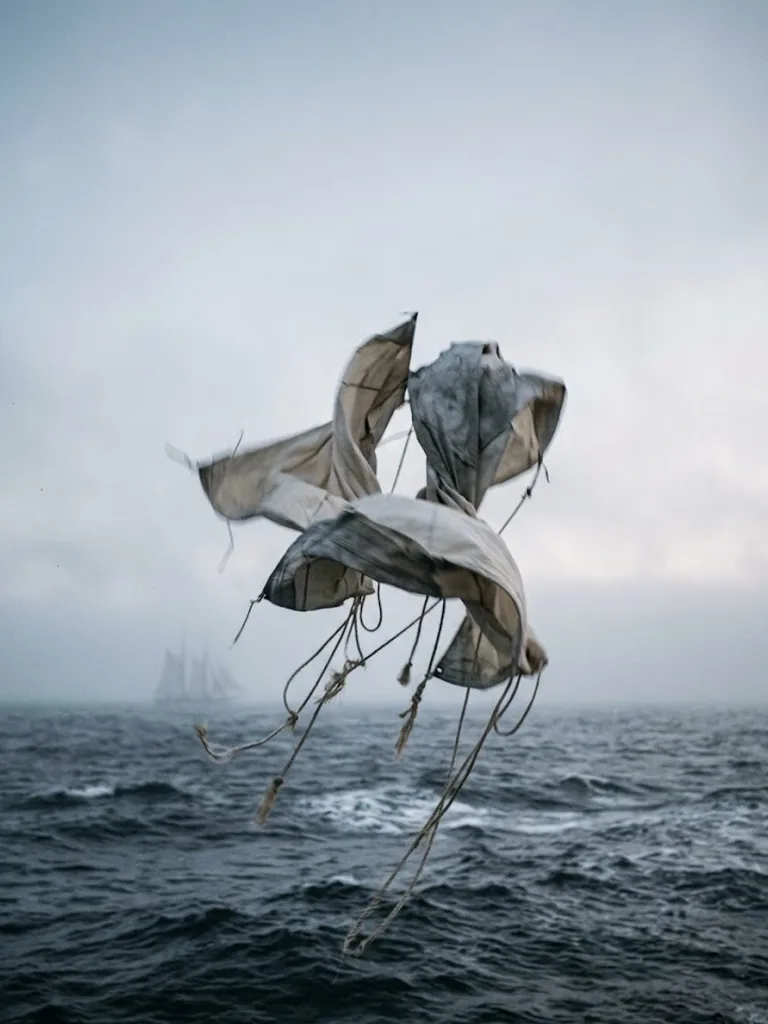
In January 1884, the London magazine Cornhill published an unsigned story titled 'J. Habakuk Jephson's Statement'. It had been written by a twenty-four-year-old doctor holding surgery hours in Southsea, on the edge of Portsmouth, who would take another three years to invent Sherlock Holmes: Arthur Conan Doyle. In the story, the ship is found sailing alone across the Atlantic and perfectly whole: the boats hanging in their davits, not a drop of water in the hold, and a spool of silk standing upright on a table. And she was called the 'Marie Celeste'.
The real one was called the Mary Celeste, her boat was missing and she had a little over a metre of water in the hold.
What there is, instead, is a case file. The 282-ton brigantine left the port of New York on 7 November 1872 bound for Genoa, with 1,701 barrels of denatured alcohol in the hold: industrial alcohol, of the kind then used to fortify Italian wines.
Ten people were aboard. The captain, Benjamin Spooner Briggs, 37, the son and brother of captains, a teetotaller and a churchgoer. His wife, Sarah Elizabeth. Their daughter Sophia Matilda, two years old. And seven crew: first mate Albert Richardson, second mate Andrew Gilling, cook Edward Head, and four German sailors, among them the brothers Volkert and Boz Lorenzen. The Briggs' elder son Arthur, seven, stayed behind in Marion, Massachusetts, with his grandmother, because he had started school.
The ship already had a bad name of her own. She had been built in 1861 at Spencer's Island, Nova Scotia, and was called the Amazon. Her first captain died nine days after taking command; in 1867 she ran aground in Cape Breton and was sold cheap. New York owners repaired her, put her under the American flag and renamed her Mary Celeste. Briggs, moreover, owned a share of her: he had put his own money into that hull.
On 4 December —the other ship's log recorded the 5th, because at sea the day began at noon— the Canadian brigantine Dei Gratia came across the Mary Celeste some four hundred miles east of the Azores. She was sailing under part of her canvas, yawing, with nobody at the wheel. The Dei Gratia's captain, David Morehouse, is said to have dined with Briggs in New York a few days before the two of them sailed; his widow told that fifty years later and it is not in the file.
His first mate, Oliver Deveau, went aboard. This is what he found.
The boat was missing. The Mary Celeste carried a yawl —a six-metre boat— lashed over the main hatch, and it was gone; a section of the rail had also been taken down, which is the gesture of someone launching a boat with time to spare, not of someone running. There was a little over a metre of water in the hold: a lot of water, but not a fatal leak for a ship loaded with barrels. One of the two pumps had been taken apart, its sounding rod out. The fore hatch and the lazarette hatch were open. Six months of food and drinking water remained. And the belongings remained: Sarah's sewing machine, her small melodeon, the sailors' oilskins, their boots, their pipes. Deveau testified that the ship looked abandoned in a hurry and that nobody had taken anything of their own.
The last entry on the log slate was dated 25 November at eight in the morning. It gave the position six miles from the island of Santa Maria, in the Azores. Between that line and the meeting with the Dei Gratia, the ship had gone on sailing for nine days without a crew.
Deveau and two sailors stayed aboard the Mary Celeste and sailed her to Gibraltar themselves: more than six hundred miles with three men for a ship with a crew of eight, standing four-hour watches and sleeping in shifts. They entered the port on 13 December, one day after their own vessel. The first thing they found on the quay was a court case opened against them.
In Gibraltar there were three months of hearings, and the man who ran them, the attorney general Frederick Solly-Flood, was convinced there had been a crime. He suspected the Dei Gratia's crew, he suspected a mutiny, he suspected the alcohol in the cargo. He had stains analysed from a sword found under the captain's bed: they were not blood. He found nothing. In the end the court awarded the Dei Gratia 1,700 pounds in salvage —some 8,500 dollars of the time— on a valuation of 42,643 dollars for hull and cargo: a fifth, when the usual share was a good deal more. That is the clearest clue to what the court thought: it accused nobody, but it cleared nobody either.
The fact that probably explains everything came later, in Genoa, when the cargo was unloaded: nine of the 1,701 barrels were empty. Those nine were made of red oak; the other 1,692, of white oak. Red oak is more porous. A closed ship, a warm sea and an evaporating alcohol make a hold full of flammable vapour, and that is indeed a reason to put nine adults and a two-year-old girl into that boat and pull away a little to wait for nothing to happen.
There is a second serious explanation, from 2007, in a documentary by the researcher Anne MacGregor: the dismantled pump. If Briggs took a bad sounding, he could have believed the ship was filling with water when it was not; and if his chronometer was running slow, he could have thought Santa Maria was closer than it was, and that they would make it by rowing.
In both explanations the same thing happens: the boat is lost and the ship sails on alone. And of the ten people, nothing was ever found: not a body, not the yawl, not a plank with its name on it.
The file also rules out three things. It was not pirates: the cargo reached Genoa intact, the captain's money was still in his cabin and nobody took Sarah's jewellery. It was not a boarding: there is not a single mark of a fight, in the timber or in the rigging. And there was no storm capable of sweeping the deck: the canvas held for nine days of sailing alone, which is incompatible with a sea that carries ten people away. What is left is a decision taken on board, calmly enough to take down a section of the rail, and a miscalculation nobody came back from.
The cargo was sold entire and the freight was paid. In Marion, Massachusetts, Arthur Briggs' grandmother raised the boy in a family of captains that had lost, in a single week, his father, his mother and his two-year-old sister, and that never received an official paper explaining how.
That was the gap, and fiction filled it. Doyle's story was liked so much that newspapers reprinted it as a real account. The United States consul in Gibraltar, Horatio Sprague, went as far as asking in writing who this Jephson was who claimed to have been aboard, and Solly-Flood dismissed the story as a fabrication from beginning to end. In 1913, The Strand published another supposed survivor, one Abel Fosdyk, with an even more preposterous version. The untouched supper and the fire lit in the galley are not Doyle's either: they appeared in the Los Angeles Times of 9 June 1883, seven months before the story. The lukewarm tea in the cups and the cat asleep on a locker were added by those who came after, copying from one another. But the mould was his, and even his misspelling stuck to the ship: half the world still calls it the 'Marie Celeste'.
The Mary Celeste did have a documented ending, and it is not mysterious. In January 1885 her last captain, Gilman Parker, loaded her with worthless goods insured for 30,000 dollars and deliberately ran her onto the Rochelois reef, off the coast of Haiti. The fraud was uncovered, Parker was tried for barratry —then a capital offence—, the jury failed to convict him, and he died ruined before the year was out. The goods he had insured for 30,000 dollars were, according to the inventory at the trial, rubber boots and cat food.