 Margen
Idea · From the Margen catalogue
The man who invented the ice rule took it back 37 years later
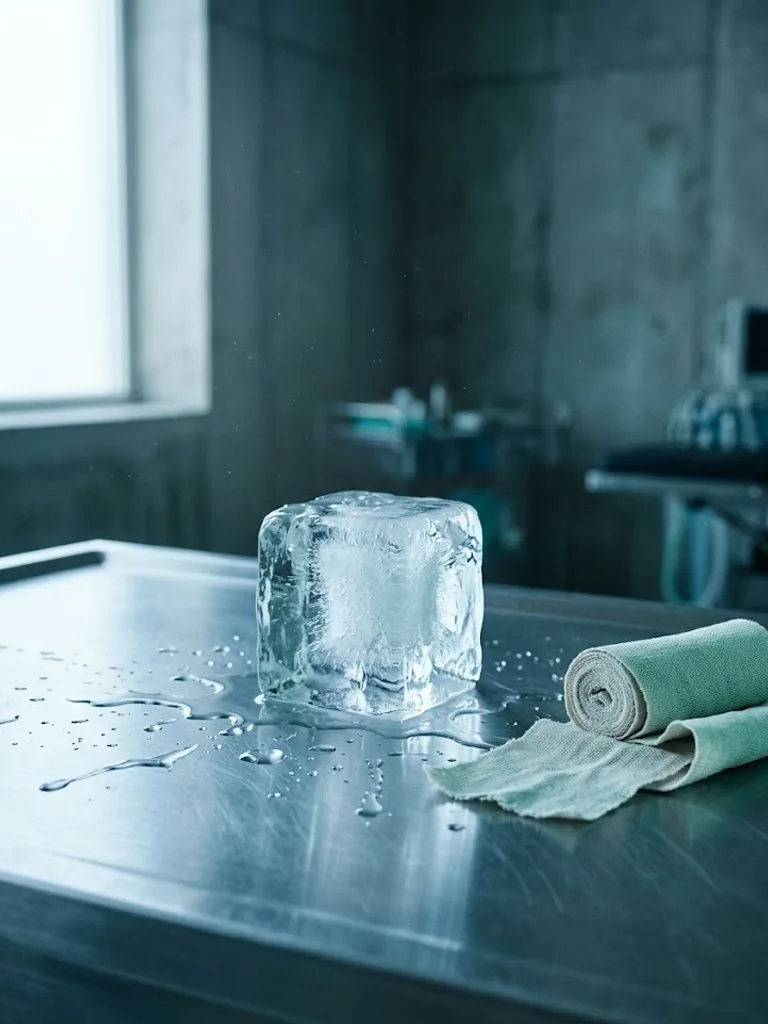
You step badly off a kerb, your ankle rolls inwards, and ten minutes later there is a purple ball where the bone used to be. What you do in the next forty-eight hours decides whether you will be walking normally in three weeks or spending the winter on a loose foot. And the first thing everyone will tell you —ice and rest— was withdrawn in 2015 by the doctor who made it famous.
His name is Gabe Mirkin, he is an American sports physician, and in 1978 he published The Sportsmedicine Book with the journalist Marshall Hoffman, a sports medicine manual that sold hundreds of thousands of copies. Inside it was a four-letter acronym, RICE: rest, ice, compression, elevation. It worked the way good rules work: it went into first aid courses, into the medicine cabinets of sports centres and into the mouth of every coach on the planet for four decades.
In 2015, Mirkin published a piece on his own website titled 'Why Ice Delays Recovery' and took back the first two letters. His reasoning needs no medical degree: the swelling is what brings in the crew that repairs. When fibres tear, the body sends inflammatory cells; among them white blood cells called macrophages, which clear the wreckage and release a hormone, IGF-1, that gives the order to rebuild. Cold closes the vessels and delays that crew. Complete rest, on top of that, denies the tissue the load it needs to heal aligned in the direction it will later have to work in.
In 2004, a review of clinical trials published in the American Journal of Sports Medicine went through twenty-two trials on ice for soft-tissue injuries and found them to be of low quality: the only thing that showed, and marginally at that, was combining cold with exercise, not cold on its own. In 2021, a team at Kobe University measured in mice what Mirkin had reasoned out on a single page: paws cooled after injury took longer to regenerate muscle, because the macrophages took longer to arrive. They are mice, not people. But the acronym had already moved without waiting for anyone: in 2012 the British Journal of Sports Medicine proposed swapping rest for 'optimal loading', and in 2019 two Canadian physiotherapists, Blaise Dubois and Jean-François Esculier, published in that same journal the scheme taught today, PEACE & LOVE: protection, elevation, avoid anti-inflammatories, compression and education for the first days, and then load, optimism, vascularisation and exercise.
What you will actually do on the day it happens:
For the first forty-eight hours:
1. Protect, do not immobilise. One to three days of walking less and carefully. After that, every extra day on crutches is a day of muscle lost.
2. Put the foot above your heart, ten minutes, several times a day. That does bring the swelling down and interferes with nothing.
3. Leave the ibuprofen in the drawer for those first two days if the pain is bearable. An anti-inflammatory does exactly what its name says, and what it slows down is the building work. For pain, paracetamol.
4. Compress with an elastic bandage, figure-of-eight around the ankle, firm but without numbing your toes.
5. Ice only as a painkiller: ten minutes, with a cloth in between and never on bare skin, when the pain will not let you sleep. It is for the pain, not for the repair.
From the third day on:
6. Load it, with pain as your traffic light. You can put weight on it up to 2 out of 10 of discomfort. Past 3, you have overdone it.
7. Move everything around it: walking, gentle stationary bike, anything that raises the blood flow without punishing the joint.
8. Train your balance. Three sets of thirty seconds on one leg, every day, and once that feels easy, with your eyes closed. This is what actually prevents the next sprain: between twenty and forty per cent of people who roll an ankle end up with trouble that keeps coming back, and the most repeated reason is that nobody told them to retrain their balance.
And when this is no longer your call. If you cannot take four steps bearing weight, X-ray. If the bone hurts when you press the back edge or the tip of either ankle bone, the outer one or the inner one, X-ray. If it hurts when you press the base of the fifth metatarsal or the bone that sticks out in the inner arch, X-ray. Those are the Ottawa rules, the ones an emergency department uses to decide whether a radiograph is needed, and they exist precisely so that every other twisted ankle does not end up in hospital.
Next time you roll it, do this: foot up, bandage, and tomorrow go out and walk slowly with the pain below two. Leave the ice in the freezer, in case you cannot sleep that night.