 Margen
Did you know? · From the Margen catalogue
Seventy tonnes in the air and an argument still open
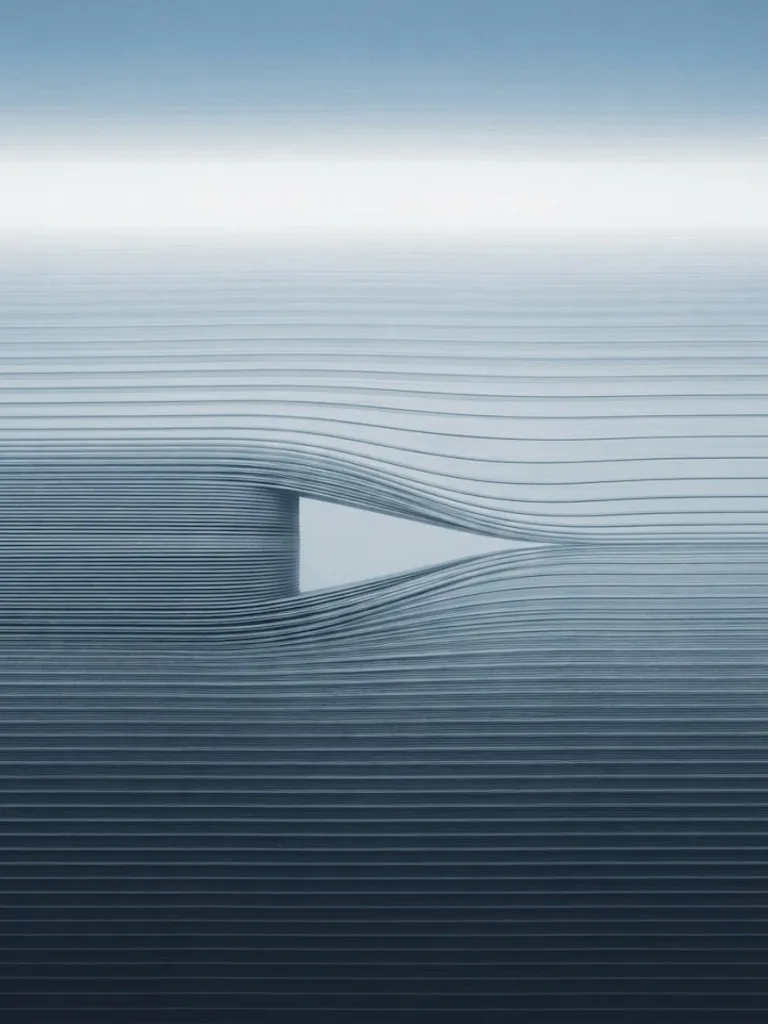
A seventy-tonne airliner takes off and, as it climbs, two things are true at once: the force holding it up has been calculated to a precision expressed in newtons, and the sentence that explains where that force comes from still has no owner. In February 2020, Scientific American ran an article headlined “No One Can Explain Why Planes Stay in the Air”.
There are four separate layers and they always get mixed up. Here they are, apart.
1. What has been measured.
A moving wing sends air downwards. An enormous amount of air, continuously. And above it a region of lower pressure forms than the one underneath. The two things are measured separately: the pressure, with tappings spread along the section; the force, with a balance in the wind tunnel. The numbers come out, they repeat, and wings are designed and aircraft certified with them. There is no argument here at all.
2. The textbook explanation.
It is the usual drawing: the back of the wing is more curved, hence longer, and the two parcels of air that split at the nose “have to meet up again” at the trailing edge, so the upper one is forced to run faster. And air that moves faster has lower pressure, which is true and which Daniel Bernoulli, the Swiss mathematician, set out in 1738.
The flaw is in the phrase inside the quotation marks, the only one nobody ever justifies. There is no law of physics obliging two separated parcels of air to rejoin their partner afterwards. NASA's Glenn Research Center, which maintains a public guide to aerodynamics, calls it in those words a non-physical assumption, and settles it by measuring: the parcel of air passing over a wing that is generating lift reaches the trailing edge before the one underneath, and travels far faster than it would need to in order to tie. If you calculate lift with that theory, the result falls well short of what actually holds the aircraft up.
3. The two competing answers, and the gap in each.
Bernoulli's: the air above moves faster, the pressure drops and the wing rises. It accounts for the low-pressure region. It leaves unexplained why the air speeds up.
Newton's: the wing deflects air downwards and the air pushes back the other way, which is the third law. It leaves unexplained, on its own, the low-pressure region. But it accounts for three facts the textbook version cannot even look at.
A symmetrical section, with the same curve above as below, generates lift the moment it is tilted.
A flat plate, with no camber at all, does too: it is what makes a paper plane fly.
And a curved-section aircraft can fly upside down, which aerobatic pilots have been doing for a century.
Where things stand today: since the work of Doug McLean, a Boeing aerodynamicist, the insistence has been that the pressure and the deflection of the air are two parts of the same flow field, each holding up the other, and that asking which of the two causes the other is a badly framed question. The air on top speeds up because of the curvature of the streamlines and the circulation the wing sets up around itself, not because of an appointment pending with the air underneath.
4. The number a pilot actually works with.
A pilot cannot change the shape of the wing in flight. They change its angle to the oncoming air — the angle of attack — and that is what governs lift from beginning to end. It is the same thing you feel holding a hand out of a moving car window and tilting it slowly: the hand is flat, it has no curved back, and the force changes all the same.
An ordinary wing holds up to an angle of attack of between fifteen and twenty degrees. Past that point the air separates from the upper surface, the lift collapses and the aircraft stalls. That is the number a pilot watches, and you do not need to win the argument in order to respect it.