 Margen
Did you know? · From the Margen catalogue
A postman spent 93,000 hours building himself a palace
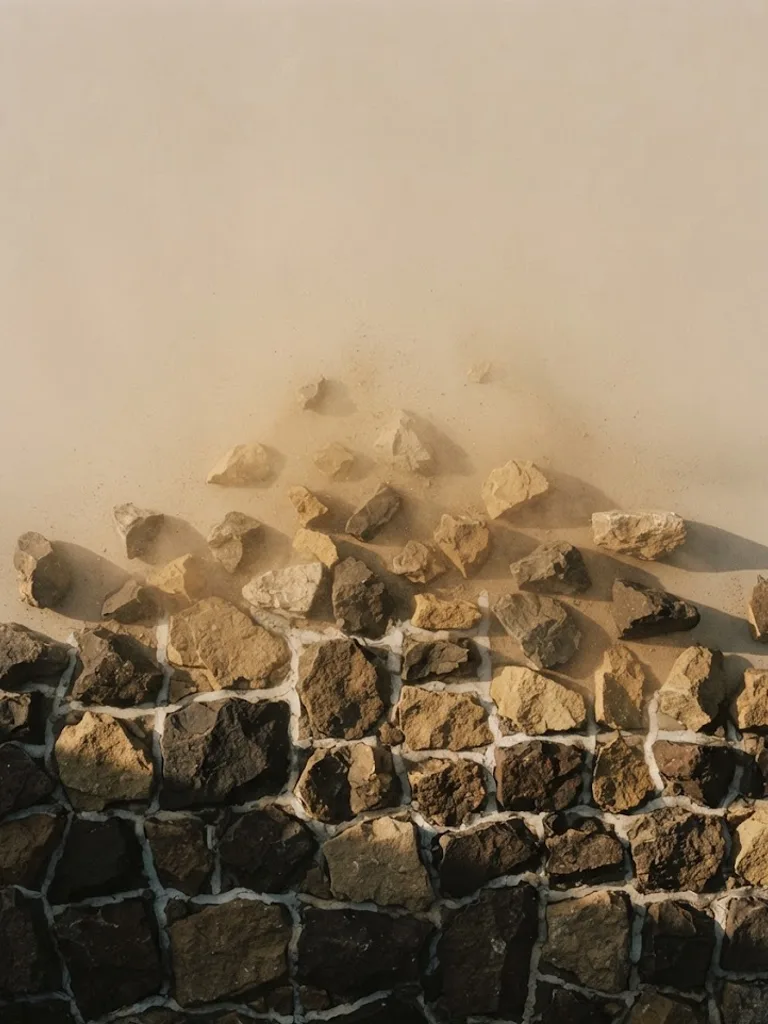
In April 1879, the rural postman Ferdinand Cheval tripped over a stone on a lane in Hauterives, a village in the Drôme, in south-eastern France, and the next day he went back for it.
He was forty-three years old and his delivery round ran to more than thirty kilometres a day, on foot, between scattered farmhouses. From that morning on, the round was also a collection. Stones of impossible shapes, river pebbles, calcified shells out of the gullies. At first he carried them in his pockets. Then in a basket on his shoulder. In the end he bought a wheelbarrow, and that wheelbarrow is still inside the palace today, kept in a recess built to fit it.
Because what he made with those stones was not a wall or a bench. It was a palace.
The Palais Idéal — the Ideal Palace — stands in his own garden and nobody designed it. There is no drawing, no architect, no builder, not one day of technical school behind it: there is a postman who mixed lime and mortar, braced what he was raising with wire, and copied, from postcards and illustrated magazines, temples he had never seen. There are towers, galleries, animals, a Hindu temple, an Egyptian tomb, stairs that climb to places that lead nowhere, and sentences he carved into the wall himself. In 1969 the French culture minister André Malraux listed it as a historic monument and said it was the only example of naive art in architecture.
One of the sentences on the wall is his own set of accounts: “10,000 days, 93,000 hours, 33 years of hardship.”
Ten thousand days is the equivalent of twenty-seven years of working every single day of the year without missing one. And ninety-three thousand hours spread over those ten thousand days works out at more than nine hours a day — nine hours on top of the thirty kilometres of delivery, which was the job that fed him.
He began in 1879 and called it finished in 1912, at seventy-six.
And then he had one matter left unsettled. He wanted to be buried inside the palace, and he had even picked the spot: an Egyptian tomb within the building itself. He applied for permission and he was refused.
So at seventy-eight he picked up the wheelbarrow again, this time in the village cemetery, and built his own tomb: eight more years of stones, finished in 1922. He died on 19 August 1924, at eighty-eight, and they buried him inside it.