 Margen
Serialized book · From the Margen catalogue
Celso takes a loaf out of the oven that he cannot sell
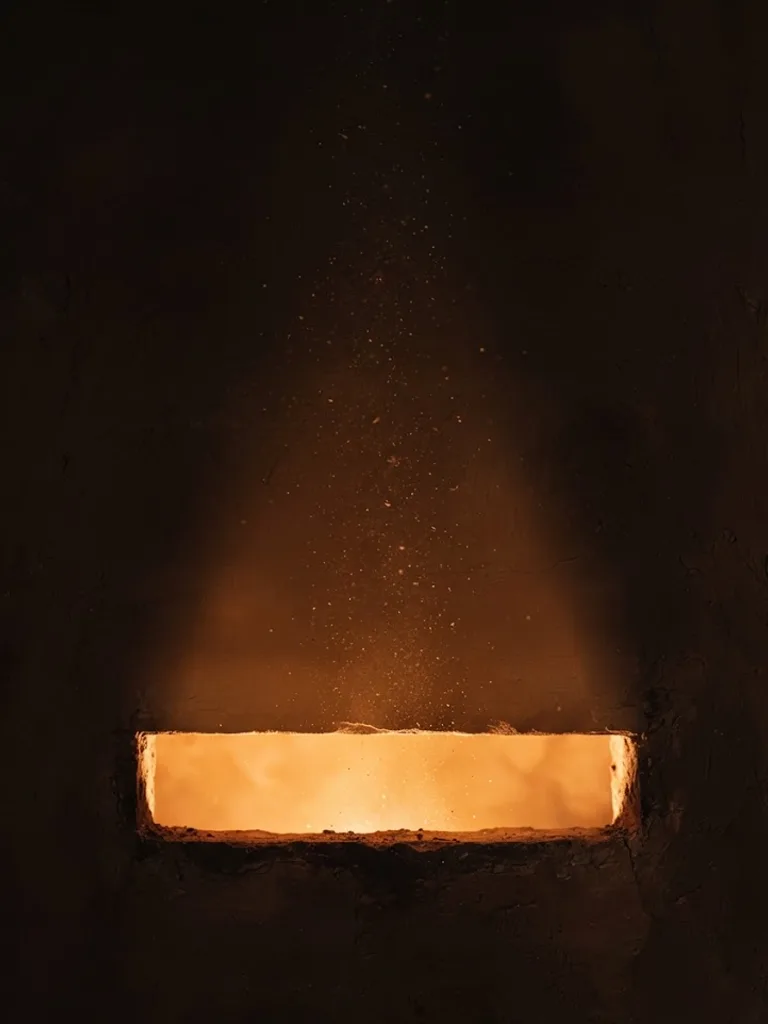
At twenty to six in the morning, Celso Larrauri, master baker, owner of the bakehouse, had the bread of eleven schools inside his oven and one thing he had never told anybody.
The oven is a hearth oven and it dates from 1931: a floor of firebrick the size of a small room, with its mouth at chest height. The fire is not where the bread is. It has its own firebox to one side, behind a brick wall, and the smoke runs through flues that pass underneath the floor on their way to the chimney. In there, with the bread, nothing but heat should get in.
Celso opened the damper with his foot, listened to the chimney draw and counted to twelve. Then he slid in the peel, a three-metre pole with a sheet-metal blade, and took out a loaf from the mouth side. He knocked it with his knuckles: hollow, good. He stood it on edge on the marble. He went back in, this time all the way to the back, and took out another from the chimney side. Hollow too. Good too.
Then he put them side by side.
“Again,” he said.
The one from the mouth side had a crust the colour of wet brick, almost brown from sheer darkness. The one from the back was fair. Both had gone in on the same minute, with the same dough, at the same weight, and both had come out as two different loaves.
Since last autumn, Celso had been baking in short batches and turning the trays halfway to even it out. He lost twelve minutes a batch and got, more or less, a loaf that matched. He had stopped telling people why he did it.
At twenty past six Eulogio Satrústegui arrived, a mixer since he was nineteen, who does not make conversation before eight. He tipped the second dough into the trough, weighed, cut and set the pieces to rest on the cloths. Nine hundred and forty loaves and eighteen hundred rolls: what the four thousand children of the eleven schools in the district eat at midday.
“Eulogio.”
“Go on.”
“Come and see something.”
Eulogio wiped his hands on his apron, crossed the bakehouse and looked at the two loaves standing on the marble. He said nothing for a long while. Then he picked up the dark one, turned it over and looked at its base.
There was a grey ring on the bottom, a very fine ash that would not come off with a finger.
“The dough doesn't do that,” he said.
And he went back to the trough.
Celso stayed with the loaf in his hand longer than he needed to. Then he opened the delivery book, ran his finger down Tuesday's column and started crossing out.
“Eulogio.”
“What.”
“The ones from the mouth side don't go out today.”
“How many.”
“The first forty. The ones from the five o'clock batch.”
Eulogio left the cutting half done and turned round for the first time that morning.
“Forty loaves is half of Santa Bárbara.”
“I know.”
“And I have to find them somewhere, because the second dough is weighed and cut. If I stretch it, the nine o'clock bread comes out unproved and then we're throwing away eighty.”
“Then make a hundred and twenty smaller pieces and send them anyway. Let them weigh less, not be missing.”
“The cook at Santa Bárbara will notice that the moment she picks one up.”
“Better she notices it in the weight.”
Eulogio looked at him for a second. Then he picked up the scraper and went back to the trough without arguing any more, which is what a man does after thirty-three years working alongside somebody.
At ten to seven Izaskun Larrauri came down, twenty-nine years old, the bakehouse administrator, who always comes down with her laptop open because she never has time to close it.
“Aita.”
“Morning.”
“An inspector rang yesterday at a quarter to eight. Begoña Carrascosa, public health. She's coming the day after tomorrow.”
“Let her come.”
“She asked to see the oven lit, not cold. She said it twice.”
Celso closed the delivery book.
“And why does she want to see it lit?”
“That's what I was going to ask you.” Izaskun leaned against the door frame. “Aita, I've had the quote for the electric oven since February. Forty-one thousand euros, three decks, steam, and a sheet of paper with every parameter on it that any inspector would sign without getting out of her car. It's in the folder upstairs and I haven't brought it out again because I know what you're going to say.”
“Then don't bring it out.”
“I'm not bringing it out. I'm telling you where it is.”
They both stood looking at the two loaves on the marble.
“There's something else,” Izaskun said. “The analysis has come.”
The district sends the bread off to be analysed twice a year. A laboratory in Logroño does it, the eleven schools split the cost, and the result arrives in an email with an attachment nobody ever opens, because it never says anything. Celso had received it fourteen times in seven years.
“Read it.”
“It's from the batch of Tuesday the twelfth of last month. They take three weeks. They sampled crust and crumb from three loaves.” Izaskun turned the screen towards him, although she knew her father was not going to read it. “There's nothing in the crumb. In the crust they measured benzo(a)pyrene.”
“What's that.”
“It's what a pepper has when you roast it over the fire. One of the hydrocarbons that come out when something burns badly and not all the way.”
“How much.”
“Three point one. Micrograms per kilo.”
“And is that a lot or a little.”
“For bread I don't know. For bread there's nothing.”
“What do you mean, there's nothing?”
“European law sets benzopyrene limits for a few things. For smoked meat and fish, two micrograms a kilo. For infant food, less still. For bread there's no figure. It doesn't exist.”
“Then I've done nothing wrong.”
“Then there's nothing to defend you with, aita.”
Izaskun closed the laptop for the first time that morning and went upstairs.
Celso stayed in front of the mouth of the oven, his face hot, looking at the brick floor that the bread of four thousand children has gone in and out of since before he was born. He heard Eulogio scrape the trough and start on the hundred and twenty small pieces.
Then he took the chalk he uses to write the temperatures on the edge of the wall, next to the wood store, where the numbers of every batch of the week are written in a column, and underneath the 240 of that day he wrote another number.
3.1.