 Margen
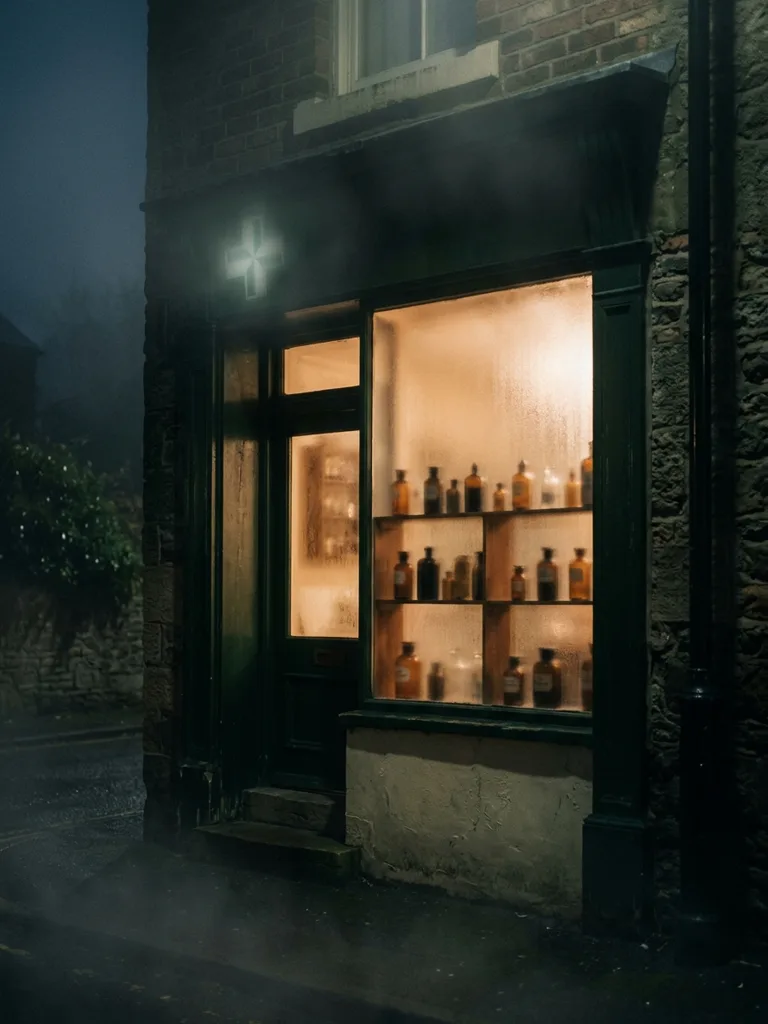
Previously: in Valdecierzo somebody signs prescriptions in the hand of Doctor Sagasti, dead since 2024. The eleven in the blue folder all lost their doctor at once.
On Monday the 18th, with eight days to go until the inspection, the wholesaler left the delivery on the pavement before Águeda Mendioroz, the chemist of Valdecierzo, had finished raising the shutter. At eight sharp, signing the delivery note propped on her knee, she heard hard-soled shoes on the flagstones and knew who it was without lifting her head.
Rosalía Sagasti, nurse at the surgery for thirty-four years and retired for three, exactly six months before her brother died, was carrying a prescription folded in her coat pocket.
—Balbina's —she said, and put it on the counter—. Like I told you.
Águeda dried her hands on her coat and looked at it closely. It was a prescription from the district doctor: the round stamp in faded blue, the registration number Águeda reads twenty times a day, the fast handwriting of someone who signs forty in a morning. Digoxin, one tablet a day, box of twenty-eight. All in order, all verifiable, all boring.
It was the early box. Since June the pack comes with twenty-eight tablets instead of thirty, so every four months you have to slip in an extra one so Balbina isn't left with nothing over a weekend. It's written in her own hand in the delivery book, next to the cross for the broken doorbell.
It was the first normal thing that had happened in the chemist's since Tuesday.
—I asked for it myself, by phone, on Thursday —said Rosalía—. They don't pick up for Balbina first time and she gets tired.
And there was the problem, thought Águeda, sliding the prescription into the drawer for today's. That it was true. That you could ring the district office and confirm it in two minutes, and that it explained absolutely nothing about the thirty-one she had locked in the blue folder.
The counter clock, which has run four minutes fast for as long as she can remember, said ten past eight. The delivery boxes were still out on the pavement, seals unbroken.
—Rosalía, sit down.
—I've got milk on the stove.
—You've had milk on the stove since Saturday.
The nurse sat on the visitors' stool, the one used for taking blood pressure, coat still on and handbag on her knees.
Águeda had spent Sunday afternoon turning one thing over. Along the spine of the grey notebook that Rosalía had pushed to the back of the couch drawer there was a row of numbers written in biro, half worn away by rubbing. It wasn't a date: too many digits and no slashes. And on Thursday, in the closed surgery, with Fermín Ozaeta, the beadle, running a finger through the dust on the chairs, Águeda had seen that same row handwritten on the opening-hours card, stuck to the inside of the front door glass.
It was the surgery's telephone number. From before the district centralised the calls in 2011 and that number ceased to exist.
—You put the surgery number on the spine —said Águeda—. So that if it got lost they'd know where to bring it back.
Rosalía looked at the blood pressure machine. Then she looked at the laboratory calendar on the wall, the one with the lavender field, days crossed off up to the 17th.
—I lost it twice in thirty-five years —she said—. Once in the bar and once on the Tafalla bus. Both times they rang that number and both times I went and picked it up.
She took the notebook out of her bag and left it on the counter, between the blue folder and the box of carrier bags. Grey oilcloth, the kind they used to cover books with at the stationer's in Tafalla, corners rounded from years of going in and out of a pocket, and a banknote band holding the covers shut.
—You open it —she said—. I already know what it says.
The first page was written in a small, very upright hand, the kind you learned so it would fit on an index card. At the top, underlined twice: *dose · allergies · who lives alone*.
—I started it in ninety-one —said Rosalía—. Braulio hadn't arrived yet. The one before him was here, the one with that spiky handwriting in the files, who told me nothing and left at two. I was the one who went up to the top of the village to give the injections, and the first time I gave a man something that wasn't his because nobody had told me, I went down to Tafalla and bought that notebook.
—And when your brother came?
—When Braulio came, in ninety-three, he knew it all by heart within six months. Four hundred people. Who doesn't answer first time, who reacts badly to penicillin, which house you have to call up to twice from the doorway. I kept writing it down anyway.
—What for, if he knew it?
—Because a man's memory gets buried with him —said Rosalía, and went back to looking at the blood pressure machine.
Águeda turned the pages. It wasn't a medical record: it was something else. Beside each name, the dosage and the allergies, yes, but also the small print no computer keeps. *Doesn't read the leaflet, read it to her.* *Lives alone, daughter in Zaragoza.* *Broken doorbell, call twice from the doorway.* *Runs out on Friday.* *Doesn't drive.* Notes of three words, written standing up, with whatever pen she had on her that day: some in blue, some in green, one or two in red.
There were also names crossed out with a clean line, without cruelty, a nurse's line, and beside them the date and nothing else. Thirty-odd in thirty-five years. Águeda recognised two at a glance: the woman who used to sell her mother eggs and the man who swept in front of the church on Saturdays.
—The district doctor has the medical record —said Rosalía—. He has the blood work, the allergy and the dose. He hasn't got this. And this is what you need to know whether a person is going to take the pill or leave the box on top of the television.
—Rosalía.
—I'm telling you because you asked me.
—I'm asking you because on the 26th an inspector sits down in that chair.
—I know. That's why I brought it today and not on Saturday: I want you to know what's inside before she's the one asking you.
Águeda reached the last pages, the ones written when a notebook has already spent half a life open. There the handwriting changed size, tightened, tilted; there were new dates on top of old ones. And in the left margin, beside some of the names, a small cross in pencil.
She counted them twice. Eleven crosses.
She got up, opened the blue folder and laid beside it the list she had made on Friday with the names from the thirty-one prescriptions. The notebook had them in the order each of them had been left alone; her list went by prescription date. She had to cross-check them with her finger, one by one, the way she had on Sunday. Baraibar. Ochandiano. Redín. And the other eight.
The same eleven, not one over and not one missing.
—These eleven have been marked here since before the surgery closed —said Águeda.
—They've been marked since they were left alone at home —said Rosalía—. Some fifteen years ago and some three. I put the cross there the day I realised that if nobody went up, nobody went up.
She closed the notebook with both hands, slid the band back on and put it in her bag before getting to her feet.
—I started it in ninety-one and I've kept it on my own —she said—. Everything about these people that isn't on any piece of paper is in there.
She went out into the street at twenty to nine, and Águeda watched her pass in front of the window without looking in. In Valdecierzo the only list that says who lives alone was written by a nurse thirty-five years ago in grey oilcloth, she carries it in her handbag, and it is on no record anywhere.