 Margen
Short story · From the Margen catalogue
I graded an honest 6a and 27 students stayed down
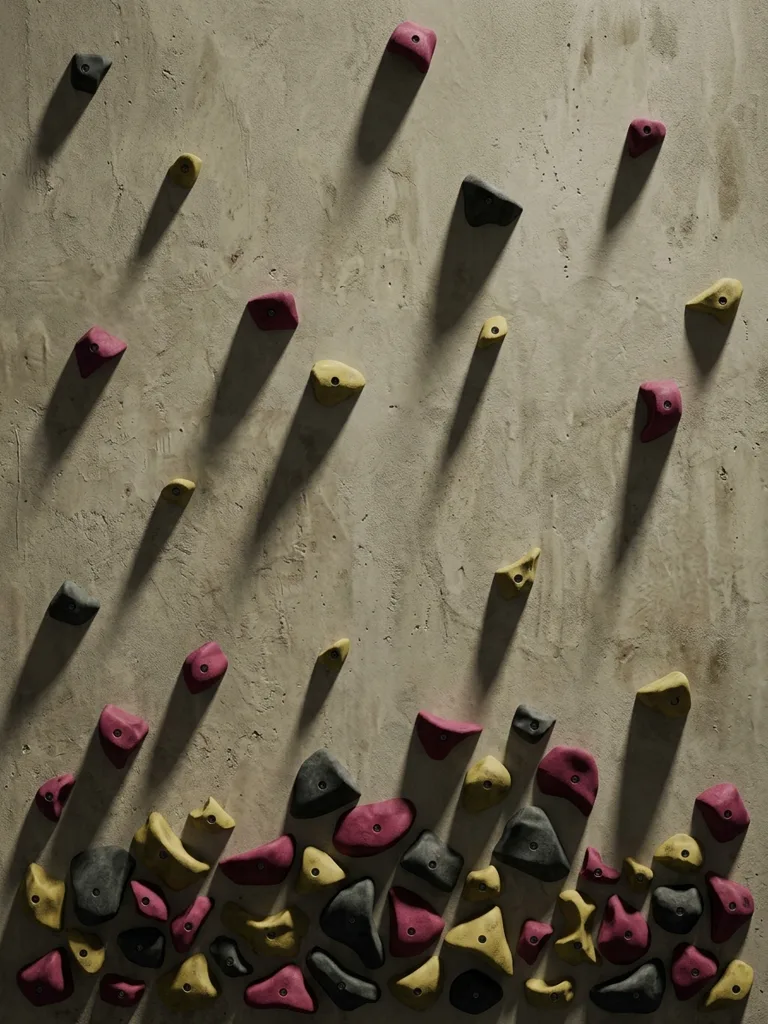
—That 6a is honest. I'll sign for it.
—I've got twenty-eight October enrolments hanging off that wall, Nekane.
—Well, of the twenty-eight, one gets up it today, and it won't be by pulling.
—That's not a forecast, that's a threat.
I've been bolting holds onto this climbing gym for eleven years. I'm the setter: I build the routes, I decide where you go up and I put the grade on them. Óscar Peláez runs the business. That morning we'd been standing in front of the same wall for twenty minutes.
The route was the final exam of the beginners' course. Twenty metres, yellow holds and one serious move at the seventh bolt, the seventh point where the rope clips in. There the right hand goes high, the left foot sits nicely, and the right foot has to find a small hold, a pinch of resin the size of half a biscuit, in plain sight from the ground. Whoever stands on it goes up. Whoever pulls with the arm first ends up hanging a hand's width from the next hold and comes down on the rope.
There's no trick. I didn't hide it. I put it where it can be seen.
—Take it off —said Óscar—. Or put a big one next to it.
—They need it.
—That's exactly why I want it off.
The number we were arguing about isn't a number. The French scale — 6a, 6b, 6c, and on up — looks like a measurement, and it isn't. Nobody puts a route in a machine and gets a grade out. The setter proposes: I build the moves and I say 6a. Then other people climb it, compare it with the routes they already know and with those in other gyms, and out of that argument comes a consensus. The grade is that, the agreement. That's why a route can spend three weeks being a disputed 6a before it settles at 6a+.
That agreement is the best thing about this sport and what makes it so easy to ruin. A metre is a metre in Pamplona and in Lyon. A 6a is an agreement between people who have hung from the same holds, and an agreement can be loosened little by little without anybody signing anything. All it takes is for each setter to round down when the customer complains. Three years of rounding down and your gym's 6a is nobody else's 6a.
—And how much exactly is a 6a? —Óscar asked me, knowing the answer perfectly well and asking it the same way every term.
—Depends who you ask.
—That's not a measurement.
—Welcome to climbing.
The exam began. The first student pulled his climbing shoes tight — always two sizes too small — got to the move, fixed his eyes on the hand above and pulled. His right foot stayed low, his hip came away from the wall and his arms took the whole weight. He held on for three seconds, went looking for a strength that hadn't come with the enrolment fee, and dropped onto the rope.
The second one saw the first fall and decided to pull faster. He managed to fall sooner. The third tried entering from lower down. The fourth swapped hands. One student asked whether she could use the blue holds and Óscar, from the ground, said that as far as he was concerned she could use the fire escape.
The same move isn't worth the same for every body, either. With long arms that small hold is redundant: you reach the next one by stretching and that's that. With short arms you have to turn the hip, load the leg and lift the shoulder. If I grade thinking only of the first, the second runs into a much harder problem under the same label. Hard, fine. For whom?
I would lower them, note down the attempt and ask each of them the same question:
—Where was your right foot?
None of them knew. They remembered the hand, the shoulder, Óscar's face, a crooked carabiner. The right foot wasn't in the film. That's the habit a beginners' course leaves when it's in a hurry: you teach gripping before positioning, and the student learns to solve everything by stretching an arm upwards.
At the tenth failed attempt Óscar came over to the foot of the route with his clipboard clamped to his chest.
—Give it 5+.
—They'd still fall in the same place.
—Yes, but they'd be falling off something easier.
That's the business of softening grades. If a gym calls 6a what the consensus would put at 5+, the student finishes the course convinced he can send a 6a — that is, climb the whole thing without falling or hanging on the rope —, renews in October to go looking for 6b and takes away a lovely feeling about the place. The label sells. The trouble comes the day he goes outdoors, because the 6a in the guidebook has no manager, doesn't depend on October enrolments and doesn't drop the grade because somebody has paid for a course. That's where the climber discovers his record was inflated, and he fails without knowing why, because he has spent months getting marks that covered up exactly what he hadn't learned.
By the time it was Rosa Iturbe's turn there were six students left, not much chalk and no commercial hope at all. Rosa is a physiotherapist, signed up in April and hasn't said more than four sentences all course. She tied in, checked the knot, looked at the wall for a good while and started up.
She got to the move and didn't pull. She put her right hand on the high hold, stayed there still and looked down. Óscar made a funeral noise. Rosa found the small hold with the tip of her right foot, waited until her hip was over that foot and only then straightened the leg. Her body went up before the arm had to do much at all. Her left hand reached the next hold almost to spare.
She finished the route and reached the anchor, the two rings bolted at the end of the line.
—Is that it? —she asked from up there.
—That's it.
—It's just that I looked at my foot.
—You can tell you work with people who walk.
She came down, and the other twenty-seven went over to the wall to take a close look at the hold they had spent two hours standing on with their eyes. Óscar looked at his list: one sent, twenty-seven pending.
—What do I give them? —he said.
—Course completed. Route pending.
—That can't be sold.
—Then don't sell it.
He went quiet for a moment, looking at the wall with the face he pulls when he stops arguing with me and starts doing sums.
—New course —he announced, already heading for the office and out loud, so the whole group could hear—. Six weeks, forty euros. It's called Feet. And you leave the exam route exactly as it is.
Twenty-seven signed up before taking their climbing shoes off.