 Margen
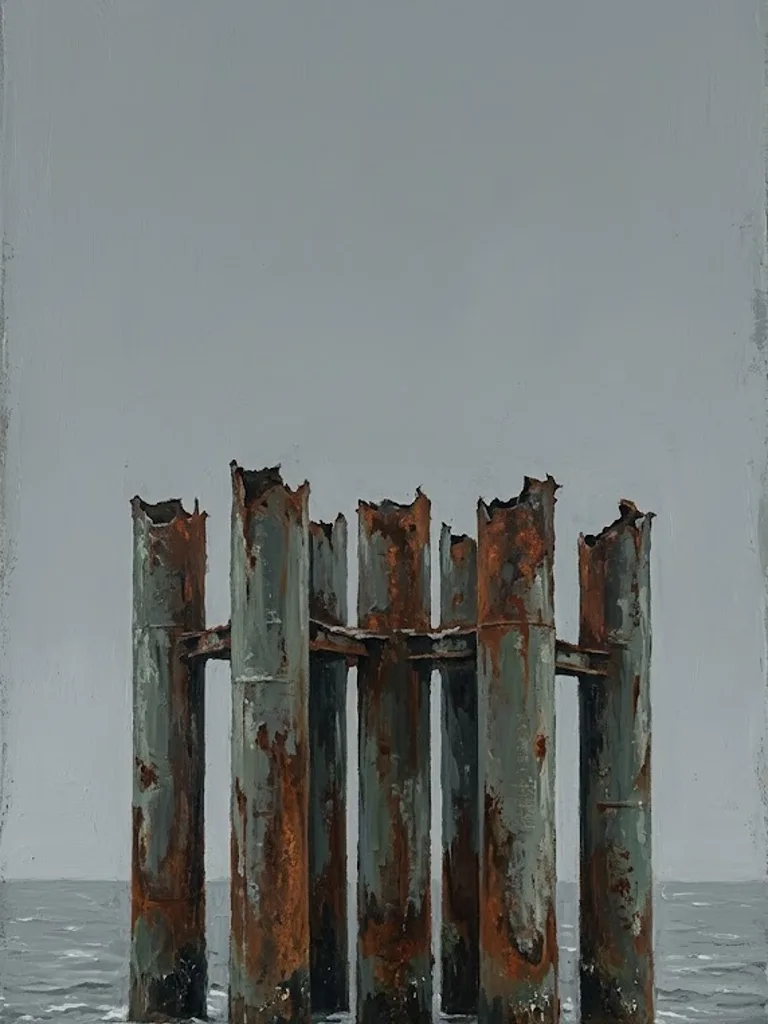
On 26 February 1969 an Adriatic storm sank a 400-square-metre steel platform off Rimini. The Italian state had spent a fortnight trying to sink it with explosives and had failed. The sea did it for free, in an afternoon.
Italy blew it up for four reasons. That bar counter was legally outside Italy. Nobody declared what was taken at the till. The plans included selling petrol without Italian excise duty, then one of the highest in Europe. And if an engineer from Bologna with a patent could pull it off, so could anybody with money and a lawyer: the country was a founding member of the Common Market, the forerunner of the European Union, and sending military divers against a bar with a terrace came cheaper than the precedent.
26 February 1969
The platform stood eleven kilometres and six hundred and twelve metres offshore, five hundred metres outside the limit of Italian territorial waters at the time, which reached six nautical miles. It had been twisted for a fortnight, its pillars split open and the structure out of square, and a winter swell took it the rest of the way down. What stayed on the bottom of the Adriatic are nine steel pillars filled with concrete.
13 February 1969: the second charge
Two days after the first, the divers came back with more explosive. According to the accounts of the operation, they had started with some seventy-five kilos per pillar and this time went up to a hundred and twenty: close to two tonnes in all, across two goes. The platform bent. It did not fall.
11 February 1969: the first charge
The divers found a spring. Rosa had given the detail in his own words: you assemble the structure on the beach, float it out to sea, lower the vertical pillars to the bottom — hollow ones — insert steel tubes inside them and push those into the sand, and at the end you fill the lot with cement, at which point corrosion stops being a problem. The system went on to have a patent number of its own, 850,987.
A telescopic structure absorbs an explosion the way a spring absorbs a blow: it deforms inside and stays where it is. The Italian Navy divers first brought down what was left of the brick and cement work, then mined the pillars, opened a notch and went back to port.
The pontoon of November 1968
Two and a half months earlier, a pontoon unloaded at Rimini everything that could be dismantled and carried: the restaurant furniture, the bar, the shop, the post-office counter. What could not be moved stayed up there waiting for the divers.
The appeal, in the autumn of 1968
Before the explosives arrived, the island went to law. Its government took the case to the Council of Europe in Strasbourg, and sought advice from Nicola Catalano, who had been a judge of the Court of Justice of the European Communities between 1958 and 1962. The appeal was rejected. The Esperantist Republic of the Island of Roses had a lawyer better than its territory.
The order, in August 1968
The Ministry of the Merchant Navy sent a dispatch to the harbourmaster's office in Rimini requiring Rosa to demolish the platform. The legal problem was that nobody held a good piece of paper. Rosa could produce no treaty recognising his country; Italy had no law clearly forbidding anyone from building on the seabed outside its waters either, because it had not occurred to anybody to write one. So the state held on to the one solid thing it had in hand: the structure had gone up without an administrative concession, and what goes up without a permit comes down.
25 June 1968: the occupation
A dozen launches carrying officers of the police, the carabinieri and the Guardia di Finanza — the Italian force that chases smuggling and tax fraud — surrounded the platform and took possession of it without a blow. There was no government up there to arrest: there was the platform's caretaker, who lived on it, and he was not allowed to land at Rimini until 11 July. The blockade banned any mooring, so the platform never opened to the public again: its whole commercial life was the summer of 1967 and the weeks of 1968 before that 25 June.
Giorgio Rosa sent a telegram of protest to Giuseppe Saragat, president of the Italian Republic. There was no reply.
The republic had lasted fifty-five days.
1 May 1968: independence
Rosa declared the platform an independent state and named himself president; the news was made official at the end of June, just in time for the people who were going to clear it out to read it. The country was called, in Esperanto, Esperanta Respubliko de la Insulo de la Rozoj: Esperantist Republic of the Island of Roses. Esperanto, the artificial language that an ophthalmologist named Zamenhof published in 1887 so that nobody would have to learn the neighbour's, was the official tongue.
The posts were handed out on 1 May too: a presidency of the council of departments and five departments, one of them devoted to getting somebody to recognise the platform's extraterritoriality. It had a government, an anthem, a flag and a post office. Stamps were printed and a currency was announced, the mill, at parity with the Italian lira. One of those stamps carries a drawing of the map of Italy with a dot marked in the Adriatic, in case anybody was unsure where the country was. The stamps are today all that is left of the state: they change hands among collectors and are worth rather more than the postage they once paid.
20 August 1967: the opening
Whoever climbed the ladder found up there a restaurant, a bar, a dance hall, a souvenir shop and a post-office counter with its own postmark. You got there by boat, there was no other way of getting there, and for the first few weeks the fresh water came up in jerrycans. It opened to the public on a Sunday in August, in high season, a boat ride from one of the most visited coasts in Europe, and the curious came up, businessmen came up, and the revellers of the Riviera came up.
The build, before 1967
The structure was assembled on land, floated out and driven in pillar by pillar, with pontoons and with steel tube ordered from a northern steelworks. Twenty metres by twenty, nine pillars and a pipe that went down two hundred and eighty metres below the seabed to draw fresh water, because a republic without drinking water is not a republic, it is a raft.
And before all of it, 1958
Six nautical miles are 11,112 metres. The platform was planted at 11,612. That difference of five hundred metres, what you walk in six minutes, is all the international law Rosa needed: inside the six miles it would have been an illegal structure and a fine; outside, it was another country. The drawing was made in 1958 by a thirty-three-year-old mechanical engineer from Bologna, qualified by his own city in 1950, who took his holidays right across from the spot. In 1974, five years after the platform went to the bottom, Italy extended its territorial waters from six miles to twelve: the gap the island had slipped through closed by itself, and that point of the Adriatic is Italian territory today.
Giorgio Rosa died in Bologna on 2 March 2017, at ninety-one, forty-eight years after the last charge of explosive. In 2020 Netflix released a film about the affair.
Nothing is left of the country but paper. The government in exile, which went on existing inside a folder, issued one last stamp: it carries a drawing of the platform's explosion and, underneath, four words in Latin, "Hostium rabies diruit opus non ideam" — the fury of the enemy destroyed the work, not the idea — printed over postage that no post office in the world would have accepted.