 Margen
Did you know? · From the Margen catalogue
A chameleon has no blue pigment and no green pigment
A panther chameleon has no green pigment in its skin, and no blue pigment either. It has yellow pigment and two layers of mirrors, and that is enough. Michel Milinkovitch's team measured it at the University of Geneva, with specimens of the Madagascan species biologists call Furcifer pardalis in front of a spectrometer, and published it in Nature Communications on 10 March 2015.
Intuition says otherwise. A panther chameleon at rest is green; if another male comes close, within seconds it turns yellow, orange and red, and one assumes pouches of green pigment closing and pouches of red pigment opening, like a palette emptying on one side and filling on the other. There is no pigment in that skin but the yellow.
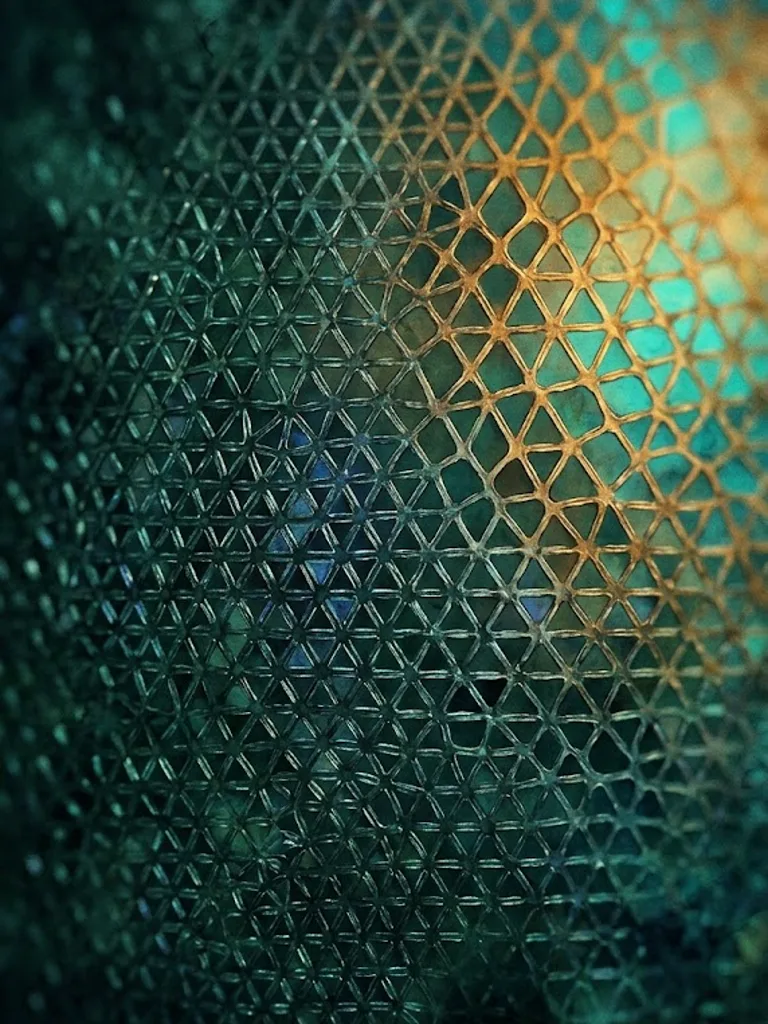
Besides the yellow there are two superposed layers of cells called iridophores, and inside them, crystals of guanine. Guanine is one of the four bases of DNA; crystallised, it behaves like a tiny mirror. The crystals in the upper layer are 127 nanometres across — a little over a ten-thousandth of a millimetre — and arranged in a triangular lattice, packed tight against one another. That lattice is a photonic crystal: it returns light at a wavelength that depends on the distance between its pieces, rather than absorbing it the way a pigment does. It is the same principle by which a patch of petrol in a puddle produces colours the petrol does not have.
The researchers measured the crystals in relaxed animals and in excited animals. The diameter of the crystal did not move: it stayed at 127 nanometres in both states. What moved was the gap between them. In resting skin, the crystals sit on average 30 per cent closer together than in excited skin. Close together, the lattice returns short wavelengths, that is, blue. Spread apart, it returns long ones: yellow, orange, red.
The green the creature wears for most of its life is the sum of two things. One is the xanthophores, cells loaded with that yellow pigment. The other is the structural blue of the crystals. Mixed in the same skin, the observer's eye receives green. When the animal gets excited and spreads its crystals, the blue turns yellow-orange, adds to the yellow of the pigment, and out comes the red of the display. Through the whole process the animal has neither made nor destroyed a single pigment. It has only moved some crystals.
The second layer of iridophores, the deep one, takes no part in the show. Its crystals are much larger and brick-shaped, and their job is to send back infrared radiation: the authors measured it reflecting close to 45 per cent of the near-infrared that reaches it, the stretch between 700 and 1,400 nanometres, which is the part that heats. It is a parasol fitted underneath the colour, on a reptile that lives in the sun and cannot sweat.
The other half of the popular belief, the camouflage one, had been dismantled seven years earlier by work done in the southern hemisphere. In 2008 Devi Stuart-Fox and Adnan Moussalli published in PLoS Biology a study of the dwarf chameleons of southern Africa, of the genus Bradypodion. They compared species with a great capacity for change against species with little, and looked for what that capacity matched. If change served to hide, the most chameleon-like species ought to be the ones living against the most varied backgrounds. They were not: variation in the background explained nothing. What did match was how conspicuous the signals are that males throw at each other in their contests and their courtship. The more dramatic the change, the more the signal contrasts against the surroundings and against the rest of the animal's own body. The authors wrote it without hedging: no evidence in favour of the crypsis hypothesis.
There is no need to overshoot in the other direction either. The chameleon does have a discreet background colour and does adjust it somewhat to where it happens to be; nobody disputes that. What the word "chameleonic" takes for granted is something else: that the repertoire of reds and oranges exists in order to disappear. That repertoire is hugely expensive to maintain and the animal saves it for the two moments when being seen is what it wants, when it fights and when it courts. The Geneva paper notes that having the two layers of iridophores is an evolutionary novelty of chameleons, and that it is precisely what lets them combine effective camouflage with a spectacular display without having to choose.
The crystals of that second layer, the one that never moves, reach 600 nanometres in length, nearly five times the mirrors above them, and they keep returning infrared whether the animal is red, green or asleep.