 Margen
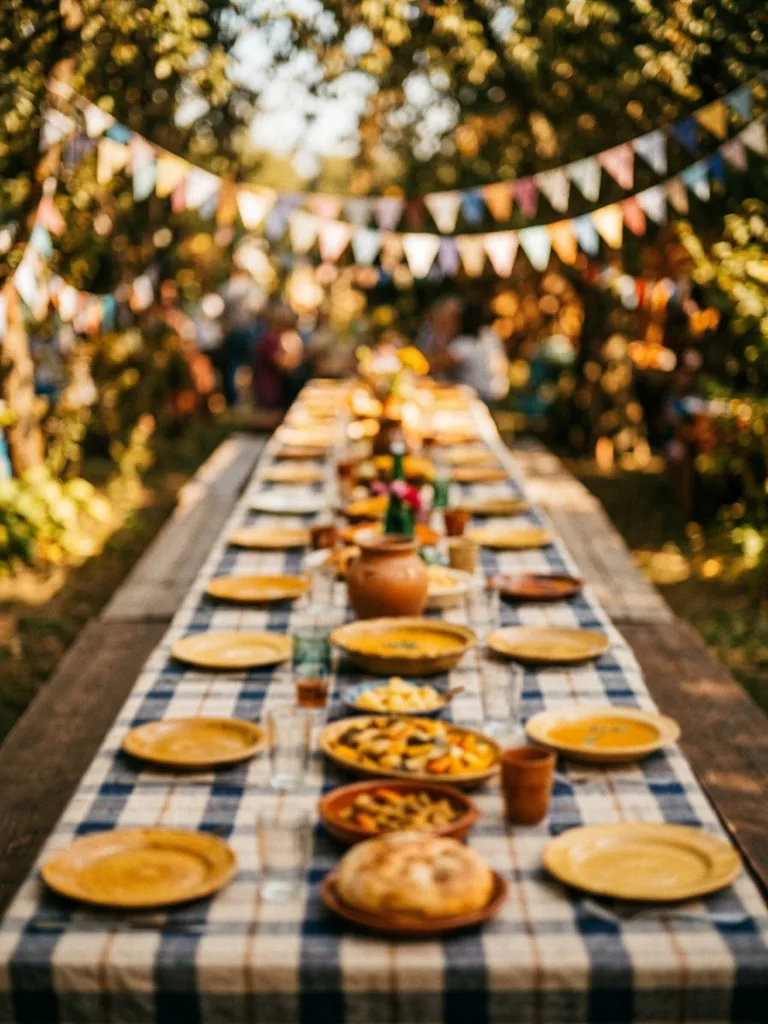
My name is Tomás Bellido, I work as a pharmacy assistant, and the minutes that ruined my study afternoon attest to everything that follows. On Saturday, August 22, 2026, at 12:10, I agreed to serve as substitute judge for the tortilla contest of Peñaclara del Tormo, a mountain village in full fiesta. At 15:47, after fourteen tastings, two tortillas tied, and my Monday civil-service exam was left hanging on an onion.
I had traveled there to shut myself up in my aunt's house and review two hundred forty pages on pharmaceutical dispensing, which I planned to get through in blocks of twenty. I needed to pass to compete for a permanent post at the health center. My contract ended on the 31st, and the contest was nowhere on my calendar.
I went down to buy bread and found Adela Bercial clutching a folder to her chest. Adela organized the fiestas after closing her hardware store and had run the tasting for nineteen editions. She was one judge short, because the retired schoolteacher she'd lined up had woken with a toothache.
—You work with measurements, she told me. This is about measurements too.
I tried to explain that a dose of ibuprofen and a tortilla did not share a protocol, but I had already written my name on the substitutes' line. She promised we would finish in forty minutes. The minutes record that claim at 12:11, though they decline to label it a fantasy.
The table in the municipal hall held fourteen numbered plates and as many aluminum cloches. The tasting was blind. Only Adela kept the envelopes naming the authors. We judges were to score texture out of ten, flavor out of ten and appearance out of five.
On my right sat Nerea Saz, who drives the regional bus and defended onion with arguments worthy of a border negotiation. On my left, Julián Cobo, an elevator technician convinced that adding it turns a tortilla into a stew. Both had sworn impartiality six minutes earlier.
The first sample had onion. Nerea closed her eyes as she tasted it. Julián marked a six and said he was scoring the egg. The second had none. Julián gave a thumbs-up; Nerea asked whether we would be scoring pharmacy wafers next.
Adela struck the table with a ladle.
—In nineteen years I have never expelled a judge, but I do have the forms.
I calculated that if each sample took two minutes, I could still get back to studying before lunch. The third took seven, because they argued over whether a browner corner was a flaw or character. The fourth prompted an inspection of thickness. At the fifth, Julián asked for bread to cleanse his palate, and Nerea replied that palates were cleansed by voting properly.
By 13:05 I knew all about the village's civilized war. During the fiestas, the onionists held the tables near the kitchen. The no-onionists preferred the trophy wall, where twelve photographs of past winners hung. Nobody truly insulted anybody, but each side pronounced the word “respect” with an incompatible meaning.
The defending champion was César Gálvez, a plumber who specialized in boilers, though his identity lay hidden in one of the envelopes. He had won the previous two editions with an onionless recipe and a very slow cook. His followers expected a third consecutive title; his adversaries wanted to keep the cup from spending another year in his workshop window.
I didn't know which plate was his. That ignorance struck me as the only healthy part of the procedure. Each round I jotted the score with the water glass in my other hand. By the eighth tortilla I had lost the ability to remember whether potato number six was firm or whether that memory belonged to number four.
Adela guarded the score sheets with a notary's rigor. She wrote down the time of every incident, collected our signatures whenever we corrected a figure and forbade comments before scores were handed in. Her method had been born after the seventh edition, when two cousins accused each other of recognizing a frying pan by its rim.
Tortilla number ten arrived at 13:42. It was juicy, it had onion and it kept a thin crust. Nerea gave it twenty-four points out of twenty-five. Julián granted it nineteen with a pained expression. I put down twenty-two, because I was beginning to suspect that every extra number prolonged my stay.
Number thirteen had no onion. The center held its shape without drying out. Julián gave it twenty-four; Nerea, nineteen. I marked twenty-two. When she added up the sheets, Adela frowned and repeated the sum on a desk calculator.
Both reached sixty-five points.
—A technical tie, she declared.
I looked at the clock. It was 14:08. In my backpack, the storage procedures for heat-sensitive medications were waiting for me. I asked about the tiebreaker. Adela opened the rulebook and read that the tasting must be repeated between the tied plates, with fresh portions and the order reversed.
The portions returned under numbers 15 and 16. I recognized the onion before tasting, Nerea recognized its absence in the other, and Julián recognized that the earlier argument had settled nothing. We scored again. The result was another tie: sixty-seven points.
Adela noted “second technical tie” at 14:26. She searched for an additional clause, but the rulebook ended with the mayor's signature and an oil stain from the twelfth edition. Nerea proposed deciding it on the flavor score. Tied there too. Julián asked to judge the evenness of the cut. Each had eight nearly identical portions.
We opened the envelopes to learn the finalists. Number ten belonged to César, the champion famous for cooking without onion. Thirteen was from Maribel Ordóñez, the baker who presided over the onionist club. For several seconds we believed Adela had switched the labels.
César walked into the hall with a wrench still in his pocket. He admitted he had made a tortilla with onion because he was tired of his friends guessing his plate before tasting it. Maribel arrived with flour on her apron and confessed she had competed without onion to prove she could win even under enemy rules.
The two camps took a few seconds to decide whom to cheer. César's followers did not want to celebrate an onion. Maribel's couldn't boast about her plate without admitting they had liked a no-onion one. Adela used the confusion to propose a third tiebreaker.
I refused. I remembered I was a substitute and asked whether the presidency of the jury carried a casting vote. Adela checked the first page: the schoolteacher with the toothache was listed as president; I held his post with all its functions. I had just acquired the power I needed least, forty hours before an exam.
I asked for a portion from each finalist. They were cold. I tried César's first, then Maribel's. Both were still good, but no flavor justified taking on half the village or giving away another hour of study.
I declared that the tie stood. Adela replied that there was only one cup. César, a man used to cutting pipe, went to his van and came back with a saw. Maribel held the trophy over a board while he split it down the middle. Each received half a base, half a chalice and one of the two handles.
The final minutes, closed at 15:47, proclaimed joint champions: a no-onionist who had used onion and an onionist who had gone without. I signed beneath Adela and ran off to study. On Monday a question came up about separating mixtures and, below the textbook answer, I wrote: “For the onion, see the Peñaclara minutes.”