 Margen
Did you know? · From the Margen catalogue
Six dead in Oregon, killed by a bomb that flew there on its own
Elsie Mitchell was twenty-six, five months pregnant, and that Saturday she had driven out of Bly, a logging town in southern Oregon, to have a picnic up in the hills with five children from her church. It was 5 May 1945. All six of them died, and the thing that killed them had crossed the Pacific with nobody flying it. Her husband, Archie Mitchell, the town's pastor, stayed a few metres behind with the van to ask a forest worker about the state of the road.
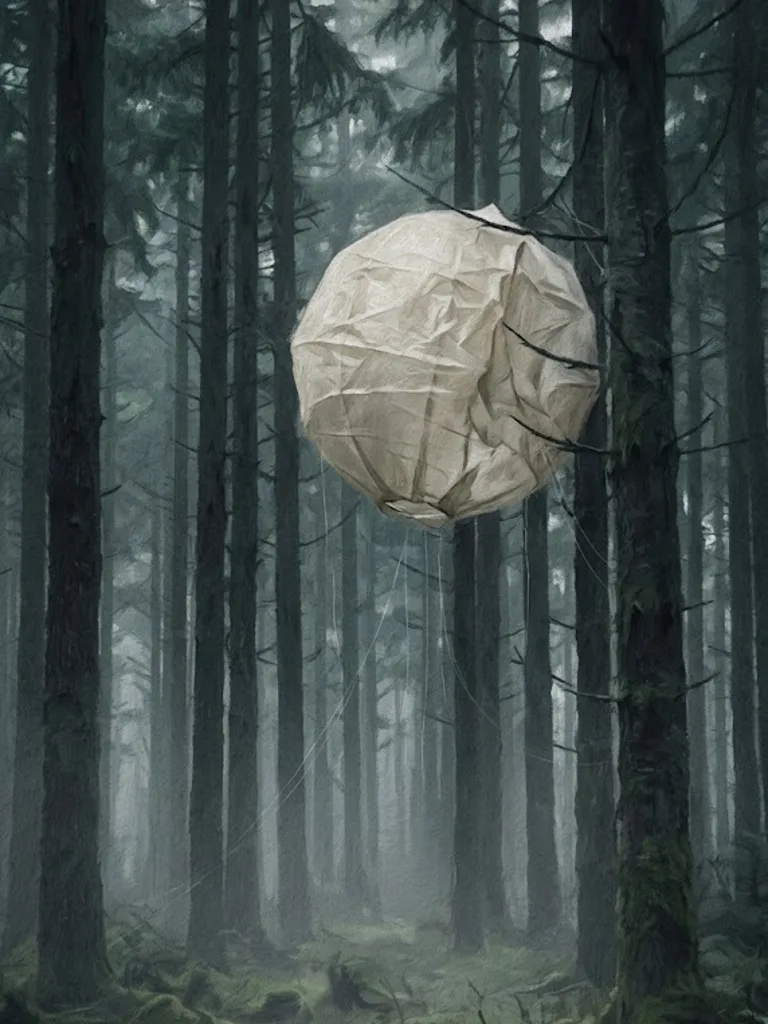
The children reached the clearing before he did and saw something among the pines, large and white, half deflated, with ropes and a frame hanging from it. Elsie called them over to get a closer look. One of them moved it.
The six were Elsie Mitchell, Edward Engen and Jay Gifford, both thirteen, Sherman Shoemaker, eleven, and Dick and Joan Patzke, fourteen and thirteen, brother and sister. Archie Mitchell was the only one left standing. The thing that had just gone off in that inland Oregon forest had been launched from a beach in Japan, eight thousand kilometres away.
It was a Fu-Go, the name the Japanese gave their balloon bombs. A sphere ten metres across, made of dozens of sheets of washi, mulberry paper, glued together with a paste made from konjac, a root used in Japanese cooking. Inside, hydrogen. Underneath, a harness with sandbags, a fifteen-kilo anti-personnel bomb and some incendiary charges.
The balloon needed no pilot because it carried a barometer: if it dropped below nine kilometres of altitude it released a sandbag, and if the sun warmed it and it climbed too high it vented gas. That way, in hops, it stayed inside the jet stream, the river of air that crosses the Pacific at more than two hundred kilometres an hour at that height. The trip took about three days.
That current had been measured back in the 1920s by Wasaburo Oishi, a meteorologist at the Tateno observatory, who released sounding balloons and tracked them with a theodolite, the eyepiece used to measure angles. He published his data in Esperanto, the invented language that then looked like the future of science, and outside Japan almost nobody read it. Twenty years later his country used those figures to send bombs to a continent that had no possible defence against them.
Between November 1944 and April 1945, Japan launched some nine thousand three hundred balloons. Around three hundred were located in North America, from Alaska to northern Mexico and as far east as Michigan. On 10 March 1945 one of them cut the line carrying power from the Bonneville dam to Hanford, the plant in Washington State where the plutonium for the Nagasaki bomb was being produced. The emergency system, which had never been used, came in so fast that the reactors never overheated; even so they took three days to get back to full power.
The United States Office of Censorship had asked newspapers to say nothing, and the newspapers agreed. With no news of fires or deaths, the Japanese command concluded the campaign had failed and cancelled it that April, a month before Bly, with two of its three hydrogen plants already destroyed by B-29 raids. Nobody in that clearing knew you should not go near a white sheet of fabric lying in the woods.
Bly is the only place in the continental United States where civilians were killed by enemy action during the Second World War. The War Department lifted the ban on 22 May 1945, seventeen days after the picnic, with a statement that asked expressly for children to be warned: that they were not to touch any balloon, any rope or any piece of fabric they came across in the countryside.