 Margen
Serialized book · From the Margen catalogue
Paulino looks at the hearth floor and asks about the wood
Previously: the inspector gave Celso Larrauri 21 days over the benzopyrene in his crust and comes back on Thursday the 28th. He has ten schools left.
Paulino Garisoain, a retired oven man, arrived on Thursday at ten past ten, with fourteen days to go until the second inspection and ten schools written on the wall, and the first thing he did was ask for a handful of flour.
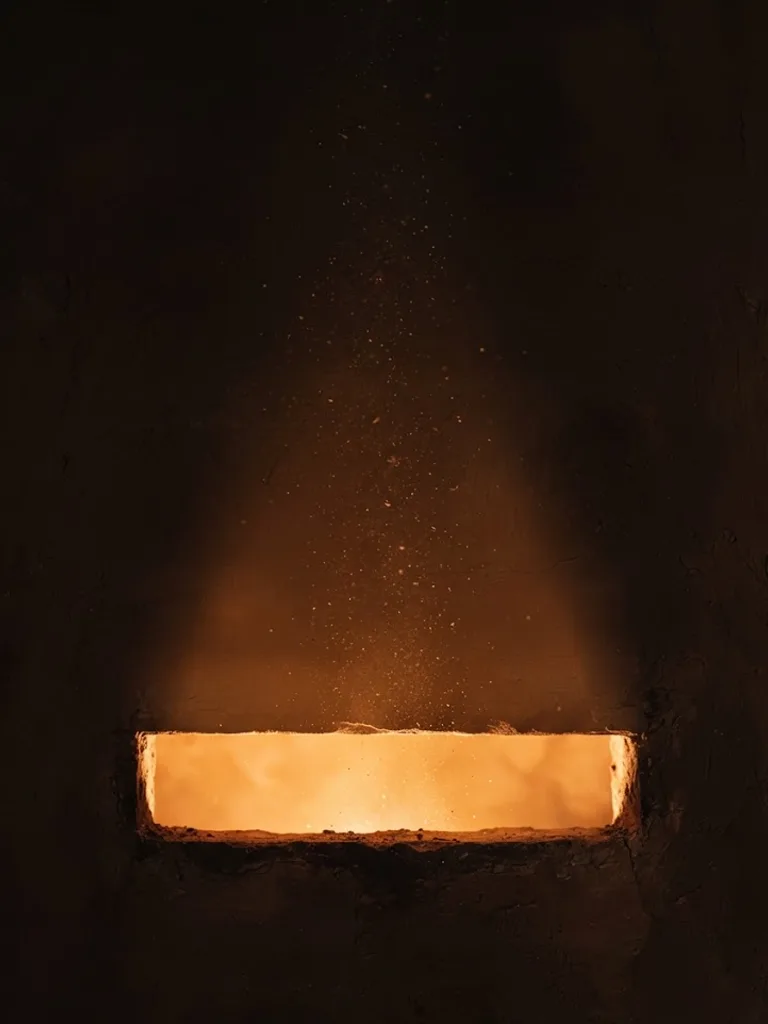
Celso Larrauri, master baker and owner of the bakehouse, gave him the flour from the dusting bowl without asking what for. Paulino knelt at the oven's mouth, stretched out his arm and threw it onto the brick, two hand-spans in from the edge. The flour went golden in three seconds and brown in six.
"Two hundred and something," he said. "You can't touch it, but you can see it. Give me the torch."
Paulino is eighty-one and was the oven man in this house from sixty-eight on, under three different owners. The firebrick floor in there he laid himself in 1974, and nobody has touched it since.
He did not sweep the chamber with the light. He did not feel his way from front to back, he did not search the far end, he did none of the things Celso was expecting. He knelt at the mouth again, brought his face close to the start of the floor, in the same place where he had thrown the flour, and stayed there looking at a line in the brick four fingers in from the edge.
"Bring a candle."
Celso brought one from the office drawer, the kind used for checking draughts, and lit it. Paulino held it up to the line and the flame leaned down towards the floor, towards the brick, slowly and without hesitating.
"There's an open joint. Air goes through there."
"And what does that mean."
"Wait."
Paulino pinched the candle out, turned it over and showed him the wick, which had come out grey and tacky. Then he ran a fingernail along the edge of the joint, the one hand-span of that floor that will let you touch it, and brought it out black.
"That's soot. And soot in your chamber can only come from under that floor, which is where the smoke goes. It has come out through here."
Celso sat down on the brick bench without being asked.
"Paulino, that joint has been there since seventy-four. I've been baking in here for twenty-six years and the bread came out the same."
"I know."
"So why now."
"Because the joint is the same joint it always was. What has changed is the draught." Paulino stood a moment with the candle in his hand, working out where to start. "You know how your oven works. What you may not have thought about is what the chimney lives on. A chimney draws on the heat of the smoke: the hotter it comes out, the harder it sucks. With beech, the smoke comes out burning, the chimney sucks hard, and the duct running under that floor sits a hair below the pressure in the chamber. So air went through my joint from the chamber into the duct, inwards, and nothing came out of it. That's why in twenty-six years you never noticed."
"And now the other way round."
"And now the other way round. With what you're burning, the smoke comes out cold. The chimney draws less. And on top of that, what you're burning leaves a layer stuck inside the ducts and the flue, and every month that passes it draws a little less still. When the draught falls short, the smoke doesn't rise: it pools down there. And pooled smoke gets out where it can, which is the only hole that floor has. Through my joint. On one side only, the mouth side."
"Hence the crust."
"Hence the dark crust on one side and the fine ash on the bottom of those loaves. And it happens on every batch, all the time, since the layer got thick, Celso. You've got it written up on that wall yourself since the autumn."
Celso looked at the chalk wall, where the numbers from every batch of the week are kept, and under them the 3.1 from nine days back, and under the line, the ten.
"There's nothing about the draught up there."
"What I need is up there." Paulino got up and went over to the wall, and followed the column with his finger without touching it. "Three charges where you used to put one. That isn't what an old oven does. The oven is asking you for wood because it won't rise, and you give it more. And every charge of that stuff you feed it dirties the duct a little further."
Eulogio Satrústegui, a dough man since he was nineteen, had finished the fourth batch at twenty to ten and was cleaning the trough with his back to the two of them. He put the scraper down, went to the wood store, took a piece from the last load and set it on the marble, next to the two loaves still standing on edge there since Tuesday. He said nothing. He went back to the trough.
"Paulino."
"Tell me."
"The joint can be closed."
"In an afternoon, if all you want is to close the joint. Closing it properly is another matter."
"And how much is that."
"That's lifting the mouth and seeing what's underneath."
Celso went over to the wall and stood beside him.
"One thing. You went in there, you didn't look at the floor and you put your hand right on top of the joint. You didn't even search. How did you know it was there?"
Paulino took as long as an eighty-one-year-old takes to decide what he tells today and what he doesn't.
"Because it's the only part of this oven that I put in."
"That doesn't answer me."
"No, it doesn't answer you. And today I'm not going to answer it. When we lift the mouth, you and I will sit down and I'll tell you the whole of seventy-four, what I did and why I did it. Today I came to look at a floor."
At twenty past eleven the lorry came into the yard and Eulogio went out to open the wood store. Celso took two steps towards the door and stopped. Paulino did not move: he stayed inside, crouched at the mouth again, scraping the grey ring off the base of the brick with his nail. When they came out into the yard, the wood was unloaded, stacked and covered with the green tarpaulin, and the lorry was already turning round.
Paulino went up to the tarpaulin and did not lift it. He rubbed his thumb against his forefinger, brought his fingers to his nose and smelled them slowly, twice, the way you smell a cork.
"What wood do you burn."
"Beech."
"Right." Paulino wiped his hand on his trousers and looked Celso in the eye. "What I've got on my fingers I took out of the inside of your chamber. Beech smells toasted and comes off with a rag. This stays, it's tacky and it's got something sweet underneath. Beech doesn't leave this."