 Margen
Did you know? · From the Margen catalogue
In 1859 two telegraph operators worked with no batteries
Boston, 2 September 1859: two telegraph operators disconnected the batteries on the line linking the city to Portland, in Maine, and went on sending messages. For about two hours the instruments ran on nothing but the electric current induced by the geomagnetic storm. The exchange between the two men appeared that same month in the Boston Traveller, a newspaper of the city.
The cause had been seen the morning before. Richard Carrington, an English astronomer devoted to the study of the Sun, was projecting the solar image at his private observatory in Redhill, England, when two patches of intensely bright white light broke out within a sunspot group. It was the morning of 1 September 1859. Carrington went out to find someone who could confirm the sighting, but the flash had faded before he could get back. Richard Hodgson, another English astronomer, had seen it at the same time and entirely on his own from a different observatory.
Seventeen and a half hours after that flare, a sudden release of solar energy, the telegraph lines of Europe and North America began to carry a current nobody had sent. The explanation accepted today is that the flare launched a coronal mass ejection, an enormous cloud of plasma and magnetic field, and that the cloud covered the roughly 150 million kilometres to the Earth in under a day, when the normal crossing takes three or four. No measurement from 1859 proves it directly: it is inferred from the interval between the two events.
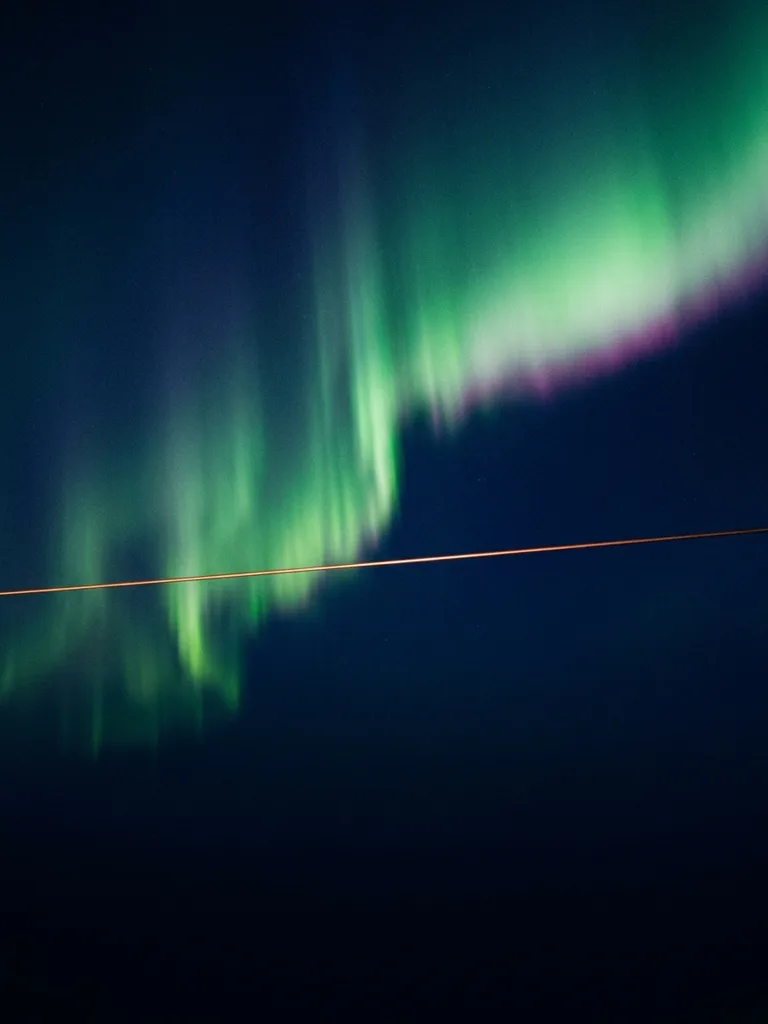
On the night of 1 to 2 September the auroras came down far beyond the polar regions. There are accounts from Cuba, Hawaii and Colombia. In some places the glow was bright enough to read a newspaper by at night. In the Rocky Mountains several gold prospectors got up because they thought day was breaking.
The telegraph lines of the United States and Europe behaved like very long conductors. The swings in the Earth's magnetic field generated current in the wires, even where the batteries were switched off. Sparks jumped from the equipment, telegraph paper caught fire and several operators took shocks. Some offices suspended the service because their own power supplies were making the interference worse.
On the Boston to Portland line the opposite happened. The Boston operator asked the man in Portland to take his battery out altogether for fifteen minutes. Then he disconnected his own. Both found that they received the signals better when they were fed by the auroral current, and they kept the line going for about two hours, until the activity died down and they put the batteries back.
The simultaneous observation by Carrington and Hodgson helped to connect a solar eruption with a magnetic disturbance on Earth. The episode ended up being named the Carrington event and it is still the historical benchmark for extreme solar storms. A 2008 report by the National Research Council of the United States, the advisory arm of the National Academy of Sciences, estimated that an episode on that scale would cost between one and two trillion dollars in the first year alone, and that full recovery of the electrical system could take anything from four to ten years.