 Margen
Short story · From the Margen catalogue
I counted 79 rings in the thousand-year-old olive
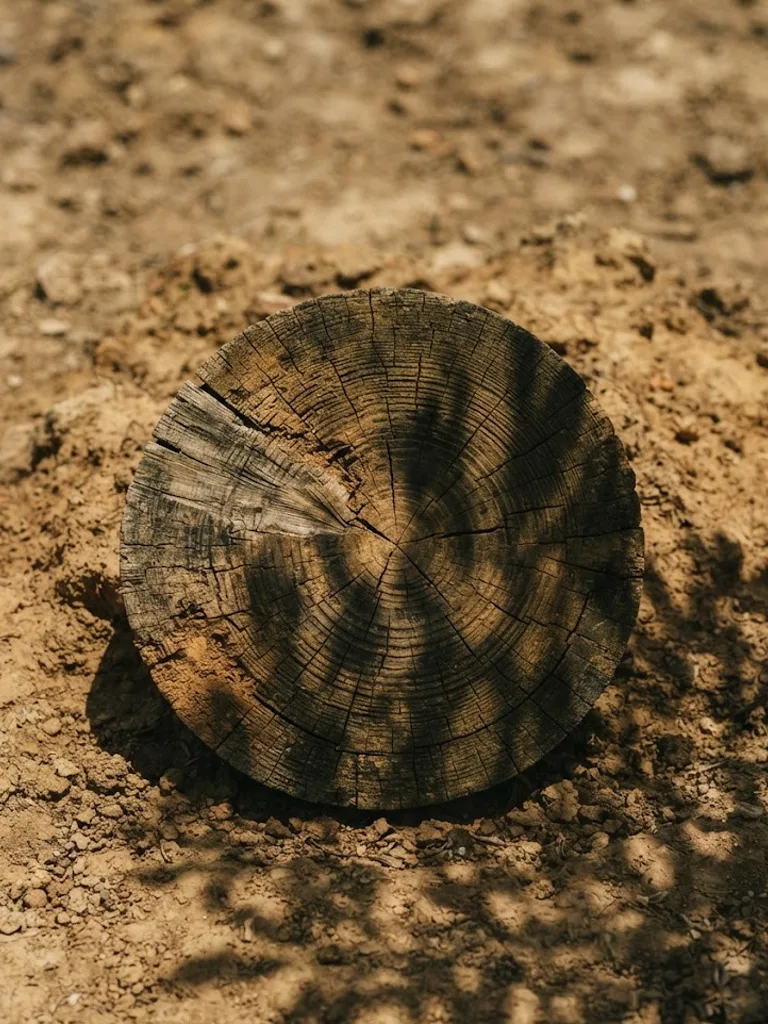
14 September. Valbarreda (Jaén). File 4471.
Bolted to a granite pedestal, four metres from the burned tree, a plaque reads: OLIVE OF THE FOUNTAIN. MORE THAN A THOUSAND YEARS OLD. MONUMENTAL TREE OF VALBARREDA. At half past nine I cut a clean disc from the thick branch the fire had brought down, sanded it with the 120-grit block I keep in the case, and sat on the stone rim of the fountain to count rings with the loupe. Seventy-nine. I counted three times and got the same figure three times.
My name is Valentina Cañedo and I assess tree damage claims for an agricultural mutual insurer. The dry storm of 2 September left two lightning strikes in the municipality and one of them went in through the fork of this olive. The trunk is hollow, as its supposed age would require, and the fire climbed up inside it as it would up a chimney: the tree stayed standing, black, with a dead crown and a branch thirty centimetres across on the ground. The council has it insured for 60,000 euros as a monumental specimen. My job is to put in writing exactly what has burned.
Reme Santamaría, the mayor, was waiting for me at the foot of the tree with a folder of press cuttings. Forty-one years old, two terms in office. She put the council resolution in front of me and pointed at the line: the roof of the health centre. "With that we fix the roof and there is still money left," she told me. I replied that I first had to certify the age.
15 September.
The seventy-nine rings prove nothing on their own, and that is the first thing I am going to write in the report so that nobody uses it backwards. The olive is a treacherous tree to count: it forms false rings when there are two rain cycles in the same season, it rots from the heart until it is hollow, and the shoots it throws up from the base can be far younger than the stock. Dating an olive by its rings is rather like measuring the age of a house by the paint in the hallway.
I asked the town clerk for everything on file about the tree and there is less than I expected. The file opens with the council resolution of 12 March 1999 declaring it monumental, goes on with the invoice for the pedestal and the plaque, and stops there. The plaque was cast by a workshop in Linares and the casting date is on the back, at the bottom, where nobody reads it: 1999. The Festival of the Olive of the Fountain, which Reme calls "the one we've always had", is in its twenty-seventh edition. The first was also in 1999.
16 September.
A whole morning in the municipal archive, which is two cabinets in the loft above the council chamber. Among the photographs of the brotherhood I found what I was looking for without knowing I was looking for it: an image of the Plaza de la Fuente dated 3 May 1997, with the May cross set up and fifteen people standing in front of the olive.
The 1997 olive has two trunks. Two, separate from the ground up, with a pruning-hook scar — the curved blade used for pruning — running diagonally up the left-hand one. The 2026 tree has one trunk and no scar. I measured on the enlarged copy using the chapel door as a scale: the girth of the 1997 tree is no less than five metres. The girth of the burned tree, tape-measured at one metre thirty above ground, is 3.42.
An olive does not shed a metre and a half of girth in twenty-nine years.
17 September.
With the mayor's written permission I opened a sixty-by-sixty-centimetre test pit a metre from the base, on the fountain side, to see how the thick roots were arranged. At thirty-five centimetres the spade hit something that was not stone.
A green nylon strap, a cargo sling, still taut around a root as thick as my arm. Beneath it, a six-millimetre steel cable loop, cut and riveted. And at forty-five centimetres, running right around the root ball, the clod of earth and roots a tree is moved in, a ring of corrugated drainage pipe of the kind sold in the nineties, holes facing up, with a drip irrigation emitter plugged in and eaten up by roots.
That is transplant equipment. Nobody straps up or lays drainage around a tree that was born where it stands. I wrote it in the notebook exactly like this: the Olive of the Fountain arrived in Valbarreda on a lorry.
18 September.
I found Balbino Ortiz where they had told me he would be, in the lower vegetable garden, grafting quinces. Seventy-four years old, municipal gardener of Valbarreda from 1979 until he retired in 2011. I told him the test pit number and how deep the strap was. He carried on with the graft.
"The olive was pruned hard in ninety-eight. That is all there was to it."
"Nobody lays drainage around the root ball of a tree they are pruning."
"I did what I was told to do."
I asked him who told him and he did not answer. I asked whether anything worried him, and that he did answer, without looking up from the knife: that he is seventy-four, that his pension is a municipal gardener's, and that he has a daughter living in the village.
I repeated both depths — the strap at thirty-five centimetres, the drainage at forty-five — and told him both were going into the report with their photographs, with his name in it or without it. He put his knife down in the drawer, wiped his hands on his trousers and took me into the shed.
Out of a biscuit tin he pulled a sheet folded in four, carbon paper, the sort written with two copies underneath.
"With my name in it, then," he said. "But read all of it."
The old olive, the one with two trunks, was sold in June 1998 for 1,200,000 pesetas to a garden centre in the province of Alicante. The deal was signed by Julián Retamar, mayor at the time, to close the shortfall on the municipal swimming pool, opened the previous summer with two unpaid work certificates. Five months later the replacement arrived on a low loader from Alcañiz, in Teruel, where there is a legal trade in thick olives lifted from terraces that are no longer worked. Balbino planted it in three days with two labourers and a hired excavator, and he watered it by hand all winter.
"Nobody asked," he said. "It left at the start of August and came back in the middle of November. People thought we had pruned it hard."
I asked him why he never told anyone.
"The next year they gave it the plaque and started the festival."
19 September.
I told Reme Santamaría this morning in her office, with the 1997 photograph, the pictures of the test pit and the delivery note on the desk. She spent a long while looking at the carbon sheet without touching it. Then she asked:
"Does it get paid?"
Something else gets paid. The policy sets the 60,000 euros against the replacement value of a monumental specimen over three hundred and fifty years old, and what has burned is an olive of about eighty, with a girth of 3.42 metres and a crown that can be recovered by pruning above the graft. The replacement value of that, lifted, transported and planted, stands at 4,100 euros under this year's schedule. I shall put the two figures one below the other, so nobody has to go looking for them.
Before closing the report I rang the garden centre in Alicante. It is still open and the olive is still alive. It is planted at the entrance, next to the till, with its irrigation ring, its two trunks and the pruning-hook scar running diagonally up the left-hand one. It has a sign: "Olea europaea. Monumental specimen. More than a thousand years old." It is for sale. They are asking 38,000 euros plus transport. I told Reme by telephone this afternoon and she took a while before asking me whether that went into the report too. It goes into annex III, with the photograph they sent me themselves by email.
The report goes out tomorrow with four annexes. The fourth is the delivery note Balbino gave me, stapled in exactly as he handed it over. It reads: "One olive specimen, empeltre variety, trunk girth 3.10 m, origin Alcañiz (Teruel), delivered at Valbarreda on 12 November 1998. Carriage included: 310,000 pesetas." And at the foot, in pencil, in Balbino's handwriting: "Planted on the 14th. Watered on the 15th, the 16th and the 17th. It took."