 Margen
Short story · From the Margen catalogue
I'm carrying a nine-metre fig tree and the gate shuts at eight
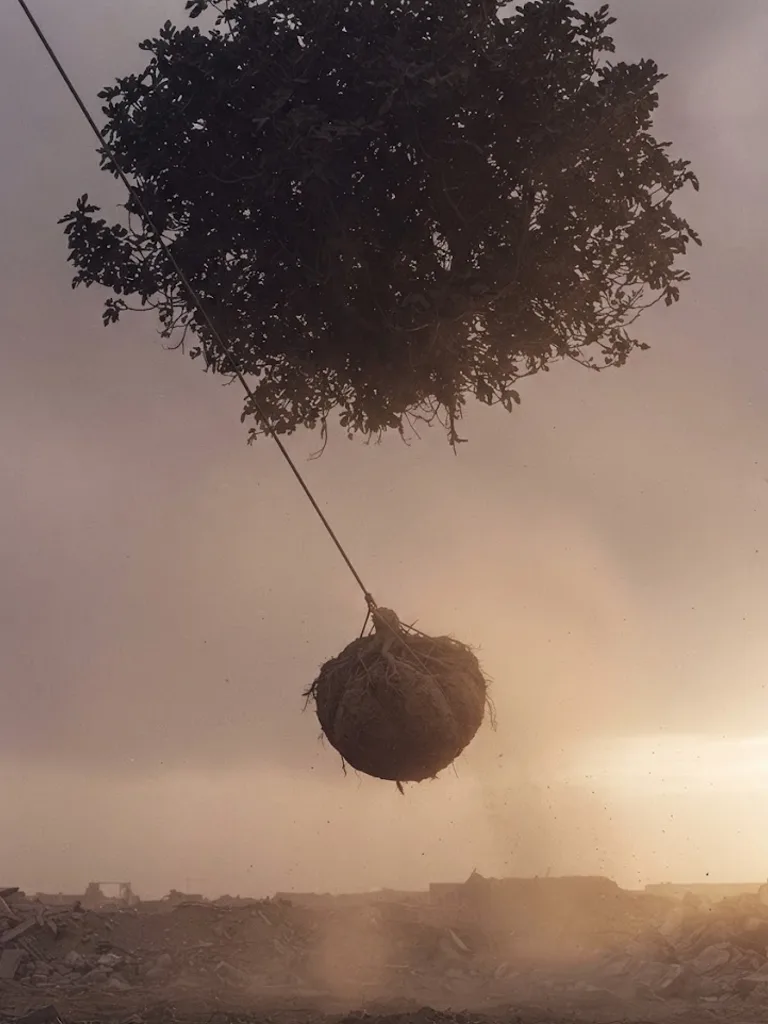
Five tonnes of fig tree were hanging from my truck's boom — the crane arm —, and underneath it two people were arguing about who would pay for the water.
My name is Garazi Zubillaga and I drive a forty-tonne crane truck: cab, articulated arm and a flatbed behind. I move big trees. It is a trade that puts food on the table in 2041 because the shade ordinances pay by the square metre of canopy: a grown tree is worth money and felling one is expensive, so developers would rather pay me than pay the fine. I do four or five a month, nearly always London planes and street hackberries, well watered and easy.
That Wednesday it was a nine-metre fig tree on a demolished plot in Bellreguard, and that fig tree was on the clock.
Somebody in the neighbourhood applied for a provisional protection order when they started putting up the hoarding, and those orders last thirty days and are not renewed. The fig tree's died at midnight. At one minute past twelve the developer could bring out the chainsaw, entirely within their rights.
The other deadline was eight in the evening, and it was set by Bieito Carnota, the site manager running the works for the developer.
"At eight I seal the plot and hand it over," he told me at two, when I arrived. "At five past eight, whatever truck is inside stays inside until Monday."
Bieito wanted the fig tree neither dead nor alive. He wanted his handover certificate signed on time. I understood him: I have also worked to a clock somebody else set.
We started at twenty past two. What you move of a tree is the root ball, the sphere of soil with the roots inside, which on a nine-metre fig comes out at about two metres across and eighty centimetres deep. The trick is to cut around it with a spade blade, a straight-entry blade that leaves the root clean. A digger takes half the time and will not do, because a digger tears instead of cutting and a torn root does not heal. About three hours if it goes well. It went well. At ten past five I had it in the air, wrapped in netting, dripping underneath, five tonnes with the soil on it.
And that was when Txell Monegal turned up.
Txell is a gardener with the town council and she is the reason that tree had anywhere to go: the Tintoreros square, newly built, with three unplanted tree pits — the openings left in the paving for a tree — and one of them three metres across. Without her acceptance signature I could not unload anything on municipal ground. With her signature, eleven kilometres and then bed.
"I can't take it," she said, without getting off her bike.
She explained it to me in thirty seconds and without a single apology, which is what you appreciate. The water for the town's gardens runs on an annual allowance. The 2041 one had been spent since the fifteenth of September, between the August heatwave and two leaks in the sports centre irrigation. A transplanted fig that size asks for three hundred litres a week for two summers or it dries out, and a dead fig in a new square is a post with branches that somebody has to pay to take away.
"If I sign and it dies in May, it's on me," she said. "Bring it to me in April, with the new allowance."
By April the fig tree would be firewood. We both knew that.
I stood looking at the tree up in the air, which costs money every minute it spends there, and then at the site hut. And I remembered something with no mystery to it at all, something anyone who has set foot on a demolition knows: building sites have water.
Dust-suppression water, the kind sprayed from a tanker — the site water lorry — over the rubble so the cloud does not drift into the next neighbourhood. It is allocated in cubic metres, requested with the licence and calculated generously, because nobody wants a complaint about dust. And the Bellreguard plot had already been knocked down.
I went to the hut.
"Bieito, how much dust-suppression water have you got left?"
He looked up from his tablet as though I had asked him his blood type.
"Forty-eight cubic metres. Why?"
Forty-eight thousand litres. Three hundred litres a week is sixteen thousand a year. Three years.
I told him. And here comes what I was not expecting: Bieito looked up and said what he wanted in exchange.
"I'll pass it over to you. But the truck out at twenty to eight, not at eight, because at eight I have to be sealing up and I don't want a crane boom in the way. And you take the rubble from the Tapinería street wall on the same trip, that's nine cubic metres and it saves me a tanker."
Nine cubic metres of rubble on top of a truck that was already carrying five tonnes of tree. I did the sum out loud in front of him: it fitted, because the flatbed was free and the tree travels lying on the gooseneck of the trailer, up against the cab. And it took twenty minutes off my deadline.
"Done."
Txell listened to the deal on the phone's speaker, standing between the two of us, and the only thing she asked was who would sign the water transfer. Bieito said he would, the developer straight to the council, and that they should call him tomorrow for the figures. She took out her phone and called the council right there, in front of us, because Txell is the sort who does not trust a tomorrow.
By a quarter past seven the tree was lashed onto the flatbed with five slings, polyester webbing straps that grip without cutting the bark, the canopy gathered in netting and the root ball against the gooseneck. At twenty-five past seven we loaded the rubble into the two rear skips. I drove off the plot at seven thirty-eight.
The eleven kilometres were the easy part, though there was one moment. With the tree lying down, the whole rig stands four metres sixty high, and the railway underpass on the N-332 is four twenty. Going round by the Marjal track is nine kilometres more and twenty-five minutes I did not have. What you do is dump the trailer's air suspension, which drops the deck seven centimetres, and tilt the tree another twelve degrees with the boom. You go through with fifteen centimetres to spare. I have done it six times and my back still sweats all six.
I got to the Tintoreros square at twenty past eight, by then at night. Txell was there with two workmen breaking open the tree pit and a ten-thousand-litre tanker parked beside it, ordered in those two hours against the first ten cubic metres of Bieito's forty-eight.
Planting at night is better than planting at midday, because of the heat. We lowered the fig at five to nine. We oriented it the way it had been growing, same face to the south, filled in with the soil from its own root ball and gave it its first water right there: eight thousand litres in an hour and a half, which is what a tree that size drinks on its first day.
Txell signed the acceptance at half past ten, with the paper resting on my truck's mudguard.
I was paid four thousand two hundred euros for the transplant and three hundred for the rubble. Bieito handed over his sealed plot at eight on the dot. And at midnight, when the order expired, the fig tree had been in the square for three hours and was no longer any concern of the developer's.
While we were gathering up the slings I asked Txell how many trees had come into the square that year. Two, she said, counting the fig.
She carried on winding up the hose and did not look up.
“There’s another one tomorrow in Oliva, Garazi. And they’re knocking things down in Oliva too.”