 Margen
Did you know? · From the Margen catalogue
They dissolved two Nobel medals in acid to hide them
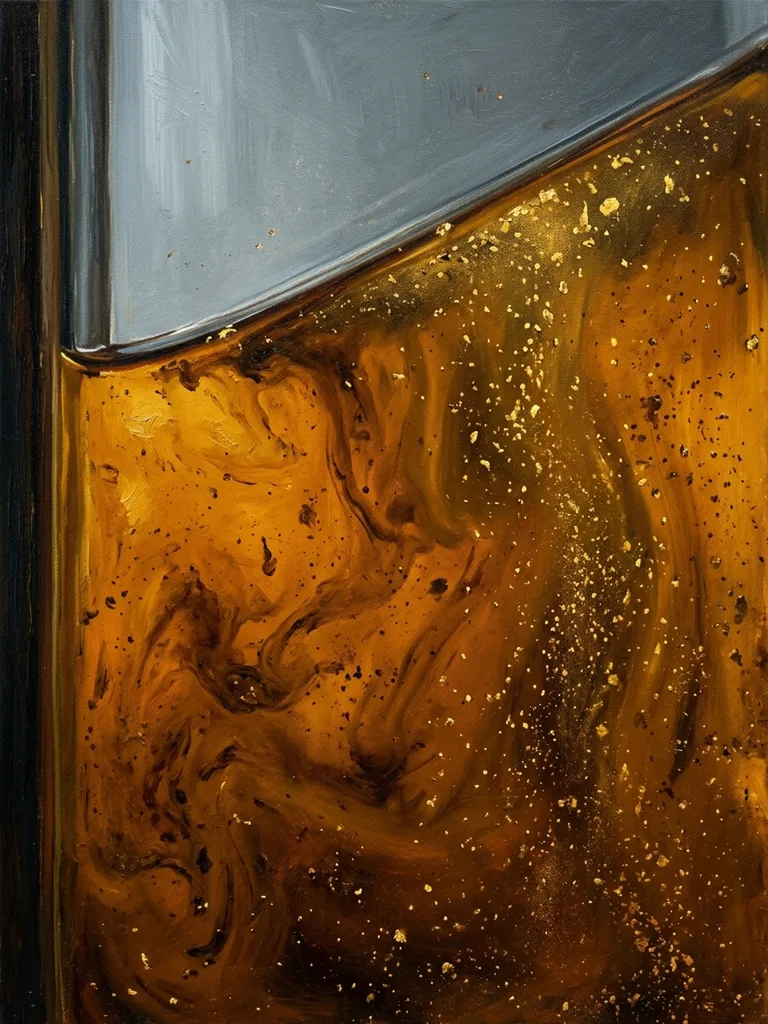
George de Hevesy, a Hungarian chemist working in Copenhagen with Niels Bohr, the Danish physicist who won the 1922 Nobel, woke up on 9 April 1940 to German troops entering Denmark and to two gold medals that were not his sitting in a laboratory drawer. He put them in acid that same morning so that nobody could find them. The flask with the solution, a dirty orange, stayed five years on a shelf at the institute, in plain view of anyone who walked in, and nobody ever asked what was inside it.
Both medals were Nobel Prizes. One belonged to Max von Laue, the German physicist who won the 1914 Physics Prize for working out how X-rays bend as they pass through a crystal. The other belonged to James Franck, German as well, Physics Nobel in 1925 for measuring how electrons collide with atoms. Both men had sent them to Bohr for safekeeping, and not out of sentiment: taking gold out of Nazi Germany was a crime, and a medal with the laureate's name engraved on the rim is a piece of evidence that arrives with the sender's address already on it. Laue, besides, had never bothered to hide what he thought of the regime, and in 1940 that was already a line in a file.
The trouble with keeping gold is that gold refuses to be kept. Burying it in the institute's garden was an idea that would also occur to the first soldier with a spade. De Hevesy chose acid. He used aqua regia, a mixture of nitric and hydrochloric acid that the alchemists named royal water precisely because it dissolves the metal of kings, the only ordinary acid that can break gold down. The two medals took their time disappearing, because gold resists even that, and what was left was an entirely unremarkable liquid.
There it stayed. In 1943, when the Germans began arresting Danish Jews, de Hevesy crossed into Sweden and settled in Stockholm. That year's Nobel Prize in Chemistry ended up being his, a year late: he was given it for inventing the use of isotopes as tracers — that is, for marking an atom so it can be followed inside a living body. He left without the flask. There was not much to take anyway: a container with an orange residue does not go into a suitcase that is going to be opened at a border.
He came back when the war ended. The flask was where he had left it, untouched, on the same shelf. De Hevesy precipitated the gold — brought it back to solid form by adding a reducing agent, first-year chemistry — and sent the recovered metal to the Nobel Foundation in Stockholm.
The Foundation recast the gold and in 1952 gave Franck and Laue their medals back: they received them twice, twelve years apart, and from the same metal.