 Margen
Serialized book · From the Margen catalogue
Nine blank prescriptions are left in the pad
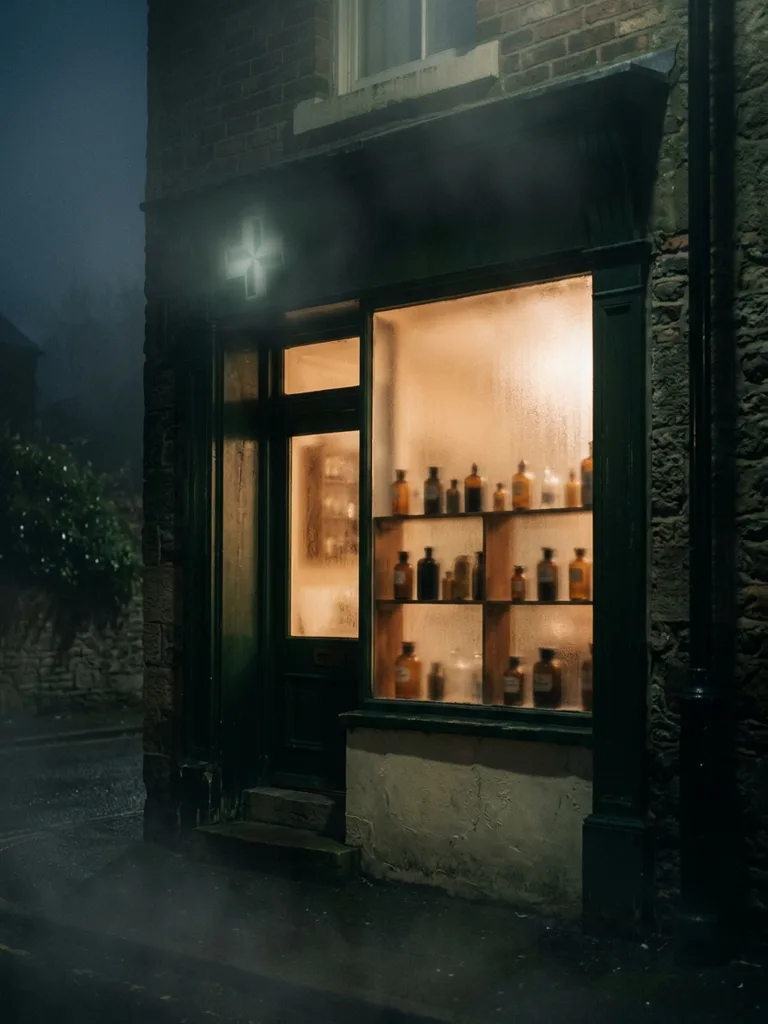
Previously: Simón Goñi, a baker, twice saw Rosalía Sagasti, a retired nurse, drop envelopes with prescriptions into the pharmacy's letter slot.
On Friday, with four days to go until the inspection on the 26th, Águeda Mendioroz, the licensed pharmacist of the only chemist's in Valdecierzo, rang the area health management office at a quarter past nine and asked for billing.
"Marcial Beloki, prescription billing at the management office, you know who I am," said the voice. "Yesterday I said I would look into it and I have."
"Then tell me, I'm alone at the counter."
Beloki made a noise of approval, or of air, and Águeda heard keys on the other end.
"You wanted to know who tipped us off," he said.
"I want to know who tipped you off."
"Nobody."
Águeda leaned on the corner of the counter, next to the baby scales nobody uses any more.
"What do you mean, nobody?"
"Nobody, Águeda. There's no complaint. There's no letter. There's no phone call. What there is, is a cross-check."
He explained the cross-check twice, the second time more slowly, because the first time it was obvious she was hearing it from somewhere else. Every prescription dispensed in a pharmacy enters the billing system with the registration number of the doctor who signs it. Until this year, that file was only cross-checked against the register of doctors in active practice. The cross-check against removals — retirements, transfers, deaths — was brought in during January, once a quarter. The first one came out in April.
"Thirty-one came up," said Beloki. "All with the same number. 31.0448."
"Braulio Sagasti."
"Braulio Sagasti, yes. Removed on death in March 2024. The program doesn't know who Braulio Sagasti is, all right? The program knows that 31.0448 is off the register and that 31.0448 has signed thirty-one prescriptions since. That's everything it knows."
"And why is the inspection now, if that came up in April?"
"Because the alert went out on the fourteenth of April and on the fourteenth of April there were forty-two alerts ahead of it in the queue. There are three of us. The twenty-sixth is the day your pharmacy got, no more and no less. I'm telling you so you can sleep: you haven't been reported. You're on a list."
For ten days Águeda had been looking at the people of the village differently. She had looked at the woman in the butcher's, who owed her four boxes of gauze. She had looked at Itziar Lizarraga, the pharmacist out at the junction, who was the one who returned two prescriptions and who, in her head, had every motive. She had even looked at her own father, the man who painted the green door in 1996 and who still comes down to ask how much has been sold.
"Marcial."
"Go ahead."
"Do all the regions run those cross-checks?"
"All of them. And next year it'll be monthly." He typed again. "Look, I'll tell you something that isn't on record anywhere. In the six years I've been here, what's come up for you I've seen four times. None of them was fraud. Three were fat-finger errors entering the number. And one was a village."
"One was a village?"
"One was a village," said Beloki.
He hung up, or the line dropped, which at the management office you never know.
At half past one Águeda pulled the shutter half down, crossed the road and climbed the three steps of the house that stands against the doctor's. The door was open, like every door in the lower quarter between one and three.
Rosalía Sagasti, seventy-one, nurse at the Valdecierzo surgery for thirty-four years and retired for three, was peeling a pear over a plate.
"Come in, Águeda. Have you eaten?"
"I'm not here to eat."
"I know." She left the knife on the plate, not on the oilcloth. "Did Simón tell you?"
Águeda stayed on her feet.
"Simón Goñi told me, yes. The baker."
"I know who Simón is." Rosalía wiped her hands on her apron. "He's been leaving my bread at the door for nine years so I don't have to open it in my dressing gown. I've given him two chances to ask me and he's never asked. Sit down."
Águeda sat. The kitchen smelled of pear and bleach, and on the sideboard was still the tin box where the doctor kept his pay envelopes.
"Rosalía, on the twenty-sixth an inspector is coming. Her name is Petra Aldunate. She's going to look at thirty-one prescriptions. They'll all be there."
"They'll all be there," Rosalía repeated. "I haven't hidden a single one."
"How long has it been?"
"Since the fifteenth of July 2024. Four months after my brother died." She said it the way dates are said when they have been thought about a great deal. "Balbina Ochandiano ran out of digoxin the Thursday before. Eighty-four years old, on her own, up in the high quarter, with the heart she has. The area doctor comes on Tuesdays and Fridays, twenty-two kilometres away, and doesn't have her file. I told her to go and she went, and she came back with a piece of paper to book an appointment for another day. I'd been keeping Balbina's blood pressure and doses in a notebook since 1991."
"The grey notebook."
"The grey notebook." Rosalía looked at the half-peeled pear. "I haven't prescribed anything new. Not an antibiotic, not a painkiller, not a sleeping pill. I've renewed what Braulio and I had already put them on. Eleven people. All over seventy-five. All living alone."
"It's a crime."
"I know that. I'm a nurse, not a fool." She stood up. "And whoever does it knowing it is one does it anyway, but doesn't lie to herself."
She went to the sideboard, opened the bottom drawer, the stiff one, and came back with one of those old elastic-band folders. Inside was the official pad: green, with the health service letterhead and the surgery's rubber stamp tucked under the same band.
"This came out of the medicine cabinet before they arrived," she said. "The secretary signed the record on the twelfth of April and put down both serial numbers; on the eighteenth the van took the boxes away and reported no material. I had the key to the medicine cabinet, Águeda. Nobody ever asked me about it."
She put the pad down on the oilcloth and opened it where the band was.
"Twenty fit in here," she said. "They're used up from the top."
She went through the sheets with her thumb, unhurried, counting under her breath. At the end she raised her head.
"Nine blank ones left," said Rosalía. "I've counted them every night since Thursday."