 Margen
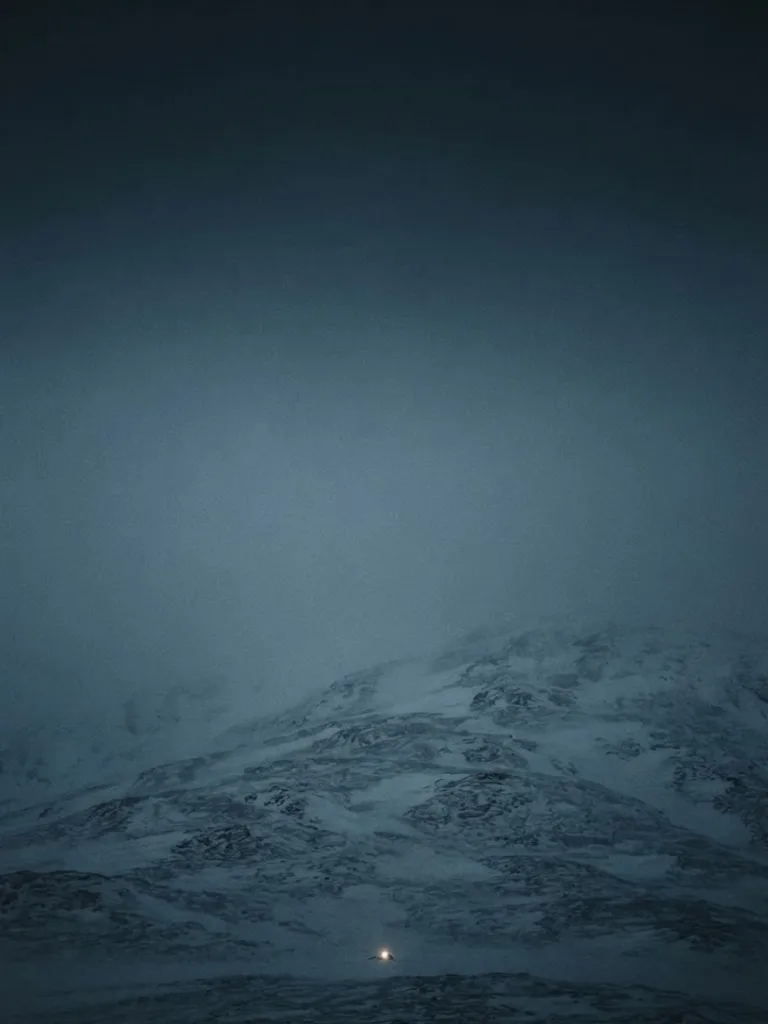
At seventeen minutes past ten, the Iratxeta refuge had diesel for twelve days. At 2,100 metres, the snow hit the west wall first with a low sound that set the glasses in the dining room rattling.
Idoia Bergara, the warden of the refuge, lifted her head before the second blow. Thirty-nine years old, an emergency nurse until 2019. She recognised the avalanche by how long it lasted: not a crack, not a gust, but a sustained pressure against the stone, as though someone were leaning a shoulder on the building and were in no hurry at all.
The door of the entrance hall bowed inwards. Two bolts sprang loose and the leaf was held by the crossbar alone. Three pans came down in the kitchen. The light flickered, came back and wavered again. From the telephone room came a dry snap. Idoia crossed the dining room without running, shut off the main valve of the cooking gas and told everyone to move away from the windows on the slope side.
She looked at the clock. Ten eighteen. She started with the people. She went round touching shoulders, looking into pupils and asking for complete answers, because a split eyebrow, two sore hands and quick breathing all fit comfortably behind an I'm fine. She found no blood and no deformities. Aitor Sein, seventeen years old, a trainee warden that season, had banged a knee against a bench. He could put weight on it.
At twenty past ten she checked the kitchen and the generator room. No smell of fuel, no water on the floor, no blown fuses. She switched off the generator so as to hear the building without its rattle. She went over the storeroom walls, the roof joints and the back door. The main exit did not give a centimetre when she pushed the bar: packed snow covered the bottom half of it from outside.
She went up to the high dormitory and opened a shutter just enough. The access path had disappeared under a compact tongue of snow and branches. The telephone pole was leaning and had pulled the two copper wires out of their terminals. Idoia noted down the time and the damage in her red-covered notebook.
At twenty-eight minutes past ten she switched on the emergency radio, extended the aerial, gave her identification and waited. A broken voice came back from the repeater. She repeated position, number of people, medical condition and damage until the other side confirmed between cut-outs: message received, ground access closed, helicopter impossible while the snowfalls continued. The first flying window was eleven or twelve days away.
Thirteen minutes had gone by. Idoia gathered everyone in the dining room and took the roll by name. Txomin Elordi, shepherd, has been carrying the club's post up since 1994. Fani Quiroga, geologist, had arrived the day before to change some sensors. Aitor answered after her and flexed his knee to prove that it held. Mercedes Arriaga, a retired justice of the peace, was next to the stove. Ramiro Bouzas, mountaineer and boat carpenter, was still on his feet. Lena Bouzas, mountaineer and anaesthetist, Ramiro's sister, was rubbing her forearms. Casimiro Lete, seventy-one years old, a club member, the only one who had come up with a pencil of his own, closed the roll.
Eight people.
"I need to know how much fuel we have," said Idoia. "Until I know, nothing gets switched on unless it is essential."
She went to the tank with Fani. The side sight glass read two hundred and forty litres, twelve twenty-litre jerricans' worth. Idoia checked it with the dipstick as well, because the impact could have shifted the gauge, and the diesel mark came out at the same height. Then she looked at the consumption notes: five litres an hour with lights, water pumps and heating.
They went back to the dining room. Idoia wrote the sum out on a large sheet and left it in the middle of the table, where everyone could see it: two hundred and forty divided by five, forty-eight hours of generator. At four hours a day, twelve days. Two at dawn to warm the building and move the water, two at the end of the afternoon to cook and charge batteries.
"Four hours is very little," said Mercedes.
"It is what gets us to day twelve with enough left to start the engine," Idoia answered. "If we spend more now, later there is nowhere to buy it."
Lena was cold. You could see it in her stiff fingers and in the way she held her elbows, and she did not ask for anything to be switched on. Idoia brought her a blanket and Lena took it without a word. Then she felt around Aitor's kneecap and ruled out any urgent injury.
Ramiro pointed at the buried door.
"We can get out through the top, cross to Larrondo and go down today. Every hour we wait, the snow walls us in a little more."
Txomin leaned over the map pinned to the wall.
"Nobody goes down the Larrondo couloir. The new snow has settled on top of the old and has not bonded. The first weight that goes in releases it."
"You haven't seen it from outside."
"I have seen which side took the avalanche and which way the wind is blowing. That's enough for me."
"I've been down that couloir four times."
"In March. And with the old snow settled." Txomin put his finger on the map and left it there. "Today it is a different couloir."
Ramiro rested his hands on the table and took them off again.
"There are eight people in here, one with a knee and one who is already shivering."
"And if you go and we bury you, there are seven and a warden climbing up to look for you," said Txomin.
"Nobody goes out," Idoia cut in. "We have no continuous radio, the normal route is covered and a second mass could come down. When the slope stops loading, we go out and take a look. Not today."
For the next hour they worked with their gloves and coats on. Ramiro cut two battens and shored up the hall door without drilling into the stone. Fani marked three old cracks in the storeroom with a pencil to see whether they grew. Mercedes counted a hundred and six full rations, food for more days than the fuel, though not many more. Aitor gathered the batteries beside the radio, the charged ones on one side and the spent ones on the other. Lena left eight numbered medical cards on top of the first aid kit. Casimiro asked for a pencil, checked that it wrote and noted on the first line the exact time of the last shutdown.
He had come up to Iratxeta for thirty winters. He did not mention it.
At twelve, Idoia gave a short update over the radio: roll call, minor injuries, telephone cut, access covered, forty-eight hours of generator. She wrote down the reply and put the set away with one battery in and another in reserve. Then she ran the generator for twenty minutes to pump water to the upper tank, and Casimiro timed the consumption from the engine's first turn.
When the pumping ended, the dining room cooled down fast again. Idoia went over the tasks, corrected two figures in the inventory and slid the rationing sheet into a plastic sleeve. She still had the report for the club to do: the people, with their time of arrival, and the damage.
She took out the signature book and sat down under the single battery lamp. She copied the names one by one, resting the tip of the pencil on each line so as not to skip any. When she reached the bottom she went back to the top and counted them again, touching one line at a time.
In the book there were nine signatures dated today. In the dining room there were eight people.