 Margen
Did you know? · From the Margen catalogue
Who sent half of London to number 54 in 1810?
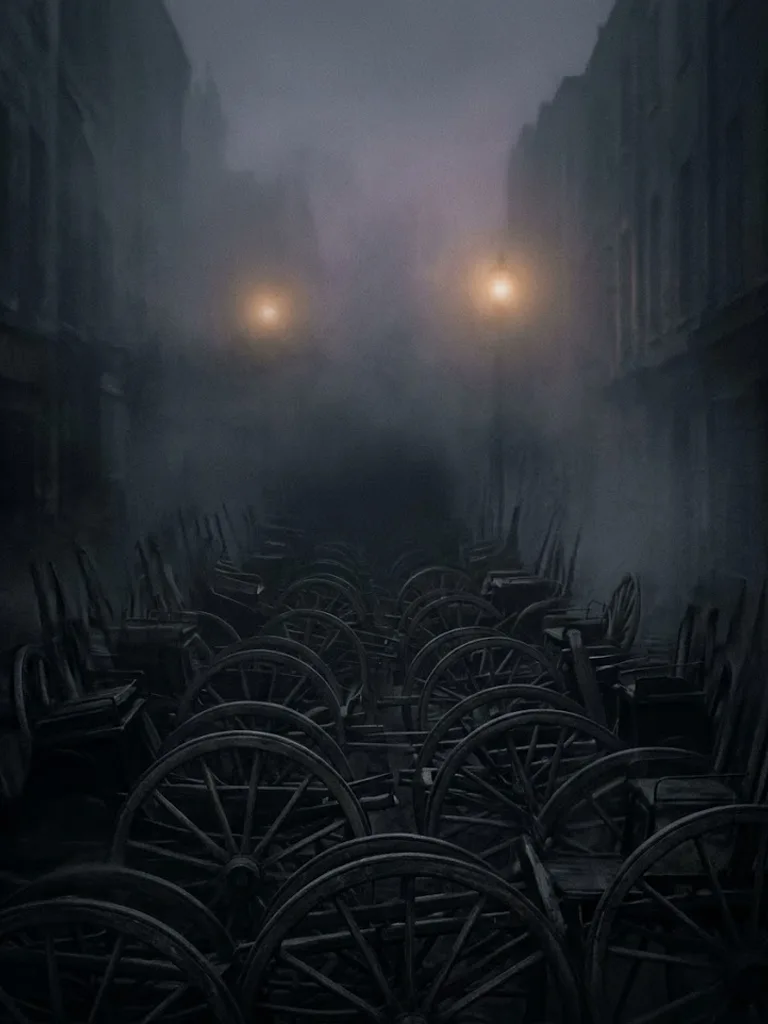
At five in the morning on 27 November 1810, a chimney sweep knocked at the door of 54 Berners Street, London, and said he had an appointment. Mrs Tottenham, a widow who lived there with her servants, replied that she had not called for any chimney sweep. The man left grumbling. A few minutes later another chimney sweep arrived. And behind him, a third.
At seven the coal carts began. According to the newspapers of those days they came one after another, with the sacks ordered and paid for, each carter demanding to unload at number 54 because that was where he had been sent. Then came the pastry cooks with wedding cakes. Then the shoemakers with lasts, the wooden moulds of the foot. Then an organ builder, the piano makers, upholsterers with chairs, fishmongers with crates that had to go on ice at once, and a butcher with a loin of pork ordered for a banquet.
Berners Street was a narrow street of brick houses north of Oxford Street. By mid-morning it was impassable. The carts that could not unload blocked the ones behind, and the ones behind could not turn round either, not in a street that width. The neighbours came to their windows and stayed there. It was the best free show in London that Tuesday.
Through the afternoon doctors, lawyers, clergymen and undertakers' men went on knocking. In the course of a single day the widow was offered a coffin made to measure, a mourning carriage, a consignment of wine, apprentices for a trade she did not have, and the services of a midwife. Officers had to be brought from the Marlborough Street station to sort out the traffic of a street that had no business having traffic, and they stayed there until well into the night. The last caller, it is said, arrived after midnight.
Of that parade, what the newspapers of the time report is trades —sweeps, carters, pastry cooks, doctors, undertakers— and one grand visit: the press of 28 November 1810 records that of the Lord Mayor of London. The other grandees the tale is usually dressed in, the Governor of the Bank of England, the Duke of York and the Archbishop of Canterbury, entered the story in accounts written decades later.
Who had summoned all those people?
He was called Theodore Edward Hook, he was 22, he wrote musical comedies with fair success for his age, and he was known in the drawing rooms for how easily he improvised songs about whoever happened to be present. According to his biographer, Hook had bet a friend that he could turn any house in London, picked at random, into the most famous address in the city within a week. They walked along Berners Street, he pointed at number 54, and he set to work. They rented a room in the house opposite for the appointed day and spent it at the window.
The work was letter-writing: weeks of it by hand, each to a different supplier, all signed with Mrs Tottenham's name, all with an appointment for a different hour of 27 November. One sweep at five. Another at a quarter past five. The coal at seven. The cakes at nine. What turned the prank into a jam was the staggering. The appointments did not pile up by chance: the hours were spread from before dawn until night, so that each trade arrived while the previous one was still unloading. The house received a nineteen-hour drip.
The prank, besides, could only work in a city without telephones. In 1810 a written order was confirmed by going to see it: the supplier received a letter with an address and an hour, loaded the cart and turned up. Checking beforehand meant sending someone to ask and losing half a morning, more than half the orders were worth. Hook did not forge anything difficult: he forged the one thing nobody verified.
No case was opened against Hook. None is on record: no newspaper of those days registers any proceedings and the injured party made no claim. He had not entered the house, had not stolen, had not threatened and had not signed a document with any financial value. The letters carried someone else's name, but none of them claimed money from anybody, and the suppliers had come of their own accord and at their own cost. By the time the authorship began to circulate in the clubs, he had already gone off to the country for a season to let the matter pass.
The ones who paid for the prank were the people who worked. The chimney sweep lost his morning and the morning's wage. The coal carter unloaded somewhere else or went home with a full cart, and coal that is not unloaded is not paid for. The pastry cooks had cakes made, with the sugar already bought, that were going to no wedding. The fishmongers were carrying stock that would last a day. The butcher was left with the banquet's loin. Nobody claimed, among other reasons because nobody knew from whom: the letters came signed by a widow who had not written them, and the widow had neither the money to compensate half a street nor the blame to compensate for. The cost was shared out in small instalments among a couple of dozen trades, and that is why it could look as though it came free.
The press of those days has 27 November in it: the address, the widow, the parade of suppliers, the jam, the officers. The number of letters, by contrast, changes with whoever writes it down: one thousand, two thousand, four thousand. Nobody counted them, and there is nowhere to check.
The authorship was fixed in writing in 1849, thirty-nine years after the prank and eight after Hook's death, in the biography the Barham family brought out: The Life and Remains of Theodore Edward Hook. The father, Richard Harris Barham, clergyman and writer, had been a friend of Hook's and wrote about him when Hook died in 1841; the 1849 volume was finished by his son, who signs the edition. The book set the episode down as typical of the friend and gave it the details that are repeated today. London's most famous prank is proved by a book of memoirs. It stands because it was told by someone in a position to know, and because the events in the street were indeed reported by the newspapers, each with its own version.
Impunity did not last Hook for everything. In 1813, aged 24 and with no known accounting experience, the government appointed him treasurer and accountant general of Mauritius, a colony recently taken from France in the Indian Ocean. He lasted four years. In 1817 a hole of some twelve thousand pounds appeared in his accounts which he could not explain; he was sent back to London and an inquiry was opened. It was never proved that he had kept the money; he was held responsible for not knowing where it was, which as far as debt goes comes to the same thing. By then he had already founded and edited a political weekly, John Bull, which started in 1820. He spent two years in prison for debt, between 1823 and 1825, and went on bringing the weekly out from inside. On his release he wrote novels at speed, was paid well for them and died in 1841, aged 52, insolvent all the same.
Almost nothing more is known of Mrs Tottenham. She received no compensation, because there were no proceedings. She left no memoirs. All that survives of her is that on a Tuesday in November she had to say no a few dozen times to people who were bringing exactly what she had asked for in writing.
For 27 November, the day that made him famous, Hook never paid anything. For the twelve thousand pounds of Mauritius he paid two years in jail.