 Margen
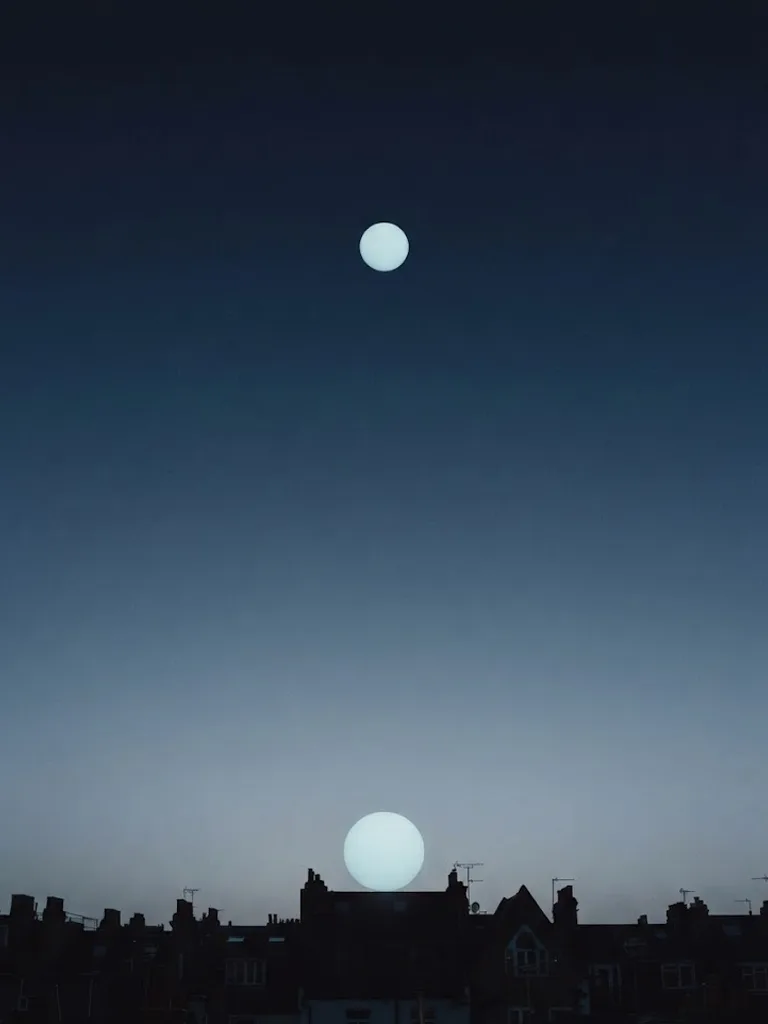
Half a degree: that is how wide the full Moon is, seen from Earth. It is half a degree when it is stuck to the roof across the street and half a degree when it is at the top of the sky, and what difference there is between the two positions runs the opposite way from what your eye tells you. The Moon on the horizon is further from you, and that is why it looks slightly smaller. The measurement has been settled for two thousand years and nobody argues with it. The only thing laboratories still argue about is why we keep seeing it as enormous.
1. The figure. The Moon's angular diameter swings between 29.4 and 33.5 arcminutes depending on where it is in its orbit, averaging around 31 arcminutes, which is half a degree. Its orbit is the only thing that changes its apparent size, and it changes with the month, not with height above the horizon. Half a degree is, so that it fits in your hand, half the width of your little finger held at arm's length.
2. The test you can run tonight. Go out as the Moon is rising, stretch your arm all the way and cover it with your thumbnail. There is nail to spare. Come back three or four hours later, when it is high, and repeat the gesture with your arm just as straight. The same nail to spare. If you have a camera, photograph it in both positions with the same lens and the same zoom, and measure the two discs on the screen: they come out identical, except that the low disc usually looks slightly squashed top and bottom.
3. Why it is further away. When the Moon sits on your horizon, you are looking at it from the edge of the Earth, not from the point on the planet that faces it. That puts one extra Earth radius between you, 6,371 kilometres, on top of a mean distance of 384,400. That works out to almost 1.7% further and therefore 1.7% smaller than the high Moon of the same night. The eye, meanwhile, swears it saw it twice the size.
4. The squashing is not the illusion; it is the opposite. Near the horizon the atmosphere bends the light passing through it and lifts the bottom edge of the disc slightly more than the top. The result is an oval Moon, lower than it is wide: far from enlarging it, the atmosphere takes height off it. Anyone who blames the giant Moon on an atmospheric lens effect has the effect measured and has the sign backwards.
5. So the illusion is in the brain, and it goes back a long way. Ptolemy, the Alexandrian astronomer who fixed the sky for the next thousand years, was already writing about it in the second century, and a fresh explanation has been proposed roughly once a generation since. The family of explanations with the most experimental support is perceived distance: between you and the Moon on the horizon there are roofs, trees, hillsides and bell towers, a staircase of objects of known size that the brain uses to decide how far away what it sees must be; overhead there is none of that. In 1962 two perception psychologists, Lloyd Kaufman and Irvin Rock, published their "artificial moon" experiments in Science: a projected disc that subjects compared with and without terrain in view. With the terrain covered the illusion went away; uncovered, it came back.
6. How to break it in ten seconds, with no instruments. Three tricks that work for the same reason — taking the terrain away from the brain —: look at it through the cardboard tube of a paper roll, which crops the landscape; block out the ground with your open hand, leaving only the sky and the Moon; or bend down and look at it between your own legs, upside down, which is the classic trick and the most effective of the three. In all three cases the Moon shrinks at once, and swells again the moment you uncover the rooftops.
The illusion is not a lunar matter either. The Sun suffers it just the same at dawn, and two stars that look welded together overhead seem to drift apart as they come down to the horizon: the same roof across the street that swells the Moon also pushes the stars away from each other.