 Margen
Did you know? · From the Margen catalogue
Agloe came out of shuffling two mapmakers' initials
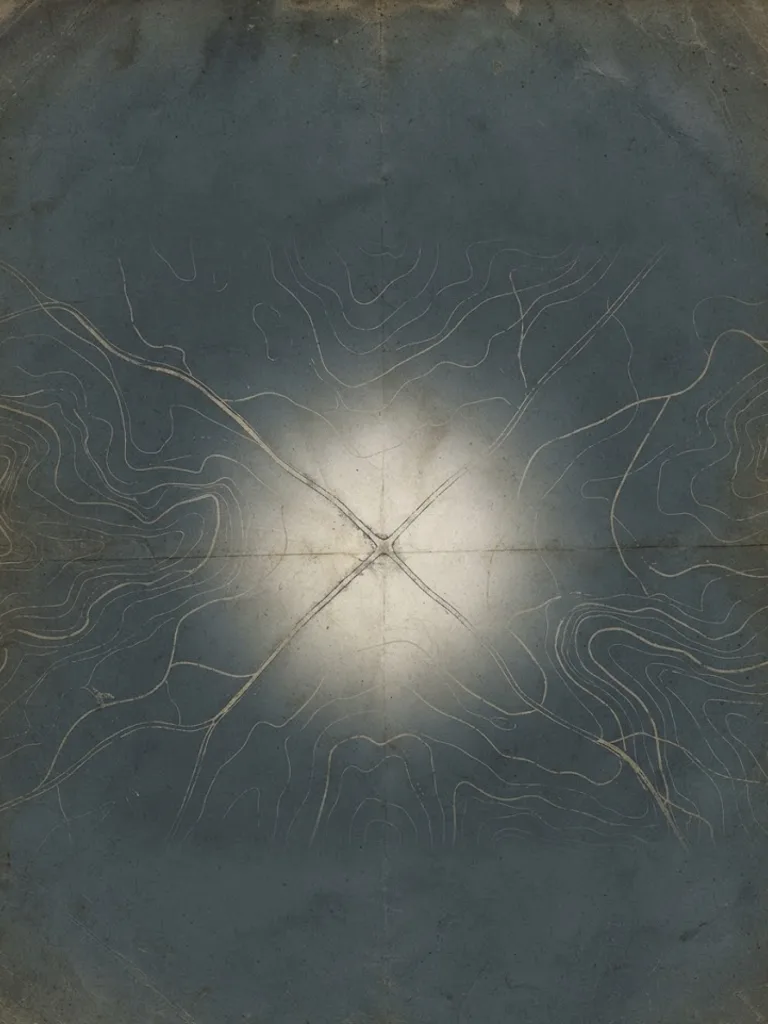
In the 1920s, Otto G. Lindberg and his assistant Ernest Alpers took their initials, O.G.L. and E.A., shuffled them, and got a word: AGLOE. Lindberg ran the General Drafting Company, the outfit that drew the road maps for the oil company Esso, and he needed a way to find out who was copying him. So he put Agloe on the map, at a dirt crossroads north of Roscoe, in Delaware County, up in the mountains of New York State.
A fake town is the one signature the copycat cannot explain. If it turns up on somebody else's map, there is no possible excuse: nobody finds a place on their own that isn't there. People in the trade call them copyright traps, and they have been slipping them in for a century.
The name climbed down off the paper and stayed on the ground: in 1930 a company called Agloe Lodge Farms was set up, bought a local fishing lodge and renamed it the Agloe Lodge. The word Lindberg had manufactured to catch a thief became the address of a place where people went to fish for trout.
From here on comes the famous part, and it is worth saying where it comes from. The story goes that Agloe showed up on a map by Rand McNally, the biggest road-map publisher in the country, that General Drafting accused them of copying, and that Rand McNally defended itself by producing county records where the name already appeared. The mapmaker Frank Brown told that story in 2002, and everyone has copied it from him since. There is no lawsuit, no letter, no file: there is one man who told it.
The neatest version says a shop once opened at the crossroads, the Agloe General Store, and that the shop is what really made the town. At the Colchester Historical Society, which is the body that keeps the papers from those valleys, they went looking and reported what they found: an old postcard of the Agloe Lodge on the Beaverkill, and not one document about any Agloe General Store.
It held on in commercial maps into the 1990s and even made it onto Google Maps, which eventually deleted it.
On 25 February 2014, the United States Geological Survey — which keeps the database of the country's official names, the ones set by the Board on Geographic Names — entered Agloe into the GNIS. The record carries a tag in brackets, put there on purpose: Agloe (Not Official). The town two men invented to catch a copycat has an entry number in the official catalogue of United States place names, and what that entry says is that it isn't official.