 Margen
Serialized book · From the Margen catalogue
Under the oven mouth there is a brick signed in 1974
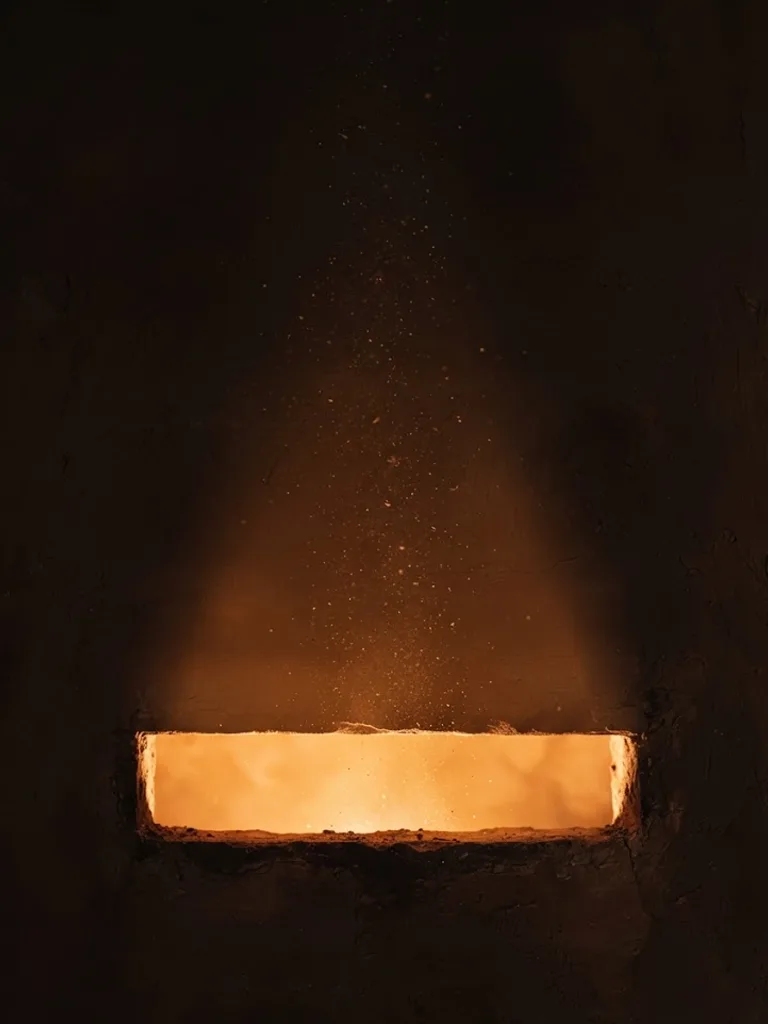
Previously: Paulino Garisoain laid the hearth floor in 1974 and said the ash in the chamber is not beech. Celso has nine schools left.
The nine schools Celso Larrauri, master baker, has left depended on Saturday the 16th on an oven that was out: he had put it out himself at midnight, knowing what it was going to cost him on Monday to start from cold.
On Saturdays the bakery serves no school canteen. It makes three hundred and twenty loaves for the village's two bars and for Mari Carmen's shop, and that is the morning over. It is the only window in the week when the baking chamber can be left to cool without losing a delivery, and Paulino Garisoain had asked for it on Thursday, standing in the yard and before getting into his car, in a single sentence: put it out on Friday and on Saturday I go in.
He arrived at ten past seven with a work torch, a carpenter's folding rule and a foam kneepad tied on with packing tape. Eighty-one years old, thirty-one of them as oven man in this very oven, retired since ninety-nine.
"What's it down to?"
"Sixty-two," said Celso. "I measured it half an hour ago."
"Sixty-two I can take. But I'm not going in yet: the stone keeps giving off heat from below for a good hour after the reading." Paulino put the torch down on the marble counter and took off his coat. "Twenty-five past eight."
Eulogio Satrústegui, dough man, fifty-two years old, thirty-three of them in this house, was finishing the Saturday loaves in the small oven, the two-deck electric one bought for the rolls, which has never produced a loaf like the other. He said nothing. He had said nothing since Friday.
The 1931 oven runs on indirect flame, and that has to be clear before anything else: the fire is not where the bread is. It has its firebox off to one side, behind a brick wall, and the combustion gases travel along flues that pass underneath the hearth floor, heat the stone from below and leave by their own chimney. Inside the chamber, where the bread goes, there should not be a speck of ash.
At a quarter to eight a white Opel nobody expected on a Saturday came into the yard, and Tránsito Chamorro got out of it.
Fifty-two years old, head cook of the Virgen del Puy group, which is four schools and one thousand four hundred and fifty children eating every day. She is by a wide margin the biggest customer the bakery has. She came in without knocking because she has been coming in without knocking for nine years, stood looking at the cold oven and then looked at Celso.
"It's cold."
"Paulino's going in today to look at the hearth floor."
"I know Paulino's going in. Milagros Beunza told me, the cook at the Erreniega school, and your daughter told her." Tránsito Chamorro did not sit down. "Celso, I've come on a Saturday because I don't want to discuss this on the phone with a screen in front of me. On Monday I have a management meeting at head office and they're going to ask me something, and I want to be able to say what you tell me and not what I imagine."
"Ask."
"Is the bread you're serving me this week the same bread as the one in the analysis?"
"No. The loaves from the mouth side have been set aside since Tuesday the fifth and they don't leave this building. That's forty a day and I throw them away myself."
"You throw away forty loaves a day?"
"I throw them away."
Celso took a document folder off the shelf and opened it on the marble: the control record for the last two weeks, batch by batch, with the temperature of each one written in his own hand.
Tránsito Chamorro looked at it without touching it, which is how she reads.
"And why do the ones on that side over-brown?"
"Because the hearth floor spreads the heat badly and what shouldn't get in gets in that way. Today I'll know how much."
"Today."
"Today, when Paulino comes out of there."
"Celso, the inspection is Thursday the twenty-eighth and I have my meeting on Monday the eighteenth." Tránsito finally picked the folder up and handed it back closed. "This is what I'm going to ask you for, and I'm telling you all of it so there are no surprises. On Monday, a written commitment from you: what you are going to fix and by what date. On the twenty-ninth, the real paper, public health's, signed by the inspector, saying the twenty-eighth went well. If that paper is not on my desk on the twenty-ninth, the four schools go to Duero on the first, and not because I want them to, but because I'll be told to."
"The twenty-eighth will go well."
"Tell me that on the twenty-ninth, like Milagros." She put her gloves on at the door and stopped. "And if it does go well, we'll talk about something I'm short of, and I'm not telling you today what it is, because I don't want you counting it as though you already had it."
"Tránsito."
"One last thing. On Wednesday a salesman from Duero rang me and told me you had a file open. He didn't give me a figure. If anybody gives me a figure, I can't wait for the twenty-eighth any more, because it means half the district knows and somebody is going to put it in front of me printed out at a meeting. Do you understand what I'm telling you?"
"I understand."
The Opel left the yard at twenty past eight and Eulogio switched the small oven off without anybody asking him to.
At twenty-five past eight Paulino lay down on the floor in front of the mouth, switched on the torch and put half his body in.
"Izaskun," he said from inside, with the voice of a man talking into a stone wall. "Bring something to write with."
Izaskun Larrauri, twenty-nine, office manager of the bakery and Celso's daughter, came down with the temperature notebook and stood beside her father's legs.
"Go on."
"From the mouth inwards: row one, row two, row three. Write it down." The torch beam moved. "Row three, closed. Row two, all five closed. Row one, four closed and the middle one open."
"One single joint in the whole hearth floor."
"One single one, and it's the one at the mouth. Write down its width: three good millimetres, and twenty-two centimetres long. Everything that comes up from the flues rises through there, and it gets in on one side only."
Izaskun wrote three millimetres and underlined it twice.
At five to ten Paulino was still half inside and had twice asked for the big torch to be brought closer. Izaskun already had three pages of the notebook filled with rows, joints and numbers.
"Come out for a bit, Paulino."
"In a minute."
"You've been in there an hour and a half."
"I've been in there an hour and a half because I'm counting it properly, not by eye." The sound of the folding rule opening against the stone. "A hundred and seventy-five."
"What's a hundred and seventy-five?"
"The firebricks I laid in May 1974, when this whole hearth floor went up."
He came out backwards, slowly, and sat on the floor with the kneepad still on and his hands white with stone dust.
"Celso, sit down, because what I'm about to tell you you only half know."
Celso did not sit down.
"In seventy-four this hearth floor came down through the middle. It didn't crack: it collapsed, because it had been baking for forty-three years and nobody had ever looked at the flues. Your grandfather told me to rebuild it with two labourers and gave me six days, which is as long as a bakery can go without bread. I did it in five. A hundred and seventy-five firebricks that he paid for with a three-year loan from the savings bank, and there's paper on that somewhere."
"I was six years old."
"You were six years old and you used to bring me the water jug." Paulino wiped his hands on his trousers. "And on the last day, before I closed the row at the mouth, I took a brick, set it in the middle and scratched my name into it with a twenty-penny nail. Paulino Garisoain, May 1974. It's under row one, four bricks in from the face, and it's been down there fifty-one years."
Izaskun stopped writing.
"And why are you telling us now?"
"Because that row has to come up before the twenty-eighth and I want you to know what you're going to find before you find it. A man who signs a thing answers for it."
"Nothing else?" said Izaskun. "On the brick. Did you put anything else?"
Paulino took just long enough to answer for it to show.
"Nothing that's any use to you today."
He got up holding on to the mouth of the oven, took his coat off the marble and went out into the yard with it over his arm. It was the first time all morning he had been on his feet.
"Paulino, how long does it take to change that row?"
"That depends on something you haven't wanted to tell me." He put his coat on at last, slowly, looking not at Celso but at Eulogio, who had come out behind them with the scraper in his hand and was not using it. "On Thursday I put my fingers in the ash in your chamber, smelled them twice and asked you what wood you were burning. You answered beech, and I told you beech doesn't leave that. I didn't call you a liar in front of your daughter, and I'm not doing it today either."
"Paulino."
"The wood invoice from February two years ago. The twenty-tonne one. Bring it to me on Monday and I'll tell you in an afternoon whether it's the row that has to change or the whole oven." He opened the car door and stayed there with his hand on the frame. "And listen to this, which is the only thing I came to say twice: I am not getting under that mouth again without knowing what has been going into those flues for the last two years. Not on Monday, and not on the twenty-seventh."