 Margen
Did you know? · From the Margen catalogue
A helicopter spotted a vegetable patch 250 km from anywhere
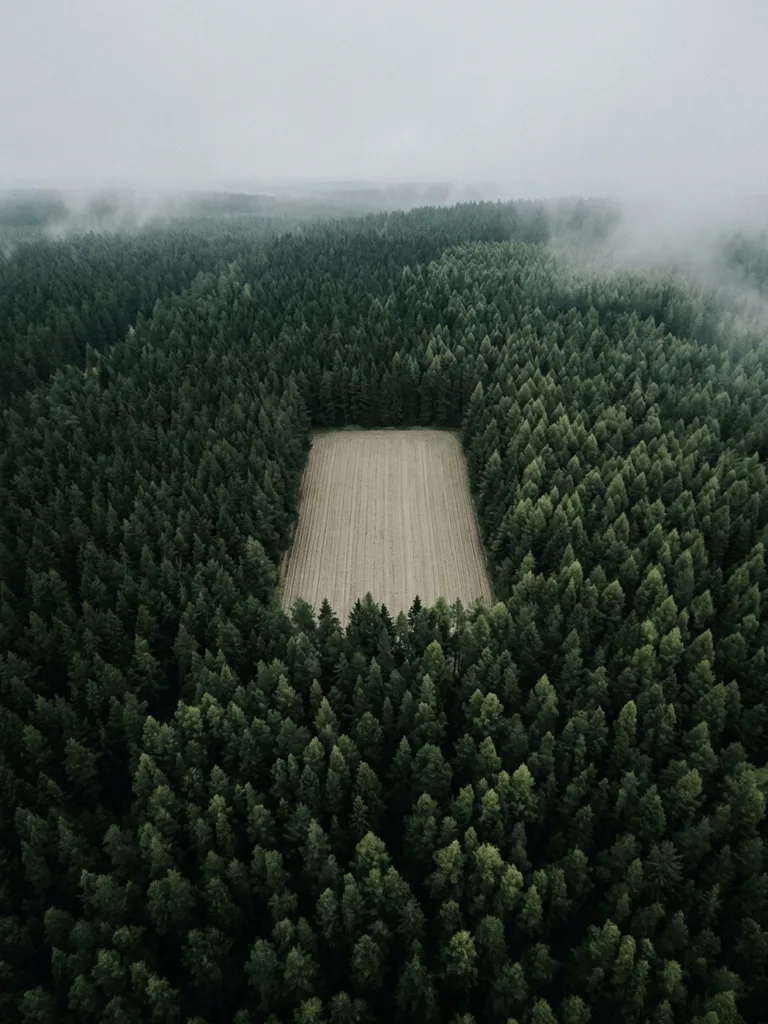
Agafia Lykova lives halfway up a mountainside in the Western Sayan, in southern Siberia, and she is past eighty. She grows potatoes on a terrace cut into the slope, cuts her own firewood, keeps goats and dogs, and the nearest inhabited settlement is some 250 kilometres from her door. She is the last of a family that walked into that forest as four, in 1936, became six inside it and never came out.
The vegetable patch visible from the air was hers. That is the whole answer to the riddle: there was no village and no forestry operation because the people tilling that ground had spent forty-two years hiding from a state that had killed one of their own.
Agafia has been taken off the mountainside several times, always for medical reasons and always with her consent, and she has always gone back. She has turned down offers of a house down in the valley. Her visitors are few: rangers from the nature reserve that surrounds her mountain, the occasional television crew, and for years Yerofei Sedov, one of the geologists who found her in 1978, who lost a leg, settled in a cabin near hers and died there in 2015. They bring her flour, salt, nails, batteries for a radio and candles. She sends back potatoes and pine nuts. The mountain ended up inside a protected area declared in 2001, so the slope the family chose for being unreachable is now protected by law and remains, administratively, a place where nobody lives.
1988
Karp Osipovich Lykov, her father, died on 16 February, in his sleep, in the same log cabin he had built with his hands: twenty-seven years to the day after his wife. The geologists had been coming down from their camp to see him for ten years and had offered many times to move him and his daughter to the valley, to a house with a stove, with neighbours and with a doctor. He said no every single time. They buried him on the slope, and Agafia was left alone.
1981
Between October and December all three of Agafia's siblings died. The first was Dmitry, the family hunter: pneumonia, on 6 October. Then Savin, on 20 December, and Natalia, on the 30th, both of kidney failure, ten days apart.
The geologists had offered a helicopter to take Dmitry to hospital. Dmitry answered that this was not permitted to them, and that a man lives however long God grants him. There has been much argument about whether those three deaths had anything to do with the contact — three years eating bread, sugar and tinned food brought in from outside, and breathing whatever the visitors brought with them — and there is no way to prove it or rule it out.
Of the four siblings, the youngest was left. Karp and Agafia went on sowing the same terrace.
1978
A party of geologists was prospecting for iron ore in the basin of the river Abakan, flying over taiga with no roads, no cables and no aerials. At around 1,800 metres of altitude, on a slope that carried absolutely nothing on any map, the pilot looking for somewhere to set the helicopter down saw a dark, regular rectangle among the cedars: furrows. Somebody had ploughed there.
The geologist Galina Pismenskaya and three colleagues waited for a fine day, filled their packs with gifts in case the place was inhabited, and walked the last few kilometres. They found a one-room cabin, blackened inside by decades of smoke, its floor covered in potato peel and pine-nut shells, and in the doorway a barefoot old man in a hemp shirt patched so many times that the original cloth was no longer visible. He greeted them without apparent surprise and told them that, since they had come all that way, they might as well come in.
Inside were four grown children. Two of them, Dmitry and Agafia, had never in their lives seen a human being from outside their own family. Among themselves they spoke an old, drawn-out, sing-song Russian, and Pismenskaya had to hear whole sentences three times before she caught them.
They did not know there had been a Second World War. They had seen lights crossing the sky since the late fifties and had reached a conclusion on their own: that people outside had invented something and were sending up fires very like stars.
They ate potatoes, rye, hemp seed, pine nuts and whatever Dmitry hunted. Dmitry made his clothes from cloth woven on the loom the family had carried into the forest, could track an elk for days barefoot in the snow until the animal gave out, and slept in the open at forty below. The family had left the village with two metal pots and, when rust holed them, there was no way to replace them: they went over to birch-bark vessels, which cannot take direct fire, and for years they had been unable to boil anything properly.
All four children could read, and the one who taught them was Akulina, their mother. She did it with the gospels the family had carried out on their backs in 1936 and with sharpened birch sticks dipped in honeysuckle juice, which served as both pen and ink. The family kept the church calendar, with its feasts and its fasts, without missing a day, for forty-two consecutive years.
The geologists offered them bread, jam, tea, alcohol. The family refused almost everything on religious grounds — "we are not allowed that" — and accepted the salt. What they did take away from that visit was an astonishment: a piece of cellophane, which Karp held up to the light before ruling, scandalised, that it was glass, but it crumpled.
1961
The previous June it snowed. The snow flattened everything sown and there was no harvest that year. The family ate tree bark, alder leaves, roots, grass shoots and the leather of their own shoes. Akulina Karpovna, the mother, shared out her portion among the children and starved to death on 16 February 1961.
In the ruined field a single ear of rye had managed to come through. They built a fence around it so that mice and squirrels could not touch it, guarded it in shifts day and night, and got eighteen grains from it. With those eighteen grains they rebuilt the crop. It took them several seasons to have enough rye again to eat bread.
1936
Karp Lykov was an Old Believer: a branch of Russian Christianity that broke away from the official Church in the seventeenth century, when Patriarch Nikon reformed the books and the rites, and that had been drifting eastwards ever since in waves, running from fines, taxes and arrests. In the nineteen-thirties Soviet pressure on believers hardened and whole communities dissolved or went into hiding.
One day in 1936, a Communist patrol shot Karp's brother on the outskirts of the village, beside the vegetable garden, in front of him.
Karp took his wife Akulina, his nine-year-old son Savin and his two-year-old daughter Natalia, some seed, two pots, a dismantled loom and whatever they could carry on their backs, and walked into the forest. Every few years they moved deeper and higher, until they reached the slope where they stayed. Dmitry was born there in 1940 and Agafia in 1944.
The journalist Vasily Peskov began publishing all of this in the newspaper Komsomolskaya Pravda in 1982, and later in a book whose Russian title means "Dead End in the Taiga". He climbed up to the slope many times and wrote down what the family told him with the care of a man who knows that nobody will ever be able to check it twice.
In one of those conversations, Karp explained what the worst part of the forty-two years had really been. Not the cold, nor the June snow, nor the hunger of 1961. "Living without salt was true torture," he told him.