 Margen
Did you know? · From the Margen catalogue
33,000 people lived on 2.6 hectares with no plans
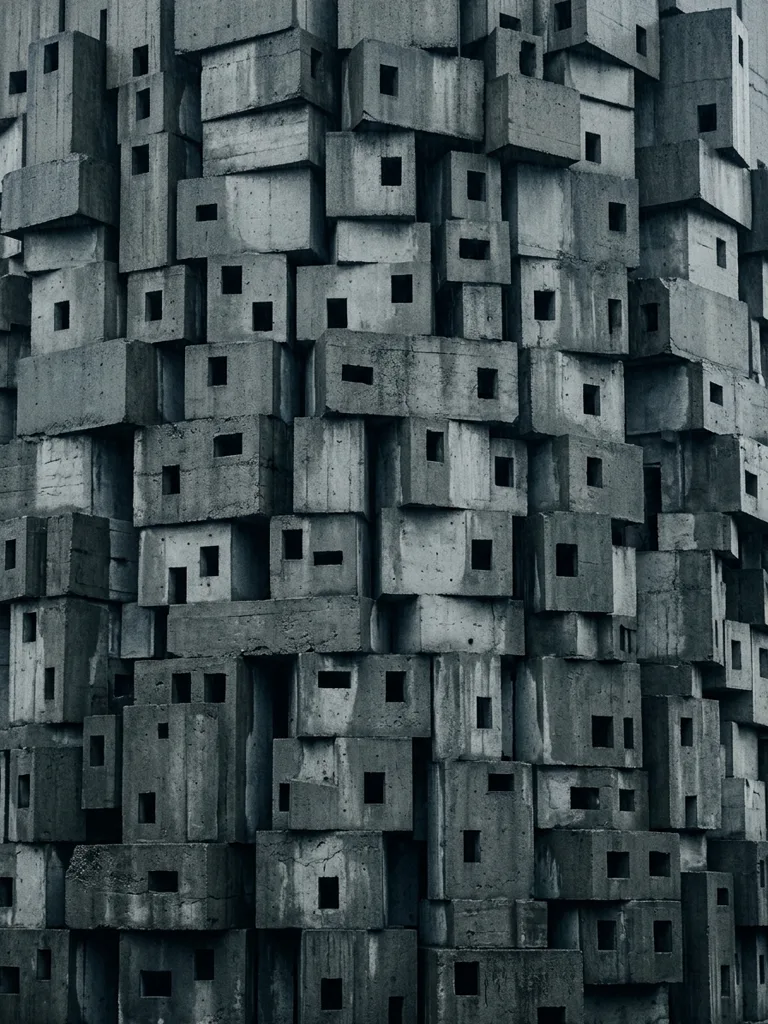
2.6 hectares: the size of three and a half football pitches. Inside lived some 33,000 people — Hong Kong government headcount, 1987 — spread across roughly 350 buildings put up with no plans, no permits and not a single architect. That block was called Kowloon Walled City, and it worked out at 1.2 million inhabitants per square kilometre, the highest density ever measured anywhere people actually lived.
Spread across the ground, each resident got less than one square metre of floor plate. That is why the city could only grow upwards, and it grew by leaning on itself: the buildings propped each other up, with no street between them, until they formed a single solid block with corridors running through it. You went in through a few gaps at street level and carried on down passages where you had to duck your head, with pipes dripping on the back of your neck and the electric light on at midday.
When Britain leased the New Territories in 1898 — the mainland strip north of the Kowloon peninsula — the treaty left out that old Chinese fort, so China kept jurisdiction and London never exercised it. In practice, for decades, neither government went in to inspect anything. There were no building permits and no professional bodies demanding a degree. Dentists who could not get their qualifications recognised in Hong Kong set up one flight up, on the outer façade, the one facing the real street, and advertised on boards at pavement level: they were cheaper, and they worked in full view.
There was one single building rule, and no councillor imposed it: the planes. The Kai Tak runway was about 800 metres away and the jets came over on final approach, so low you could see the rivets. Nobody went above thirteen or fourteen floors.
The roofs were the other ground. Since the sun never reached the bottom, people climbed to the top slab to hang washing, do homework, keep pigeons and smoke. From up there you watched the planes land and heard the concrete shake.
The end came by agreement. On 14 January 1987, London and Beijing jointly announced the demolition. The rehousing ran until July 1992 and the machines finished in April 1994. What stands on that plot today is a Chinese garden in the style of the Qing dynasty, Kowloon Walled City Park, opened by Governor Chris Patten on 22 December 1995, with ponds and a chess pavilion.
Of the 350 buildings, not one remains. As the rubble was cleared, the stone foundations of the original fort's South Gate turned up, buried ever since the Japanese took the wall away to lengthen the airport runway during the occupation. They are where they always were, open to the sky and protected as a monument, and they are the only thing left standing of the Walled City.