 Margen
Did you know? · From the Margen catalogue
Esperance fined NASA for littering and got paid in 2009
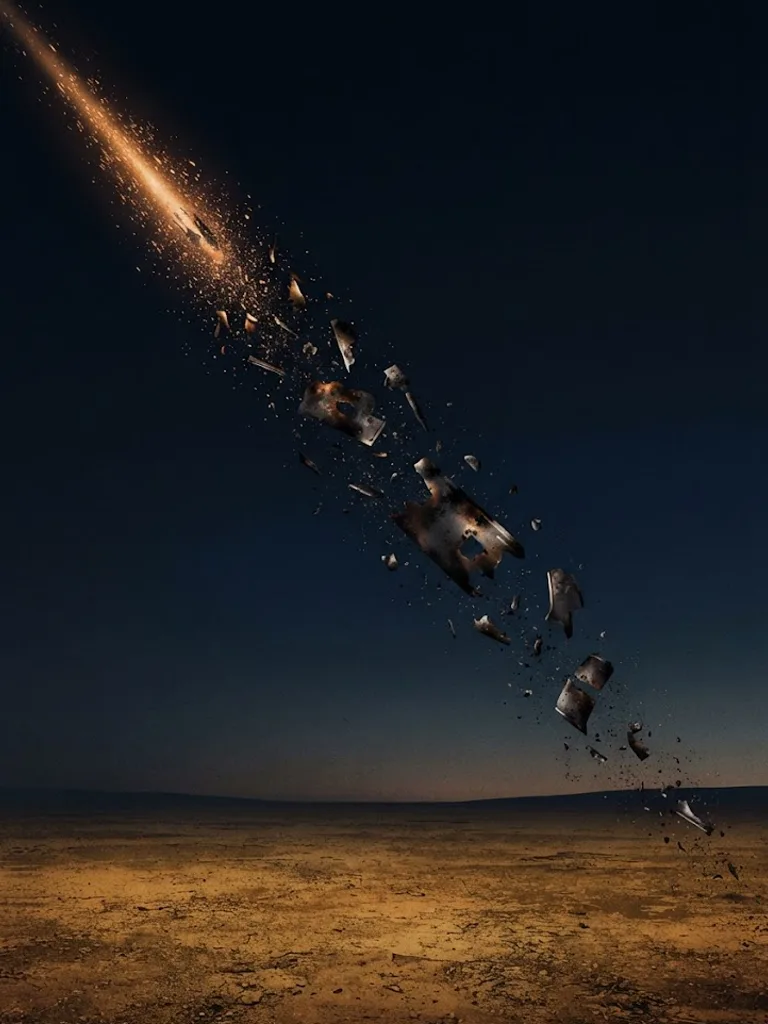
Four hundred Australian dollars reached Esperance in 2009, thirty years after that town in Western Australia issued its most ambitious fine. The cheque was not signed by NASA. It had been raised by Scott Barley, a presenter on Highway Radio, a station in Barstow, California, with contributions from his listeners. Barley flew to Australia and handed it over in person, in the form of a giant novelty cheque.
He had found the debt online: the Shire of Esperance maintained that the United States owed it $400 for littering, and the litter was pieces of a seventy-seven-tonne space station spread across the municipal boundary. He offered to settle it on his show, collected the money and sent it in the space agency's name. The town accepted the payment, and a penalty that began as a joke became a debt paid by a third party.
Sixteen years earlier, in 1993, Geoff and Pauline Grewar spotted one of the station's oxygen tanks while flying over their own farm. It had been lying there for fourteen years and ended up in the Esperance museum, which now holds one of the world's largest collections of Skylab debris.
And a few days after the fall, an Esperance teenager named Stan Thornton scraped up the charred fragments that had landed at his house and took them to the San Francisco Examiner, which had offered 10,000 US dollars to the first person to put a piece on its desk. He flew to San Francisco with help from a Perth radio station and from Qantas; a passport and a visa had to be arranged for him in a hurry. He collected the $10,000.
The fine itself had been handed to NASA by a ranger from the Shire of Esperance, who handed the technicians NASA sent to collect the debris a $400 ticket for dumping rubbish inside the municipal boundary. It was a joke, and the agency treated it as one: it never paid.
All of it began in the early hours of 12 July 1979, local time — in Washington it was still the 11th — when people across Western Australia heard six sonic booms at around half past midnight. Skylab, the first American space station, which had housed three crews, had lost altitude sooner than expected and was breaking up in a re-entry NASA could no longer control.
Flight controllers had oriented the station so the debris would come down over the ocean, but it broke up lower than calculated. The documented debris footprint measured 2,450 miles, almost 4,000 kilometres, and part of it crossed Western Australia.
Nobody was hurt.
NASA managed to put a 77-tonne station into orbit, live in it three times and bring its nine crew members home. To settle its one and only fine for litter falling out of the sky, it needed — without knowing it — a whip-round on a highway radio station in California.