 Margen
Did you know? · From the Margen catalogue
Nobody could read his 37.5 million words until 2024
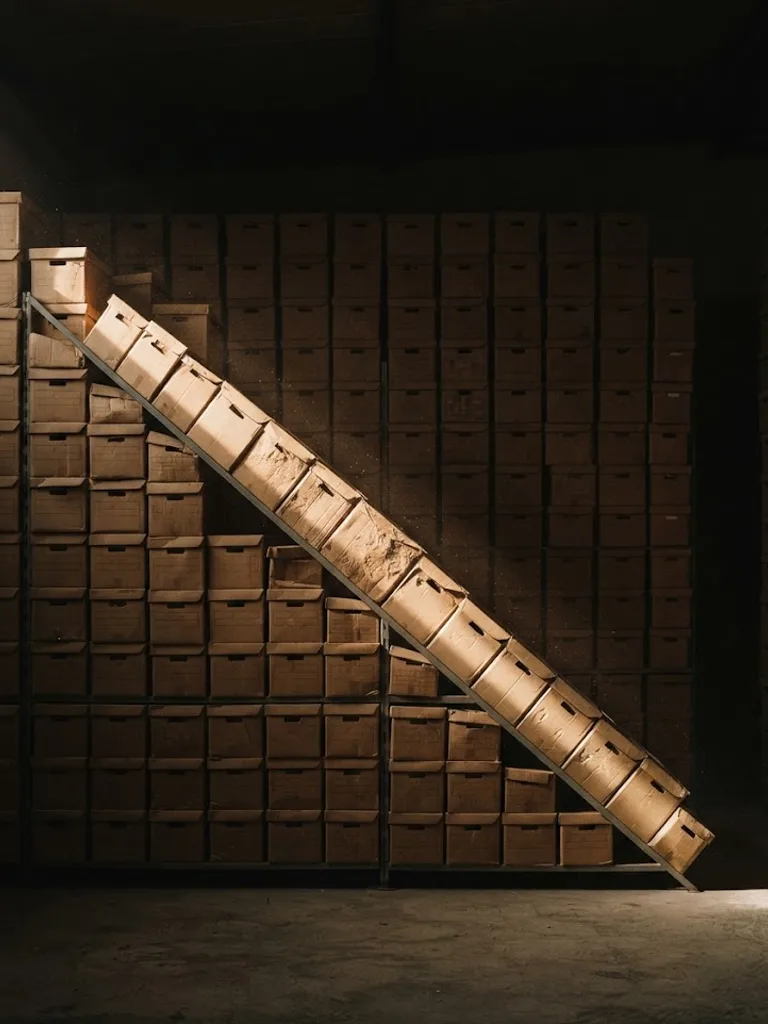
Dayton, Washington, has fewer than 2,700 residents and holds the longest diary ever written; nobody was allowed to read it until 2024. Robert Shields, minister of the town's Congregational church and English teacher at the high school, kept it from 1972 to 1997: some 37.5 million words. For scale, War and Peace runs to about 587,000. Shields wrote War and Peace sixty-four times over without leaving his sun porch.
The diary is written in five-minute blocks, one after another, from the moment he got up to the moment he went to bed. One entry might note that between 7:05 and 7:10 he had weighed himself, and that between 7:10 and 7:15 he had put in a slice of toast and opened the window. He typed for about four hours a day on the glassed-in porch of his house, with several electric typewriters lined up so he never lost time reloading paper, and often in his underwear, because it got hot in there.
He left nothing out. He logged the temperature outside and the temperature of the room, what he ate, his blood pressure, the junk mail that arrived and what he did with it. He taped physical samples of the day onto the pages — labels, clippings, on occasion hairs from his own nose — so that whoever read it would have the evidence too. He slept in two-hour stretches and woke deliberately to get his dreams down before they faded, which is the part of the business his children recounted with the most resignation.
He was asked why, many times. He said that stopping would have been close to being dead, and he also said, more cheerfully, that if anyone wanted to know what an ordinary man did in the twentieth century, there it was, minute by minute. Literature never entered into it: the thing was an inventory, and an inventory is judged by what is not missing from it.
There had been a mild stroke before that, which cut his speed from ninety words a minute to about fifteen and did not stop him. The one in 1997 did: after it he could no longer type, and the diary ended that year, twenty-five years after it began. From 1999 onward he handed it over to Washington State University in Pullman in eight instalments that did not finish until the year he died: ninety-seven cardboard boxes, at least a hundred and twelve linear feet of shelving, some thirty-four metres. And he attached a condition the university accepted: none of it was to be opened while he or his wife was alive.
He died in 2007, aged eighty-nine. The researchers opening those boxes today are not finding the life of an extraordinary man. They are finding the most meticulous record in existence of what goes on inside an ordinary house in a small town: the bills, the toast, the supermarket flyers. Historical archives are built by throwing things out: somebody decides a 1974 dry-cleaning ticket is worth nothing, and the ticket disappears. Shields did not throw out the dry-cleaning ticket.
37.5 million words in twenty-five years works out at around 4,100 a day, every day, flu days included. Grace Shields, his wife, died on 17 April 2024, and with her the last standing condition lifted. The ninety-seven boxes have been coming open one by one ever since, on the fourth floor of Holland Library.