 Margen
Serialized book · From the Margen catalogue
At twenty to seven the eight of us were in the kitchen
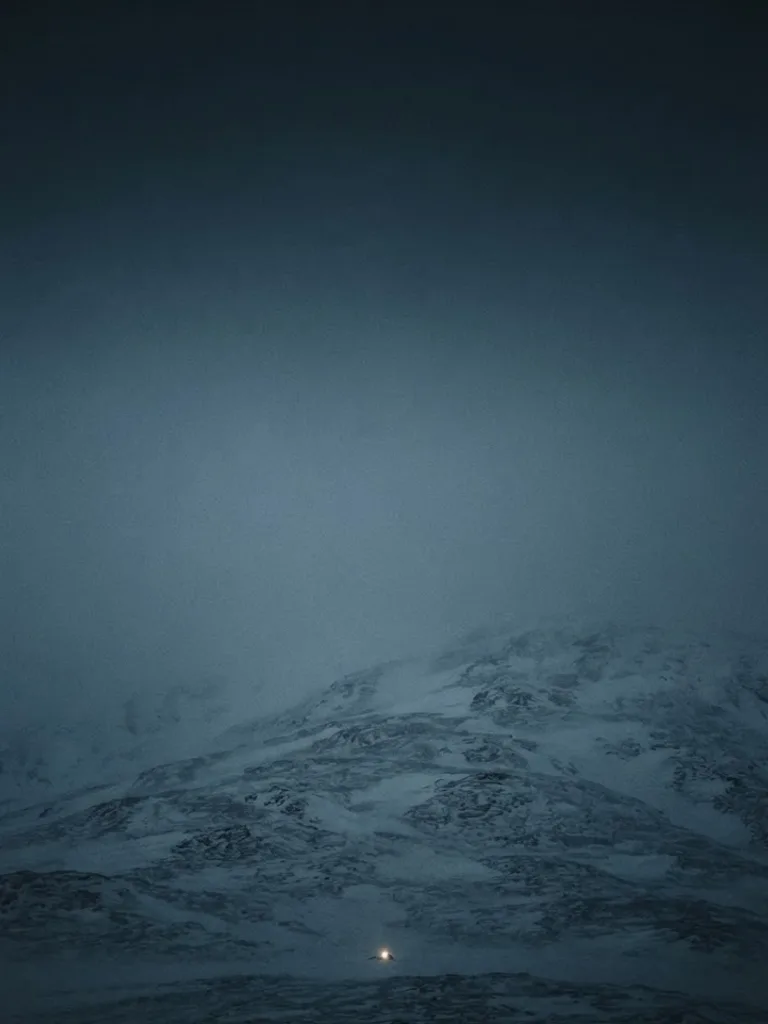
Previously: an avalanche cut off the Iratxeta refuge, at 2,100 metres, the day before, with eight people inside and diesel for twelve days.
At seven in the morning on the second day there was diesel left for eleven. Idoia Bergara, warden of the refuge and an emergency nurse until 2019, had slept three hours with the signature book under her arm, and woke with the same count that had kept her up half the night: nine names, eight people.
It was not an addition error. She had gone over it four times under the battery lamp, touching line by line with the tip of the pencil. Nine signatures dated the previous day, the day of the avalanche. And in the dining room, counting those snoring on the benches and the one keeping watch by the stove, eight.
The Iratxeta book is not a visitors' notebook. It is the mountain club's compulsory register: everyone who comes up writes their name, their time of arrival and, if they are a member, their number. Idoia has kept it since she became warden, and she keeps it well, because the reports come out of that book and the rescues come out of the reports. One signature too many in a refuge sealed by snow is not an anecdote: it is someone nobody can account for.
She started with the time. Almost all the lines had a time of arrival from the previous day, written in different hands: ten past nine, half past nine, a quarter to ten. People had come up over the course of the morning, before the weather closed in completely at ten seventeen. But one line, the seventh from the top, had a time that fit none of the others: 06:40. Twenty to seven in the morning. And the signature, a cramped stroke slanting backwards, looked like none of the other eight.
Idoia woke the others one by one, without alarm, using the water count as an excuse. She did not want the word "signature" running round the dining room before she had something firm to say. To each of them she asked the same question, wrapped in others: where were you yesterday at twenty to seven in the morning.
Txomin Elordi, a shepherd, has carried the club's mail up to Iratxeta since 1994 and knows the refuge better than his own hut. At twenty to seven, he said, he was in the kitchen, lighting the gas stove and putting water on for everyone, as he does every morning he sleeps up there. He remembered it precisely because at that hour the club radio gives the snow report, and he had listened to the whole thing.
—Alone? —Idoia asked.
—Not at all. Almost all of us were already there. The lad helped me with the pots.
The lad was Aitor Sein, seventeen, a trainee from the guides' school and the son of a local guide. He confirmed the business with the water and added a detail: at twenty to seven he had gone twice to the woodshed for kindling, and the second time he had crossed Casimiro Lete in the doorway.
Casimiro Lete, seventy-one, a club member for more winters than he admits, confirmed it in his own way, without looking at her:
—At that hour I was already up, yes. In the kitchen, with the boy and with Txomin. I haven't slept more than five hours since I buried my wife.
Idoia went on adding people to the kitchen of twenty to seven. Mercedes Arriaga, a retired justice of the peace, had come down early because her hip ached on the pallet and she preferred the bench by the stove; she remembered seeing Txomin with the radio pressed to his ear. Ramiro Bouzas, a mountaineer and riverside carpenter, and his sister Lena Bouzas, a mountaineer and anaesthetist, had risen early together to check the boots and the gear before attempting the descent, and at twenty to seven they were arguing in low voices, at the long table, over whether to wait. Fani Quiroga, a twenty-eight-year-old geologist who had come up to change the slope's sensors, had fallen asleep over her field notebook at that same table and woke, she said, to the noise of the pots and the voice on the radio; that is, at the hour of the report.
Idoia did the sum slowly, because it was a sum she did not like. At twenty to seven on the morning of the avalanche, the eight people now alive in the refuge were together, all eight, in the same room: the kitchen and the dining room, which in Iratxeta are the same space with a half-height partition. They could see one another. No one got up to sign anything in the vestibule, where the book's lectern stands, because no one had any reason to sign at twenty to seven: they had all come up and signed the day before, in broad daylight, with their late-morning times.
And yet, in the book, dated the previous day and timed at 06:40, there was a ninth signature.
She went back to the lectern with Mercedes, who of all of them best knew how to read a document. The retired judge ran her finger along the spine of the book and held the binding up against the light of the lamp.
—No page torn out —she said—. None glued in. The book is what it is. This line was written here, on this page, with this pencil or one just like it. —She brought the signature to the light—. And it was written the right way up, with the book resting on the lectern, not any old how. Whoever did it was standing there, taking their time.
—At twenty to seven —said Idoia.
—At twenty to seven —Mercedes repeated—. When the eight of us who are alive were in the kitchen, in each other's sight. None of us wrote that line, Idoia. It's materially impossible: there was no one else in the kitchen we couldn't account for, and in the vestibule, at that hour, none of the eight were there.
Idoia looked at the cramped signature, the backward stroke, the impossible time. The debt that had kept her awake half the night —whose is the ninth signature— had just been settled from the worst side. It was not a botched sum or an absent-minded member who signed twice. It was a ninth person, real, who had climbed to Iratxeta before dawn on the day of the avalanche, planted themselves at the lectern with the refuge still dark and written their name at twenty to seven.
And since ten seventeen that morning, when the avalanche sealed the door and no one came in or went out again, that ninth person had to be still inside the mountain. In the refuge, closed by the snow, they did not turn up. Outside, in that weather, you don't survive a night.
Mercedes closed the book and set it on the lectern with both hands, the way you set down a file that is going to make work.
Idoia ran through the map of the refuge in her head, which she knows by heart. The dining room and the kitchen, with the eight in view. The two bunk rooms, which she had checked herself doing the night count. The little generator room, locked with a key only she has. The washroom. And, outside the main door —the one the avalanche had sealed—, two spaces that open on their own from the outside: the equipment store and the woodshed, the latter with a low hatch onto the western side, the one that had taken the blow of the snow.
—I counted the bunk rooms myself last night, bed by bed —she said—. In here, on the beds and the benches, we're eight. If there's a ninth person, they're not where we looked yesterday.
Aitor Sein, the trainee, looked up from the bench. He had been quiet for a while, with the face of someone who remembers something and isn't sure it's worth saying.
—The woodshed —he said—. Yesterday morning I went down twice for kindling and the western hatch was ajar. I thought I'd left it that way myself. Since the avalanche I haven't gone back down: the wood in here lasts us for today.
No one said anything for a moment. Txomin Elordi, the shepherd, who in thirty winters had seen people come into that refuge half frozen without warning, was the one who put into words what Idoia was thinking.
—If someone came up before dawn, in that cold, and signed at twenty to seven —he said—, it's because they were after shelter. And if they're not with us, it's because they got into the one place with a roof you can enter without going through the big door.
Idoia looked towards the partition, towards the lower part of the house, where a short stair goes down to the woodshed. She took the battery lamp from the lectern and checked it still had charge.
—There's one more person up here —she said, in a low voice, so it wouldn't cross the partition—. And they're not in the dining room.