 Margen
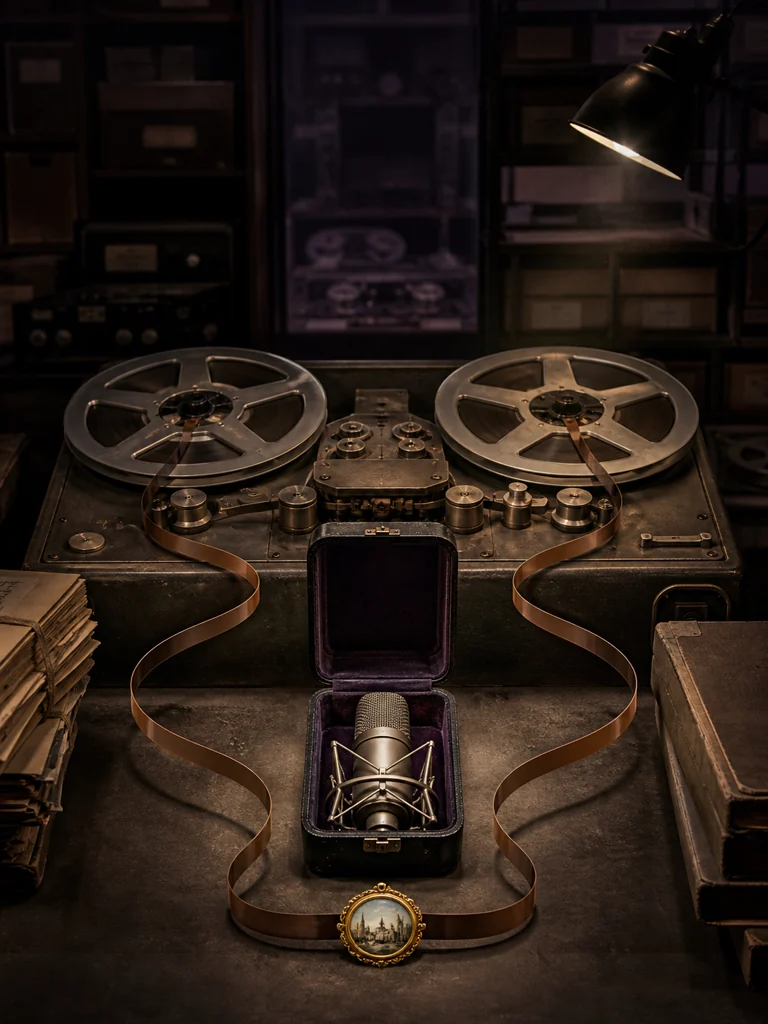
The woman on the tape said, “The envelope is still under seat fourteen. If Requena comes, don’t give it to him.” Vega drew her hands away from the table. Through the headphones, she had just heard her own voice recorded in 1987. She had been born in 1992.
Saúl Benet stopped the tape recorder. He was a documentary producer and had been renting that studio by the hour for a week. On the floor lay thirty cassettes from Radio San Telmo, bought along with the archive of a retired technician. He wanted to turn them into a three-part series about programmes that had never been broadcast. Vega, a sound editor, was responsible for listening to them, cleaning them up and dating them.
“Play it again,” she said.
“We’ve played it four times.”
“Five won’t bankrupt us.”
The line returned, with a short breath before “seat”. Then someone struck a music stand and a man’s voice asked her to begin again from “if Requena comes”. The woman repeated the line more slowly. It was neither a clandestine call nor a conversation captured by accident. They were rehearsing.
A typewritten label on the box read VOICE TESTS. Underneath, in pen: 14 / ORBE / H. ROLDÁN. Vega read the initials without saying anything. Her mother’s name was Helena Roldán, and she had worked as an administrator at a radio station during the 1980s. At home, she had never mentioned a microphone.
Saúl raised his phone to photograph the box.
“Wait.”
“It’s only the record card.”
“It has her name on it.”
“Which makes it a very good record card.”
Vega removed the cassette from the machine and slipped it into her jacket pocket. Saúl stared at her, alarmed by the gesture.
“That material isn’t yours.”
“Nor is it yours to turn into a trailer before we know what it says.”
Their contract allowed them to digitise the tapes and use extracts from the collection. It did not settle what they should do when a discarded voice test pointed to the sound editor’s mother. Saúl had paid the rent, the rights and two months of research. Vega could walk away and leave him the rest of the reels, but the voice was already out.
She opened the cassette. The shell had no screws; its tabs had to be separated with a fine pick. Inside, she found a folded strip of paper placed there to stop the tape from knocking against the case. It was not a hidden message. It was a torn corner of a script: “Palacio Orbe, scene 6. Clara returns to the stalls.” A cast list remained on the back. Helena was listed as Clara. Beside her name, someone had written “too young to sound tired”.
“Your mother acted,” Saúl said.
“My mother gets nervous ordering bread.”
“Both things can fit inside one person.”
Vega returned the paper to the table. Saúl searched for Palacio Orbe in the digital newspaper archive. He found advertisements for a touring company and a report from 1987: the radio station had been preparing a weekly drama, but the sponsor withdrew before the premiere. No episode was broadcast. Helena’s name did not appear in the report.
They had one hour of studio time left. They listened to the complete tape without speaking. Helena tested five scenes. In one she played an old woman; in another, a girl calling from a railway station. Halfway through side B, the director praised her laugh, and she answered with a burst of laughter Vega knew from the kitchen at home. The resemblance did not depend on a line or a filter. It was there in the way they both bit into their r sounds and drew breath before a long word.
When they reached the end, Saúl returned to the first scene.
“This opens the episode.”
“Not until I’ve spoken to her.”
“If she says no, what do we do?”
“You find another tape.”
“There isn’t another one with this story.”
“You still don’t know what the story is.”
Helena lived twenty minutes away. Vega did not want to call her from the studio. She arrived at her flat with the cassette inside a transparent bag, holding it away from her body. Her mother was trimming green beans over a sheet of newspaper.
“Palacio Orbe?” Vega asked.
The knife stopped halfway along a pod.
“Where did you get that?”
Vega put the tape into a small player. Six seconds were enough for Helena. She sat down, wiped the blade of the knife with her thumb and asked Vega to stop it.
“You weren’t an administrator,” Vega said.
“I was that too. Nine to five. The tests were at night.”
Helena had studied acting without telling her parents. At Radio San Telmo, she recorded advertisements, station idents and pilots that paid little. Palacio Orbe was going to be her first named role. The scriptwriter had not written the line about the envelope. Two pages were missing during the rehearsal, and the director asked them to improvise a farewell.
Requena was a real agent. A week earlier, he had left an offer of a touring role for Helena beneath seat fourteen at the Mirall Theatre. She collected the envelope, read the dates and returned it. Her father was ill, her wages paid part of the rent and the tour lasted nine months. During the rehearsal, she used the surname because it had lodged painfully in her mind. Afterwards, she asked to repeat the take with the correct script. Tape fourteen preserved both versions.
“Did you stay because of Granddad?” Vega asked.
“I stayed because I was frightened and because he was ill. In that order on some days; the other way round on others.”
“And why didn’t you go back?”
Helena picked up another bean.
“Because the next year I was already ashamed to say I wanted to go back. Then I met your father. Then you were born. People line the years up one after another, and it looks as though they form a decision. I was just making it to Friday.”
Vega explained the documentary to her. Helena did not want the tape presented as the sad secret of a self-sacrificing mother. Nor did she want to conceal that she had acted. She asked to hear the other tests before deciding. On Sunday, the three of them met at the studio: Helena, Vega and the voice from 1987. Saúl stayed in the booth with his microphone switched off.
On tape seventeen, Helena imitated a referee. On tape twenty-two, she sang a jingle for a mattress shop and stumbled three times over “ergonomic”. She laughed until she cried. When they reached tape fourteen, she no longer asked them to stop it.
“You can use it,” she said, “but no violins underneath. And say that I returned the envelope because I was scared. Don’t turn me into a saint.”
Saúl switched on the intercom.
“Would you like to say it yourself?”
Helena looked at Vega.
“If she records me.”
The interview lasted forty minutes. Helena spoke about the night-time tests, her wages at the station and Requena. When she ran out of words, Vega did not fill the gap with a question. She waited on the other side of the glass. Saúl crossed the phrase “a career abandoned for love” out of the script and wrote “an actress who returned a tour”.
Before leaving, Helena asked for a copy of all her tests. Vega prepared a folder organised by date and number, but her mother renamed the files: “referee”, “mattresses”, “tired woman”. They played the jingle once more through the large speakers. Saúl, who had already switched off the camera, had to leave the booth because the three mistakes on “ergonomic” kept making him laugh during the take.
Vega asked whether she wanted to look for Requena. Helena shook her head. Thirty-nine years had passed, and she did not need to turn the tour into a belated second chance. She wanted the recording, a meal and enough time to catch the bus home. She put the original cassette in the bag and handed Vega the digital copy.
Two weeks later, they edited the first episode. Tape fourteen opened with the envelope and the seat. Then Helena came in, now sixty-seven years old: “That young woman is me trying to sound tired.” Vega left the two voices together, without an echo effect and without explaining the resemblance.
During the final listen, Helena pointed to a breath in the old take.
“You do the same thing there.”
Vega rewound and leaned towards the monitor. The woman from 1987 drew breath before saying Requena. In the booth, Helena breathed with her. Vega pressed record.