 Margen
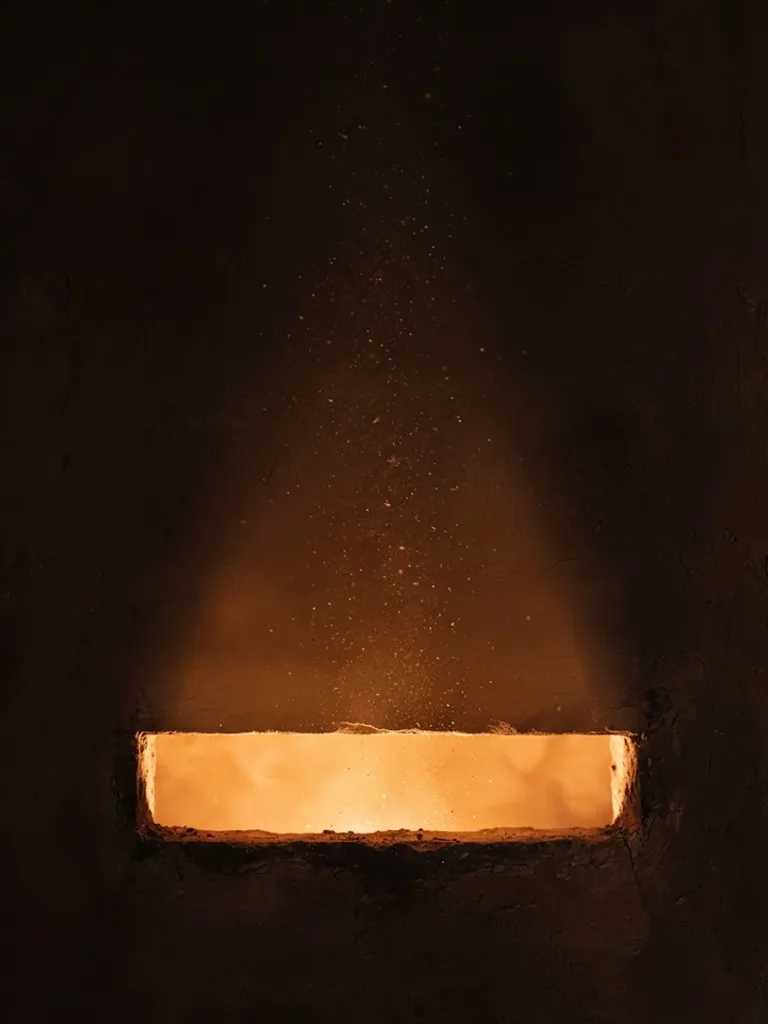
Previously: Celso Larrauri, master baker, bakes for eleven schools. A test found 3.1 micrograms of benzopyrene in the crust and he held back forty loaves.
Begoña Carrascosa did not take out the inspection form. The first thing she did, forty minutes after coming in, was ask for a chair and sit two metres from the mouth of the oven, with the fire lit and the bread for all eleven schools inside.
“Carry on,” she said. “Do what you would do if I weren't here.”
Begoña Carrascosa, forty-four, public health inspector for the district, had asked twice on the telephone for the oven to be lit when she arrived. A cold oven is measured with a thermometer and written into a box. A lit oven is watched.
Eulogio Satrústegui, the dough man, went on cutting as though there were nobody else in the bakehouse, which is his way of being uncomfortable. Izaskun Larrauri, twenty-nine, the office administrator and the one who had brought the folders down, stayed on her feet by the office door with her laptop closed for once.
The oven is from 1931 and it is an indirect-fired oven. That means the fire is not where the bread is: it has its own firebox to one side, behind a brick wall, and the combustion gases go out through flues that run beneath the floor of the chamber to the chimney, which has its own draught. The bread above takes heat from the brick, not the smoke. By design, there is nothing in that chamber but hot brick and bread.
Begoña knew that before arriving, because she had asked. But she wanted to see minute eleven.
Eleven minutes into the bake, Celso put in the peel and began turning the trays one by one, front to back, saying nothing.
“Stop there,” she said. “Why are you doing that?”
“So it comes out even.”
“And you didn't use to?”
“I didn't use to need to.”
“Since when do you need to?”
Celso leaned the peel against the marble.
“Since the autumn.”
“And it costs you.”
“Twelve minutes a bake. Four bakes. Forty-eight minutes a day.”
Begoña noted it in a small notebook, not on the form. Then she asked him to finish the bake without turning anything else.
When the time came, she told him to take out two loaves: one from the mouth side and one from the back, the chimney side, and not to choose. Celso drew out the first and stood it on edge on the marble. He pushed the peel to the back and drew out the second.
The one from the mouth side had a crust the colour of wet brick. The one from the back was pale.
Begoña got up from the chair for the first time in an hour. She took the dark one, turned it over and ran her finger along the base, exactly as Eulogio had done two days earlier, though she did not know anyone had already done it.
“This is ash.”
“Yes.”
“Fine ash. And it is inside the chamber.” She said it without raising her voice, looking at the loaf, not at Celso. “Señor Larrauri, you are a master baker: in this oven the fire does not get into the chamber. Do you confirm that?”
“It doesn't get in.”
“Then something does.”
She took a spatula and a sealable bag out of her case, scraped the grey ring off the base, closed the bag and wrote on the label the date, the time and which side of the oven the loaf had come from. Then she did the same with a sample from the pale one, so as to have both.
“This doesn't go to the same laboratory as the schools' bread,” she said. “This goes to find out what is being burned. And it takes just as long.”
Before opening the folder she did the round she always does: flour, water, salt, yeast, temperatures, delivery book. She did it standing up and noted everything in the small notebook.
“Flour?”
“Two suppliers. My daughter has the delivery notes.”
“And the wood?”
“Beech. Twenty tonnes a year.”
“One supplier only?”
“One.”
She wrote it under the temperatures, on the same line as the water, and moved on.
Then she turned towards the trough.
“You're the dough man.”
Eulogio Satrústegui wiped his hands on his apron before answering.
“Since I was nineteen.”
“Has anything changed in the dough in the last year? Hydration, times, yeast, water temperature.”
“Nothing.”
“Nothing at all?”
“The dough is my father-in-law's. The only thing I've changed in thirty-three years is the brand of the tying twine.”
“And does the bread come out the same?”
Eulogio looked at Celso, and then he looked at the dark loaf on the marble, and he took as long to answer as somebody takes who does not want to lie and does not want to say it.
“The bread comes out the same until it goes in there.”
Begoña underlined that sentence in the notebook. It was the only one she underlined all morning.
And then, at last, she opened the folder.
“The test on the batch from Tuesday the twelfth of last month. Crust: three point one. Crumb: nothing. You've read it, haven't you?”
“My daughter read it.”
“Then I'll explain it to the two of you.” Begoña laid the sheet on the marble, beside the two loaves. “Benzo(a)pyrene is a polycyclic aromatic hydrocarbon. It appears when something burns badly, with too little air, and it settles on the surface of whatever is nearby. That is why it is in the crust and not in the crumb. In your oven it should never touch the bread, because the smoke runs underneath. There it is, in the crust.”
Celso had both hands in his apron.
“There's no limit for bread,” he said. “My daughter looked it up. There's no figure for bread in the European rules.”
“There isn't.”
“Then I haven't done anything wrong.”
Begoña did not argue it back quickly. She took her time, like somebody who has said that sentence many times and knows the first version is no use.
“There is a figure for smoked meat and fish: two micrograms per kilo. There is a figure, lower, for cereal-based baby food. For bread there is no figure, that's true.” She took two steps and stood beside the dark loaf. “But having no figure is not the same as having no rule. The contaminants regulation forbids placing on the market a food containing a contaminant at a level unacceptable for public health, and it requires that level to be kept as low as can reasonably be achieved by applying good practice. That is not a figure. It is an obligation.”
“But then you can't write anything on that paper.”
“I don't need a figure for bread. I need you to explain to me why your bread has this in it, and I need it gone.”
Izaskun came away from the door jamb and up to the marble.
“And if we don't know why?”
“Then we find out.” Begoña looked at her. “You're the one who keeps the paperwork, aren't you? Then write this down: uneven browning, ash on the base on the mouth side, manual compensation since the autumn. Those three things together have an explanation, and the explanation is in this oven.”
Eulogio had stopped cutting. He did it without looking at anyone, as if he had simply run out of dough.
“I'll tell you what I can do today, and then what I am going to do,” Begoña went on. “I can write this up and suspend the business this very morning, as a precaution. Let me tell you what happens if I do. Eleven school canteens have no bread at midday: that is four thousand children, and one thousand four hundred and fifty of them are from the Virgen del Puy group, which is four of the eleven. The canteens would ring another supplier this afternoon, and the other supplier does not give customers back. And in here there are nine wage packets.”
“I know,” said Celso.
“You know and I know. That is why I am not going to do it. But I am not going to not do it for free.”
She took out the form, propped it on the folder and started writing standing up.
Izaskun asked what she was going to put. Begoña read it aloud as she wrote, which is what people do once they have been to court for not doing it: that the bakehouse stays open; that supply to the eleven centres is maintained; that the business must submit a technical explanation of where the contaminant comes from and correct it; and that crust sampling will be repeated at a second visit.
“And how long do we have?”
“Twenty-one days.”
“Why twenty-one?”
“Because that is how long the laboratory takes to give me back a crust.” Begoña looked up from the paper. “If I give you fifteen, the second sample doesn't reach me in time and I have to give you a third visit. If I give you forty, that is forty days of bread with this in it for four thousand children. Twenty-one is what fits.”
She wrote both dates in the box at the bottom, in figures, from the 7th to the 28th, and turned the form round on the marble so Celso could sign it beside the two loaves.
Celso read the box before signing. Three Thursdays exactly.
“The twenty-eighth.”
“Thursday the twenty-eighth, first thing, with the oven lit again. And until that day you go on baking for all eleven.”