 Margen
Short story · From the Margen catalogue
Forty-one trout go up in nine minutes and not one more
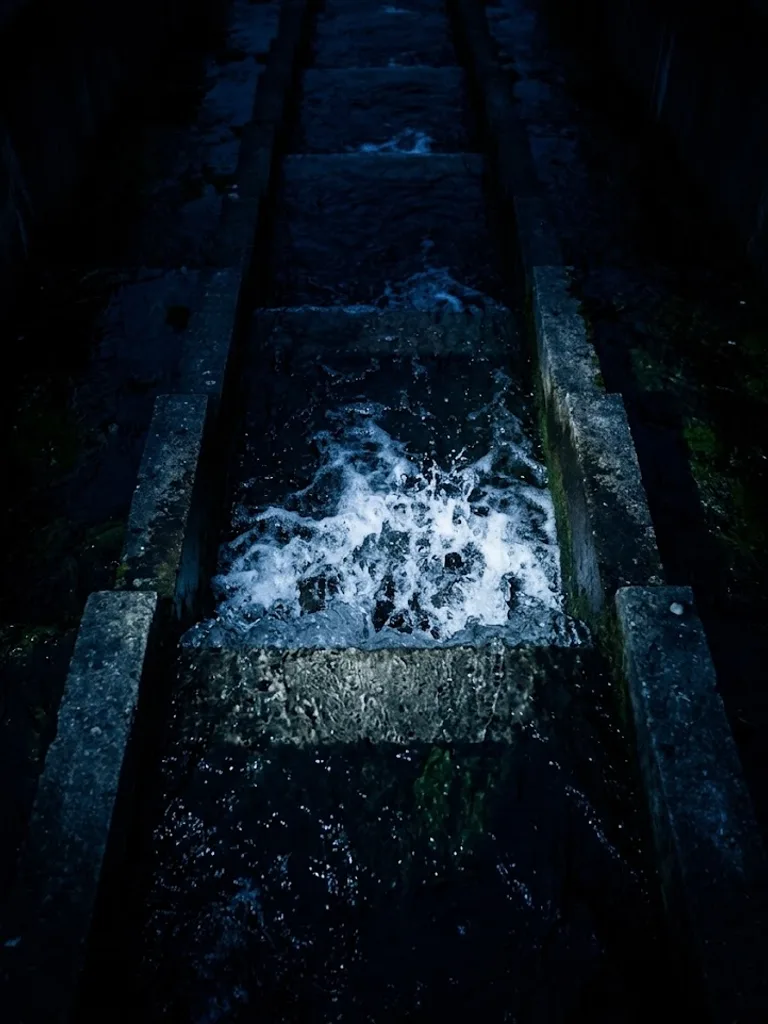
2 November, Monday. 18:40.
First night at the Zubielqui weir, the two-and-a-half-metre wall that has crossed the river since 1954. I bolt the counting camera to the bottom mouth of the fish pass — the staircase of successive pools the trout is supposed to climb — right above the entrance slot, which is where a fish pushes its nose in if it finds it. Infrared trigger, new card, fifteen nights of fieldwork.
My name is Maialen Zabaleta and the job fits in one sentence: say whether the pass built here last year for a hundred and eighty thousand euros gets fish up the weir or does not. Eighteen pools one after another, and it is immaculate. It is the model the river authority, the body that manages the river, wants to repeat at nine more weirs in the basin. That is why they sent me and not an intern.
19:10. Uxue Arregui, river warden for this stretch, twenty-nine, drives up with me to leave the car.
"How many are you expecting?"
"In a pass that works, a hundred and fifty in fifteen nights."
"I have spent three autumns watching the pool down there and I can tell you how many go up: none." She stops the engine without turning the lights off. "And I wrote it up. A report last September, with photographs. They told me the pass was new and certified and that what I was looking at were fish waiting for a rise in the river."
"And what do you want me to write?"
"That the pass does not work. For three years I have been the girl who does not understand hydraulics."
4 November. Count: 0.
I go down to the pool at seven in the morning with polarised glasses, the ones that cut the glare off the water and let you see the bottom. Fifty or sixty adult trout, three and four years old, holding still nose-first against the current some seventy metres below the weir. They are exactly where Uxue says they are every autumn. The odd thing is that they do not even try: a trout that wants to climb a wall throws itself at the wall, and these do not move.
5 November. Count: 0.
Teodoro Irisarri, forty-seven, runs the Zubielqui micro power station, the brick building on the far bank that turbines the weir's water to make electricity. He shows me the water licence framed on the machine-room wall: fourteen hundred litres a second. The fish pass keeps a hundred and eighty, the attraction flow, the jet that has to come out of the bottom mouth so that the fish can find it.
"A hundred and eighty is coming out," he says. "Measure it yourself if you like."
I measure it. A hundred and eighty-two.
7 November. Count: 0.
I start to distrust the camera. I test it by hand at midday, pushing a pole through the slot: it fires. That night an eel comes in at 23:40 and it catches the whole forty centimetres of it. It is not the camera.
9 November. Count: 0.
It rains from the afternoon of the 8th and the river comes up nine centimetres. A rise in flow is the signal that triggers the run: every manual says they go up en masse after a small flood. Nothing goes up. I write in my notebook the first line of the report I do not want to write: "The pass is not functional."
13 November. Count: 0.
Email from the department at 9:02 asking for a preliminary conclusion by the 20th, because the nine weirs go out to tender in December. I answer that I still have three nights. What I do not write is the rest: that if I sign that it does not work, not one of the nine gets built, and that I have spent ten days watching sixty trout circle in a pool seventy metres away from a perfect staircase.
15 November. Count: 0. Thirteenth night.
16 November. Count: 41.
The viewer tells me at ten past seven in the morning, in the van, before I have had breakfast. Forty-one trout coming in through the bottom slot. All in the same window: the first at 02:14:36 and the last at 02:23:09. Nine minutes. Before 02:14, nothing. After 02:23, nothing. Not one in the other twenty-three hours and fifty-one minutes of the day.
Forty-one trout filed in through a door that had stood open for thirteen nights and that not one of them had used.
17 November. Count: 0.
I spend the whole day on the frames. Water temperature that night: 8.4 degrees, the same as on the 14th. Flow: identical. Moon: none. Rain: none. Pressure: steady. There is nothing in my data separating the night of the 15th from the night of the 16th except those nine minutes.
At five in the afternoon I go down to the pool with Uxue and ask the only question I can think of.
"What happens here at two in the morning?"
"Nothing. At two in the morning there is nobody here."
"And in the power station?"
Uxue looks at the brick building on the far bank.
"In the power station there is always somebody. And before you go over, tell me one thing: if it turns out the pass works, my September report is decoration."
18 November, 08:30.
Teodoro Irisarri opens the door with his coffee in his hand and is not surprised to see me. I ask him for the unit log: the sheet where the machine records when it starts and when it stops. He prints it without arguing. And there it is, every day of the year, without a single gap: stop at 02:03, start at 02:26. Twenty-three minutes.
"That is the screen cleaning," he says. The screen is the grille in front of his intake that keeps branches out of the turbine, and it clogs with leaves in autumn. "If I do not clean it at night, by six I have lost my production and by then the leaves will not come off. And while I am cleaning it, the unit is stopped and not a litre comes out of the tailrace."
I work it out standing there with the sheet in my hand, and it is so simple that I am ashamed not to have seen it on the 4th. A trout goes up looking for current, and when the station is turbining, the fourteen hundred litres a second come out seventy metres downstream, right in the pool. Next to that, my pass's hundred and eighty do not exist. And even the eleven minutes between his stop and my first fish add up: the tailrace takes a good while to stop pushing, and after that a trout still has to cover seventy metres of river working out where the water is coming from now.
"You knew this."
"I know they go up when I stop. I have seen it forty times from the footbridge with a torch, and the first time was pure chance, one November when I lost track of the hour."
"And why have you never told anyone?"
"Because the day that is written on a paper of yours, they put a compulsory stop into my licence. And a compulsory stop means turbine hours I do not decide." He puts the coffee down. "The fish has never done anything to me, madam. What they are going to put in my licence is a compulsory stop, and that means hours."
19 November. Count: 29.
Uxue does not believe the forty-one, and she is right not to: one night is nothing. She is the one who asks for the test, and she asks for a hard one, at an hour that is not the usual one, so that coincidence cannot be the answer. Teodoro stops the unit at 23:00 sharp. At 23:09 the first one comes in, two minutes earlier than the other night because it had been raining for half an hour and the river was running harder. In eight minutes twenty-nine trout pass through the slot.
Uxue watches it with me from the footbridge, torch off, and waits for the turbine to start again before she speaks.
"Twenty-nine in eight minutes. That is almost four a minute."
"Three point six."
"So my report was wrong."
"Your report said seventy fish stay down there every autumn. That has been true for three years and it goes on being true twenty-three minutes a day less."
20 November. Report.
I write that the Zubielqui pass is functional and that its performance depends entirely on the flow from the station's tailrace; that the nine weirs in the tender need, on top of the structure, a daily stop window; and that this window, on this river, is lasting twenty-three minutes and is decided by one man with a log sheet. In the annex I put Uxue Arregui's report from last September, with her photographs and her date on it.
I read it to Teodoro in the machine room before sending it, because it seems to me that I have to read it to him. He listens standing, arms crossed.
"Put the exact time in: two oh three. And put down that I am the one who stops it. But write as well, on the same line, that I have been stopping it for twelve years and that you are the first person who has come to ask me why."