 Margen
Idea · From the Margen catalogue
Three people watch the smoke and almost no one speaks up
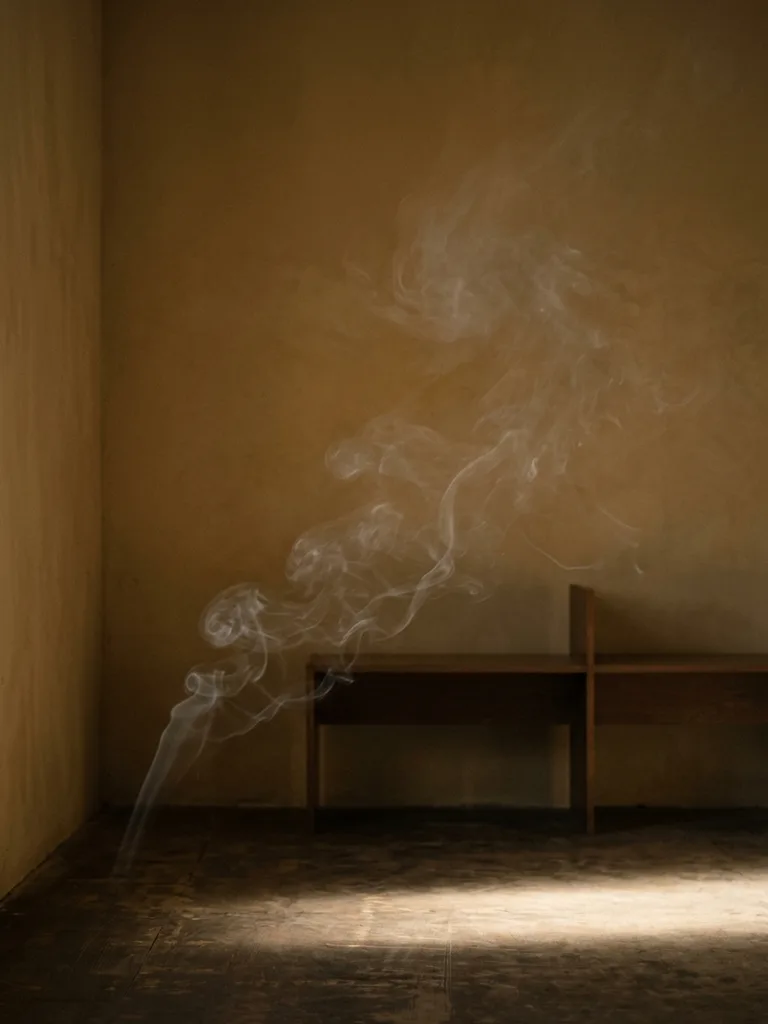
You are filling in a questionnaire in a room with two other people when smoke starts drifting in through a vent. You look at it, wait for a reaction, and find that your companions keep writing while the air turns unpleasant. If you are alone, the odds are high that you will get up; if there are three of you and the others play it cool, it is almost never you who raises the alarm.
In 1968, John Darley and Bibb Latané, two young psychologists obsessed with why people help or fail to help, staged that scene with students; Darley taught at New York University and Latané at Columbia, a few subway stops away. You, in the participant's seat, do not know that the smoke is part of the experiment.
When you are left alone, 75% of the people who sit in your chair get up and report what is happening. When two confederates of the researchers are with you and both act perfectly calm, the figure drops to 10%. If the people around you are two genuine strangers, caught in the same doubt as you, 38% speak up. Company, which in theory should multiply vigilance, often multiplies your stillness instead.
The most uncomfortable detail is not in any table. While the smoke keeps coming in, you may find yourself rubbing your eyes and staying seated. Your body registers that things are getting worse, but your companions act as if nothing deserves a response. You look at them to read the danger and they look at you with the same intention. Each one receives from the others a calm that none of them truly feels.
That paralysis is known as the bystander effect, the inhibition caused by others being present. You do not need to be cruel to fall into it. First you doubt your own reading: maybe the smoke comes from a scheduled test or a harmless machine. Then comes diffusion of responsibility, the mental sharing-out of the duty to help. If three people can raise the alarm, you feel the obligation no longer rests entirely on you.
Darley and Latané tested the same mechanism that year with a different emergency. You talk over an intercom with another participant and hear his recorded voice turn into what sounds like an epileptic seizure. When you believe only the two of you can hear the conversation, 85% of the people in your place go out for help. If you believe four other people can hear it too, 31% act.
The laboratory records keep a detail that dismantles the easy reading. Those who did not leave the booth were not calm: the researchers found them with trembling hands and sweaty palms, and the first thing they asked when it was over was whether that person was all right. That stillness had little to do with decision: what held them was the tie between two fears, the fear of doing nothing and the fear of looking ridiculous, as they waited for a signal the others were not giving either. Several stood up as soon as the experimenter opened the door: all they lacked was permission.
The seizure seems just as serious in both situations. What changes is the number of possible helpers you imagine around you. If you think there are two of you, the plea practically points at you. If you believe six people share the scene, you can assume someone else has already moved, is closer, or knows better what to do. Responsibility divided among six ends up with no visible owner.
The question that drove that research was born of a newspaper story worth knowing along with its correction. In March 1964, Kitty Genovese was murdered, a young woman attacked in the small hours by her doorway in the New York borough of Queens. A newspaper claimed that 38 neighbors had witnessed the crime without doing anything. That version turned the case into the perfect image of an indifferent crowd.
Decades later, you can now know that the figure was largely a legend. There were people who did not witness the whole attack, someone called, someone shouted from a window, and a neighbor came down to hold Genovese in her arms. The real story does not erase the researchers' question, but it does force you to separate a phenomenon proven in experiments from an exaggerated piece of journalism.
There is also another counterweight to set against the idea that a group always paralyzes. In 2019, a team reviewed security-camera footage of real street fights in the United Kingdom, the Netherlands and South Africa. In roughly nine out of ten conflicts, someone stepped in. If you expected to find a motionless crowd in every scene, the cameras show the opposite.
Help almost always appears, but that fact does not guarantee that you will be the one to start it. Someone else may move while you wait, and your waiting is still governed by the same sharing-out. What you can use is learning to recognize the instant you catch yourself looking for permission in other people's faces — because those faces, you now know, may be waiting for your move.
You do not need a laboratory to watch it work. Think of the last time you saw a fallen suitcase on a platform with twelve people looking on, or that “can someone go take a look?” that has sat unanswered for two hours in an email with eight recipients. None of the eight has refused: each one has left the errand, without noticing, in the hands of the other seven.
When you are the one who needs help, you can cut that sharing-out before it starts. And it is worth knowing that 112 works the same all over Europe, from any phone, even without coverage from your own carrier. Shouting “somebody call!” leaves the task floating among everyone present. In first-aid courses they teach you to pick one person by a visible trait, look at them, and give them a single job. The moment you point at them, they stop being part of the scenery: they have a name, even if it is “the one in the blue jacket”, and they have a task.
If you are the one who sees the smoke, the same knowledge can unlock you. You do not need to wait for a certainty no one else has. You can stand up, ask what is going on, or raise the alarm. Your movement gives the rest the social information they were all looking for. In that room in 1968, the first person to leave their chair would have broken the involuntary agreement to keep filling in the questionnaire.
Keep the uncomfortable, true version: you belong to a species that usually steps in, and even so your behavior changes the moment you believe others can take care of it. The way out fits in one gesture. If the one in trouble is you, choose a face before asking for anything.
Point at that face with your hand and say, in these words or your own: “You, in the blue jacket: call 112 now”.