 Margen
Short story · From the Margen catalogue
Luzdivina wins her case and the school has already been pulled down
I'm the one telling this because on Monday the thirteenth, at seven in the morning, I was the one who was surplus and I didn't know it yet.
My name is Nicanor Pelayo, I'm thirty-one, and I'm the caretaker at Fuente Grande school: two hundred and twelve children, two floors and a playground with a ramp that ices over. My job starts at seven: I open the gate, turn on the heating, raise the blinds in the dining hall and clear the ice off the ramp with coarse salt, because at nine the three-year-olds come up that way holding hands.
That morning, when I got there on my bike, there was a woman waiting at the gate. She had a sports bag, a flask and a blue work coat folded over her arm, the kind you work in, with a name embroidered on the pocket.
"Good morning. Are you the one who opens up?"
"I'm the one."
"Luzdivina Quintanilla. Caretaker at Valdenoceda school."
"Valdenoceda isn't there any more," I said.
"I know. I went past the site yesterday."
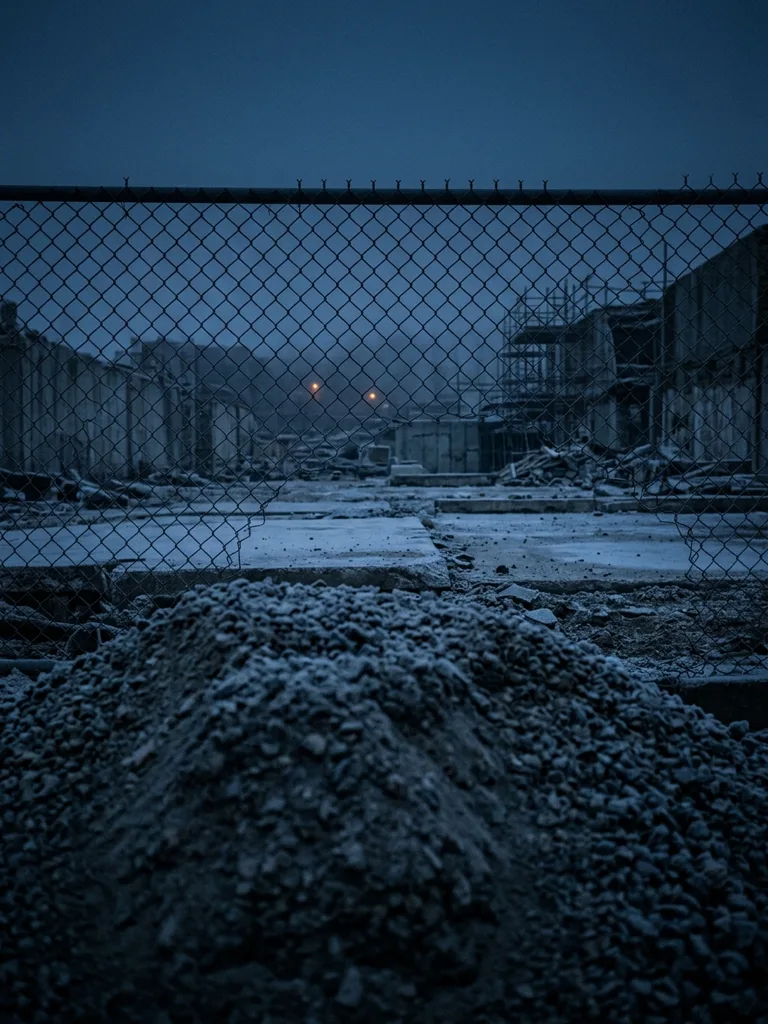
Valdenoceda school was pulled down in August. It was a 1964 building with sixty-eight children and four classrooms, and what's there now is a cleared plot with a wire fence, a works notice and a heap of gravel where the playground used to be. The sixty-eight children were brought here, to Fuente Grande, four kilometres away on the reservoir road. That's why I've got two hundred and twelve and not a hundred and forty-four.
"So what are you here for?"
"To work."
She put the flask on the counter by the entrance, next to the visitors' book, and set down two china cups upside down, one on each side.
"What's that for?"
"I've always brought two cups," she said. "One for whoever opens up with me."
Luzdivina Quintanilla was dismissed in March two years ago over something I don't have to tell you about, because a court told it, and told all of it: the dismissal was void. The judgment came in December. Reinstatement in her post, the wages of all twenty-two months, and the duty to present herself on the first working day after notification.
The notification reached her on Friday at two in the afternoon.
"I've read the paper four times," she told me, while I was opening the fuse box. "It says the school. It doesn't say the council, it doesn't say the municipality and it doesn't say the position. It says the school."
"And the school doesn't exist."
"The school exists wherever the children are. And the children are here."
She said it without raising her voice and without looking at me, looking down the corridor, and it came back to me that I had painted that corridor in August so the Valdenoceda children would fit.
Araceli Villacampa, the head, arrived at seven forty, which is half an hour earlier than usual, and I knew she was coming about this because she'd left the car on the pavement instead of in the square.
"Morning, Luzdivina."
"Morning, Araceli."
Araceli took us into the office and didn't sit in her own chair, she sat in the parents' chair, which is something she does when she doesn't like what she's about to say.
"I've had the whole weekend to look at it and I haven't found the way out. I'll tell you how it stands, which is the only thing I know how to do."
And she told us how it stood.
The council appealed the dismissal twice and defended it for twenty months, with a lawyer on contract, Olegario Rebollo, who filed the last submission in November. The closure of Valdenoceda was decided by that same council meeting that was paying for the case, last March, the same councillors in the same room, two items further down the agenda. Olegario Rebollo signed the November submission without having looked at that item. By the time the notification reached her, the post had been gravel for five months.
"So what now?" I said.
"So there is one caretaker's post for two hundred and twelve children, and the post is yours. And there is a final judgment saying it's hers."
"I'm on a temporary contract," I said.
"You're on a temporary contract and she has a judgment. If I send you home tomorrow, what happens is that you are dismissed for no reason and you start another case like hers, with the same lawyer on the other side. And if I don't seat her, the one breaching a court judgment is the council, again."
Luzdivina hadn't said a word since we came in. She had the work coat on her knees, folded exactly as it had been at the gate.
"Araceli, I didn't come here to take anybody's job."
"I know."
"I came because if I don't come today, I lose the judgment. It's on the paper. First working day."
"I know, Luzdivina. And if you do come, he loses this month's wages. That's on the paper too, even if it isn't written anywhere."
And there the three of us stayed, in the office, with an hour to go before the Valdenoceda bus.
I have a three-year-old daughter in the ground-floor classroom of this same school, forty metres from where we were sitting. I pay six hundred and ten euros a month for a flat out on the main road. I started here last August, with a contract and a payslip, and it was the first time that had ever happened to me: before this I did six years of seasonal work, two months here, three months there. When Araceli said "the post is yours", I knew exactly how much money was in that sentence, and I did not think about Luzdivina for half a second. I thought about the payslip.
Then she opened the flask.
She opened it without asking, in the middle of the meeting, because she'd been on her feet since half past six and because that is what a caretaker does at ten to eight. And the smell of that coffee put my whole memory back in place at once, in order and without warning.
My mother's name is Fidela and she cleaned Valdenoceda school from 2001 until she had her hip done, in 2016. She started at twenty to seven, and I went with her from the age of seven to the age of eleven because there was nobody to leave me with, and I used to sit at the first desk in the corridor with a notebook until they opened up.
At twenty to seven there was already a light on in the caretaker's room, and there was coffee. I never asked who made it. My mother said "the caretaker", and the caretaker was a woman who took my wet coat off me in the corridor and put it on the corridor radiator so it would be dry by nine, and who had a flask with two cups because my mother didn't bring a cup from home.
"You used to take a kid's coat off him in that corridor," I said.
Luzdivina stopped pouring.
"I've taken a lot of kids' coats off them in that corridor."
"Mine. I'm Fidela Pelayo's son, the one who cleaned."
She stood there with the flask in her hand and set it down on Araceli's desk without quite letting go of it.
"You were the one with the notebook."
"I was the one with the notebook."
I still had a three-year-old daughter and six hundred and ten euros of rent. What changed is that I stopped being able to think of it as my problem, and that, at a quarter to eight on a Monday, is an enormous and very uncomfortable change.
"Araceli," I said. "Can it be split?"
Araceli looked up.
"Split what?"
"The post. Half days for her and half days for me."
"It could be. It's the only thing that can be done without anybody breaching anything." She said it slowly, because she had thought of it on Sunday and hadn't dared to propose it. "But it's half a wage each and you both have to accept it in writing, today, before nine. And I have to say this plainly: it is the least bad of the arrangements that fit. It takes half your salary off you and half her judgment off her."
"I'll open," she said. "Half past six is already a habit with me."
"And I'll close," I said. "I have to pick the girl up at five."
Araceli looked at the two of us and then she did get up, and went to her own chair, which is where things get signed.
At ten to nine the Valdenoceda bus arrived with the sixty-eight. Luzdivina put her work coat on in the corridor, did up the three buttons and went out to the ramp to throw the salt before I could pick up the sack.
At nine on the dot, with the children already inside, she wiped her hands on her work coat and stood looking at the gate.
"Tomorrow I'll do the ramp," she said. "Don't get up early, you have to be at your girl's door at five."