 Margen
Did you know? · From the Margen catalogue
Eastland left 844 dead without leaving the wharf
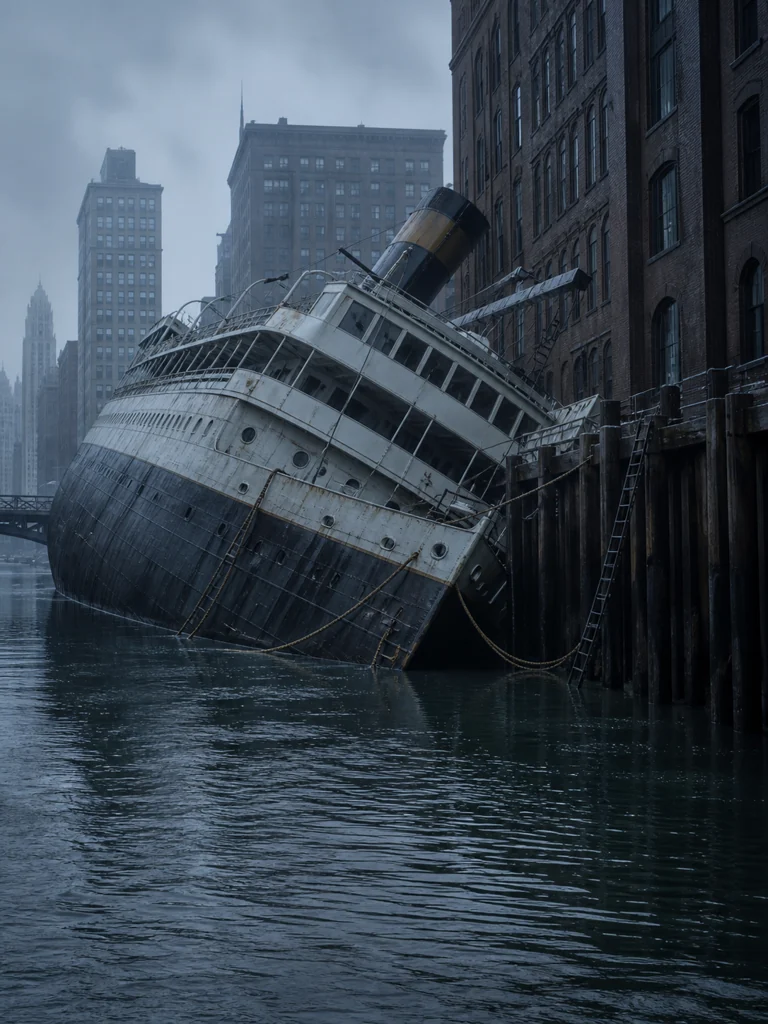
Beside the Clark Street bridge, anyone looking from the wharf could see passengers inside Eastland, behind its windows. The steamer was still moored in central Chicago on the morning of 24 July 1915. Before travelling a single metre towards Lake Michigan, it had rolled over and killed 844 passengers and crew.
Nearly 2,500 people had boarded for an outing organised by Western Electric. The plan was to sail to Michigan City and hold a picnic there for workers from the Hawthorne plant. Their partners and children were coming too. Tickets had been distributed by department, bringing colleagues from the same workshops aboard together and placing many families in the saloons and on the decks in their Sunday clothes. Drizzle fell outside; inside, the day still looked like a company celebration.
Eastland had suffered from stability problems since its earliest years. It had a shallow draught and relied on several tanks to adjust its balance. The crew pumped ballast water between them whenever weight shifted. After the Titanic disaster, more lifeboats had been installed on the upper decks, a change intended to increase evacuation capacity that also added weight high on the ship. The centre of gravity rose, leaving the vessel even more vulnerable to a moving crowd.
The first warning that morning came at 6:41. While boarding continued, Eastland began to list towards starboard. In nautical terms, starboard is the right when facing forward and port the left; at that berth, the former faced the wharf and the latter the river. The crew pumped water into the ballast tanks and managed to bring it upright. A list then developed towards port. They reduced that lean too, though only partly.
Rain sent some passengers into the covered saloons. Others gathered on the port side to watch the river and the boats passing by. Weight aboard kept shifting while the tanks tried to compensate, and the furniture had no fittings capable of holding it in place during a severe list. The lean towards the river returned and grew steadily: by 7:27 it had reached between 25 and 30 degrees.
One minute later it was about 45 degrees. Crockery and benches slid towards the descending side. People fell that way too, adding weight just when the hull needed to recover. Water reached the open portholes and poured into the rooms. At 7:28 Eastland rolled completely onto port and came to rest on the riverbed, about six metres below the surface. Part of the hull remained above water, but many compartments flooded and escape routes were blocked within minutes.
People on the upper decks tried to climb across what was now an almost horizontal expanse of hull. Some jumped towards the wharf; others needed ropes or outstretched hands to pull them from the wet slope. Inside, benches and tables had fallen against doors and into corridors. Soaked clothing hindered every movement, and the windows on the submerged side were underwater. Pockets of air remained in some rooms, allowing rescuers to hear blows coming from within.
Workers from nearby warehouses were among the first to run towards Eastland. Crews from other vessels brought their boats alongside without waiting for a formal operation to be organised. The tug Kenosha positioned itself beside the exposed flank and became a floating bridge, allowing survivors to cross over it to land. Police officers and firefighters then arrived with ladders. They rigged ropes and used cutting torches to open the hull wherever they could still locate trapped people.
Among those who climbed onto the overturned metal were the surfmen from the Old Chicago station, maritime rescuers who already belonged to the Coast Guard. The federal service had been created on 28 January that year by combining the Life-Saving Service and the Revenue Cutter Service. They worked alongside firefighters and police officers. Sailors and labourers were also on the wet surface, which heated up with every cut. Some openings were barely wide enough to extract one person; others had to admit a stretcher that then needed to be manoeuvred around twisted metal and displaced furniture.
Jun Fujita, a photographer for the Chicago Evening Post, documented the rescue from the riverbank. His plates show men moving over Eastland’s side, a crowd gathered at the water and downtown buildings immediately behind them. Eastland was still touching the wharf when hundreds of people became trapped inside it.
The injured were taken into nearby buildings as the number of recovered bodies increased. The Second Regiment Armory became a morgue and identification centre. Relatives arrived there looking for people who had boarded only hours earlier; clothing and personal belongings helped establish the victims’ identities. Decades later, the same building would house Oprah Winfrey’s Harpo Studios.
The losses struck Hawthorne particularly hard, where many Czech immigrants and their descendants worked. Distributing the passes together had placed colleagues, neighbours and relatives in the same parts of the steamer. Afterwards, the same surnames appeared repeatedly on missing-person lists, in parishes and along streets near the plant. Twenty-two entire families died. Western Electric records and family statements were checked against survivor lists. The recovered bodies completed the official toll of 844 dead.
The federal investigation reviewed Eastland’s history of listing, the handling of ballast, the open portholes, the additional lifeboats and the crew’s decisions. Proceedings began in Chicago and moved to Grand Rapids, where the owners hoped to find a more favourable judicial setting. Clarence Darrow defended chief engineer Joseph Erickson while engineers and officers debated the influence of the design, passenger distribution and the alterations made after Titanic. Owners, officers and inspectors were accused, but the criminal proceedings ended without penalties matching the scale of the disaster.
The capsize also intensified debate over federal control of passenger-ship designs. The Coast Guard’s official history records a proposal allowing the government to examine plans and specifications before approving a vessel. Congress granted that power twenty-one years later, following the Morro Castle and Mohawk disasters; by then, Eastland had already lost its civilian name.
The hull was returned upright in August 1915 and never carried excursion parties again. The Navy bought and converted it, keeping it in service on the Great Lakes for decades as USS Wilmette. The ship that killed 844 people without leaving the wharf was scrapped after the Second World War.