 Margen
Did you know? · From the Margen catalogue
Calcutta took delivery of a hundred tons of Boston ice in 1833
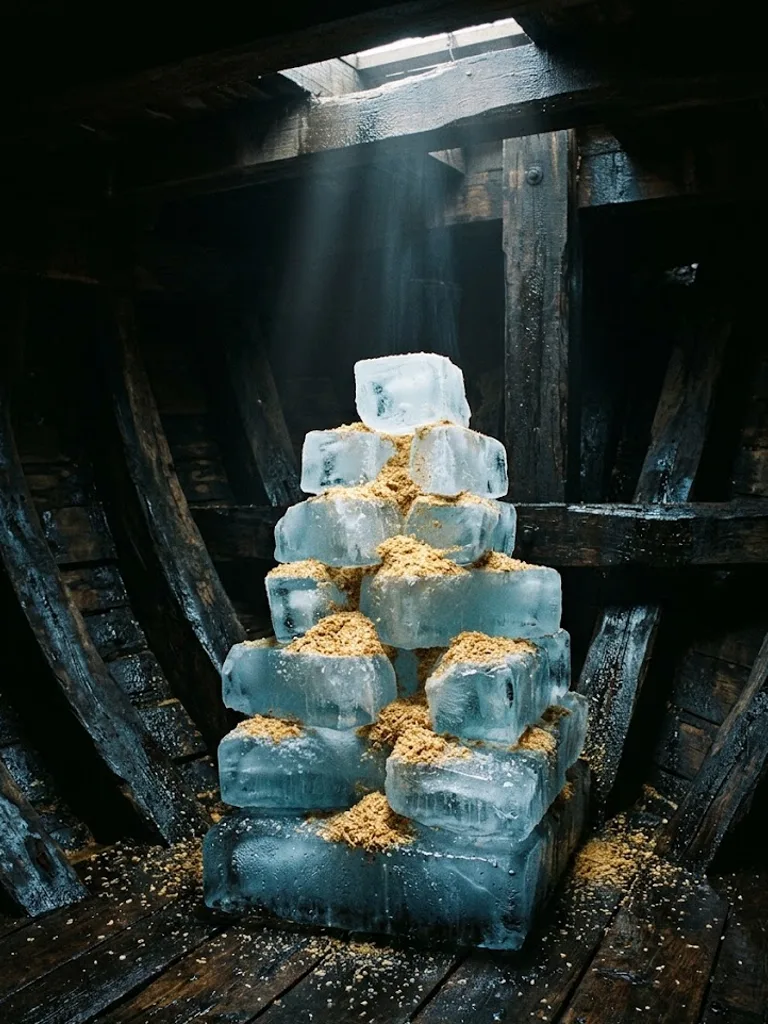
One hundred and eighty tons of ice left the port of Boston on 12 May 1833, and some hundred of them went into a warehouse in Calcutta four months later, still in blocks. They were carried by a two-masted brig called the Tuscany: sixteen thousand miles of sea, round Africa and across the equator twice, once going down the Atlantic and once coming up the Indian Ocean.
The man who put the cargo together was Frederic Tudor, a Boston merchant, forty-nine years old, and he had been trying for twenty-seven years.
His first shipment was in 1806: one hundred and thirty tons cut from the frozen ponds of Massachusetts and carried to the Caribbean island of Martinique. He lost almost all the money. There was nowhere on the quay to put the ice, nobody knew what it was for, and it came apart in front of the buyers. In the years that followed, Tudor got to know the inside of the Boston debtors' prison, which in those days was a place you left by paying.
What changed between that disaster and the ship of 1833 was not the ice.
The insulation was tanner's waste. The Tuscany's hold was lined with a foot of ground bark from the tanneries, thoroughly dried — the refuse from the pits where hides are cured — another foot of hay on top and one-inch pine boards on all four sides. Tudor had spent twenty years trying dry waste instead of blankets, which soak up water and hold it against the block: sawdust from the mills, hay, bark. What cost nothing insulated better.
Then came the way of cutting it. In 1825 Nathaniel Wyeth, an employee of Tudor's, hitched a toothed blade to a horse and scored the frozen surface of the pond into a grid, the way you score a bar of chocolate. Before that, lumps were hacked out with an axe, with crooked faces: stacked up they left pockets of air, and heat comes in through every pocket. Wyeth's blade produced identical blocks that sat against each other with no gap.
In Havana and in Charleston, Tudor had already built double-walled brick icehouses to receive his ships. In Calcutta there was nothing. He sent the cargo without knowing where he was going to unload it.
The Tuscany docked at Calcutta, on the Hooghly — the arm of the Ganges that reaches the city — on 10 September 1833, and opened the hold on the thirteenth. Unloading took four days.
The British residents of the city came down to the docks to look. Many had spent years in India and had never touched natural ice in their lives; what was sold there was so-called Hooghly ice, paper-thin crusts that labourers obtained by leaving water out overnight in shallow clay dishes during the cold weeks, and which fell apart in your hand.
Within three days, by subscription among themselves, they raised the money for a proper icehouse; in the meantime the hundred tons were kept in the ground-floor room of a house at Brightman's Ghaut, floored and lined with planks in a hurry for the occasion. The route was open, and New England ice kept arriving in Calcutta for decades, until artificial ice plants pushed it out of the market at the end of the century.
Of the one hundred and eighty tons that left Boston, fifty-five had melted before reaching Diamond Harbour, the anchorage at the river mouth; another six or eight went on the way upriver, and some twenty were lost in the unloading itself, with the ice already in plain sight of everyone.