 Margen
Did you know? · From the Margen catalogue
They blamed the pilot for 40 years over two degrees of longitude
It took New Zealand forty years to say out loud whose fault it had been. The official 1980 report put it on the captain, who had been dead for six months. The real cause was two degrees of longitude wrongly entered in the airline's computer: when they were finally corrected, the route shifted fifty kilometres east and began to run straight past a volcano.
2019. On the fortieth anniversary, Prime Minister Jacinda Ardern apologised on behalf of the Government to the families of the 257 people who died against Mount Erebus, the active Antarctic volcano the country's airline had spent almost three years showing off from the air. She did not apologise for the crash, but for the way the state had responded: the report that dismantled the official version was delivered in 1981 and did not reach Parliament until 1999. The apology for the crash itself came, at the same ceremony, from the airline.
2006. Not until that year was there anything official for the people who went down onto the slope. The teams of police officers and forensic staff spent eleven days on the ice, four thousand kilometres from home, recovering and identifying remains with the tools of the day: dental records, X-rays, rings, engraved watches. They put names to 213 of the 257; the other forty-four, never. Several of those officers carried what they saw there for the rest of their lives. Twenty-seven years later, the Government created a medal for them.
1983. The Privy Council in London, then New Zealand's court of last resort, dismissed Justice Peter Mahon's appeal. Two years earlier, a New Zealand appeal court had struck from his report its gravest charge — that the airline's executives had agreed among themselves to lie to him — because he had made it without giving them the chance to answer that particular accusation, and that is a procedural defect. The facts were left untouched. What Mahon established about the coordinates nobody disputed, and it still stands.
1981. On 27 April, Mahon delivered his report. He was no airman: he was a High Court judge whom the Government had put in charge of a royal commission, a public inquiry with the powers of a court, because the previous year's technical report had left half the country incredulous. His conclusion was that the dominant cause lay in no decision of the captain's, but in the change made to the flight plan coordinates hours before take-off and not communicated to the crew. The chief executive resigned a few weeks later.
1980. In June, the chief inspector of air accidents, Ron Chippindale, signed the official technical report. Probable cause: the captain's decision to continue the descent below the minimum safe altitude in an area where he could not fix his position by looking out of the window. Translated into headline language: pilot error. The captain, Jim Collins, and the first officer, Greg Cassin, could not answer back. Their families spent the following year asking someone to look at the airline's paperwork instead of the aircraft's.
December 1979. The aircraft had broken apart against a snow slope at 447 metres of altitude, on the volcano's north face. Erebus stands 3,794 metres high. The plane did not graze the summit or go anywhere near it: it struck low down, on the flank, on a stretch of snow as smooth as a sheet of paper.
28 November 1979, 12:49. Air New Zealand flight 901, a DC-10 registered ZK-NZP, was an eleven-hour excursion that never touched ground, and it had been in the air for four and a half hours. On board were 237 passengers, who had paid to see Antarctica in a day and be back for dinner in Auckland, and 20 crew. Visibility reported at McMurdo station was better than sixty kilometres. The plane was descending in circles so that people could take photographs, cleared down to 1,500 feet, some 460 metres, if the weather allowed. And the weather allowed: sun above and snow below.
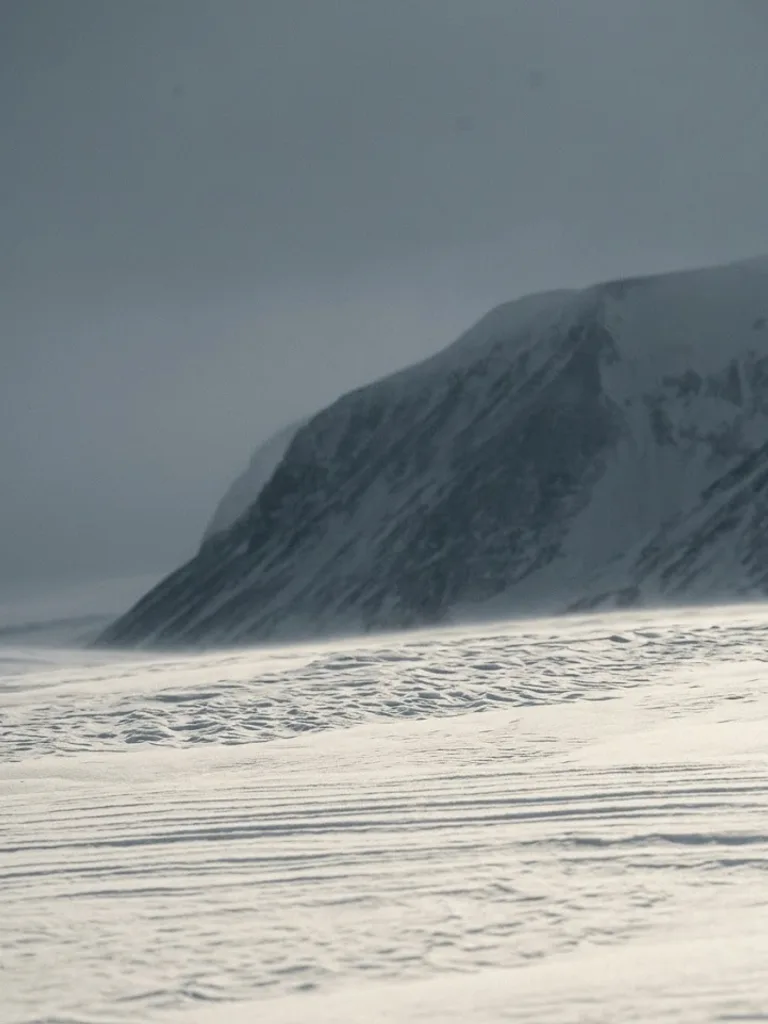
That was exactly the problem. What killed those 257 people has a technical name: sector whiteout. When a cloud layer spreads the light evenly and below it lies snow with no rocks and no shrubs, the shadows disappear; and without shadows, relief disappears. A white three-thousand-metre slope and a horizon of flat ice send back to the eye the same wall of light. Those pilots were not flying blind inside a storm: they were flying in sunshine, with sixty kilometres of reported visibility, looking head-on at a mountain that was not drawn anywhere in what they could see.
There was also a guide on board, with the microphone, who should never have been there. Those flights carried a well-known mountaineer explaining the landscape over the public address system, and that day it was Edmund Hillary's turn, the New Zealander who climbed Everest in 1953; a commitment prevented him and he sent his friend Peter Mulgrew, also a mountaineer, in his place. Mulgrew was describing McMurdo Sound over the loudspeaker, to 257 people looking out of the windows, while the aircraft closed on something that was not McMurdo Sound.
The only machine that noticed was the ground proximity warning system, which measures the distance to the ground below and cannot see what lies ahead. It sounded. The crew reacted at once and called for go-around power. Between the first beep and the impact, six seconds passed.
The small hours of 28 November, around twenty to two. In the airline's offices someone corrected an error in the computer that generated flight plans. The coordinates of the destination waypoint, the American base at McMurdo, had been wrongly entered for fourteen months: two degrees of longitude out, some fifty kilometres at that latitude, twenty-seven nautical miles. With the wrong coordinates the route ran down the middle of McMurdo Sound, flat sea ice, the perfect place to drop to fifteen hundred feet and circle slowly; most of the thirteen previous flights had gone that way. That night someone put the waypoint where it really was, and the route moved fifty kilometres east, directly over the flank of Erebus.
On 14 November, two weeks earlier, another of the airline's captains had already reported in writing that the coordinates the computer carried did not match those handed out at the briefings. That report is what eventually prompted the correction made in those small hours. Nobody cross-checked it against the list of who was flying the next day.
The correction was correct. Nobody told the crew, which took off almost seven hours later.
Nineteen days earlier. Collins had attended the briefing for the flight and had copied by hand, onto his own navigation charts, the coordinates on record at the time: the wrong ones. He arrived in Antarctica with a route drawn over the sound and a navigation system taking him towards the volcano, with no way of knowing that his paper map and his computer disagreed by fifty kilometres. During the descent he asked twice for his position. Nobody could give it to him: McMurdo had no radar covering that area.
The rest is arithmetic. An aircraft at 480 kilometres an hour covers fifty kilometres in a little over six minutes.
What changed in 2019 was not the cause of the crash, written down since 1981: it was that the state stopped asking the families to hold up the comfortable version. For forty years Jim Collins's children were told their father had gone down where he should not have. Mahon had long before described the explanation the airline offered him at the hearings with a phrase that the courts struck from his report and that the country has not forgotten: "an orchestrated litany of lies".