 Margen
In the summer of 1964, Wheeler Peak, a mountain in Nevada, received Donald Rusk Currey, a geography doctoral student at the University of North Carolina, carrying a question about ancient climate. Currey asked the United States Forest Service for permission to fell a bristlecone pine recorded as WPN-114, the code of his sample in White Pine County, and he got it. When he counted its rings he discovered he had cut down the oldest known non-clonal tree.
Currey was not after a record. He was studying the moraines, the rock debris left behind by glaciers, around Wheeler Peak. He wanted to order the chronology of ancient glacial advances and reconstruct cold spells, among them the Little Ice Age, a cooling that lasted several centuries. To date those movements he needed natural calendars able to reach much further back than any written archive in the region. Bristlecone pines, trees of the species Pinus longaeva, kept that calendar inside their wood.
At over 3,000 metres, the slope offered nothing like the tall forest that an age of almost five millennia suggests. The wind combed pale stone and scattered trunks; WPN-114 was low, twisted, with bare sectors, bleached wood and a strip of living bark still feeding a few branches. In a kind year it added a narrow band; through an extreme season it might lay down none at all around part of its girth. Currey was trying to read it with an increment borer, a hollow bit that pulls out a thin cylinder without felling the specimen, but an eroded trunk split into living veins does not always yield a continuous sequence. The part of the scene that is certain begins after the guesswork about that tool: Currey requested authorisation to cut, and he obtained it. In the summer of 1964 a crew came up with a chainsaw, braced the work against that harsh slope and went through the warped wood. Then they parted the trunk into sections that several men carried down the mountain. In the laboratory Currey planed the surfaces smooth, followed tight lines under a lens and spent months counting towards an incomplete centre.
For decades it was repeated that Currey's borer had got stuck and that they felled the tree to recover it. That explanation is disputed. Other accounts say the tool was too short, that the cores obtained did not reach the centre, or that a full section was needed to settle the age. The available documents do not let anyone choose between those scenes. They do fix the administrative decision: the researcher asked for a permit and the Forest Service granted it.
The land did not yet belong to a national park. The area was under forest administration, and cutting specimens for dendrochronology, dating by growth rings, was part of scientific practice accepted at the time. Nobody yet held the number that would make that pine a world exception. Its battered form allowed one to suspect an enormous age, but bristlecone pines deceive the eye: they survive by losing bark, letting parts of the trunk die and keeping a minimal connection between roots and branches.
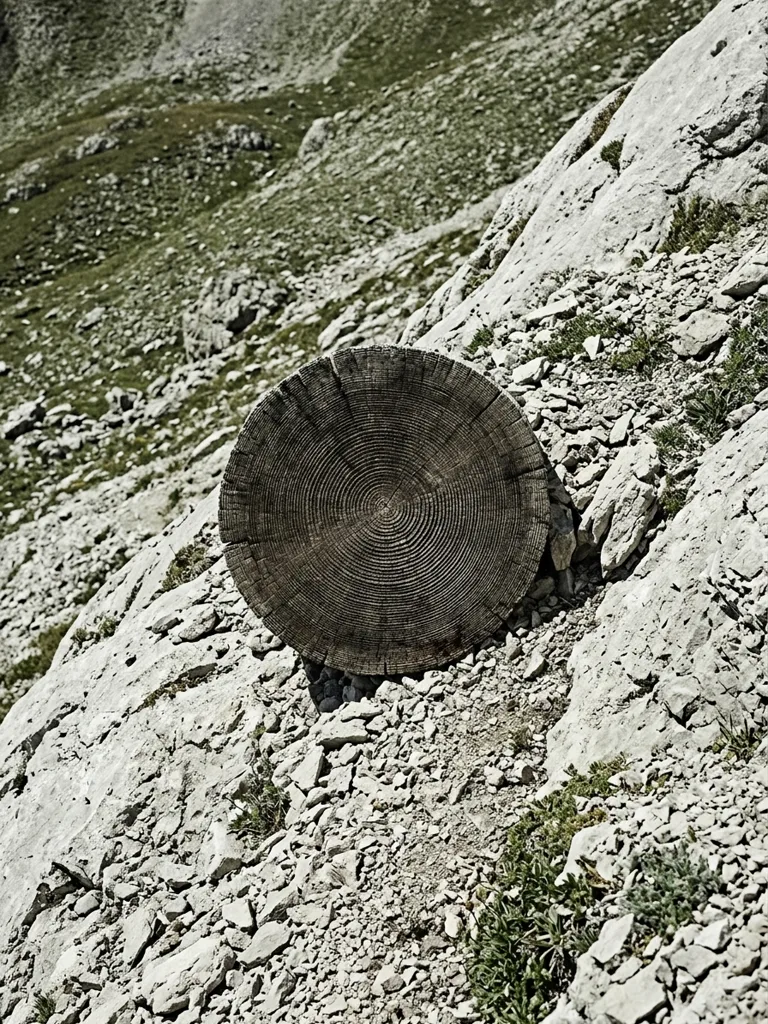
The crew left a stump in the grove and brought down wooden discs meant for study. Each section showed a drawing far removed from the clean circumference of a schoolbook tree. There were curves that compressed, lines that vanished into a scar and zones eaten away by centuries of erosion. Currey had to recognise where each season continued, mark it, and avoid counting twice a line that forked. The world record came through that manual work, one stroke after another, not in the instant the saw was started.
The local mountaineers called the tree Prometheus, after Prometheus, the Greek figure associated with fire given to humans. Currey used the code WPN-114 in his research. The label identified one specific sample within a series and did not take for granted an age that still had to be proved. The mythical name became famous later, when the discs were already off the mountain and the count was starting to approach five thousand.
Currey published the result in 1965 in Ecology, a scientific journal of ecology. He reported 4,844 visible rings. The figure already exceeded the established ages for known non-clonal specimens, but it was not the full age either. The section did not come from the exact base of the trunk and part of the centre had been lost to erosion. Currey estimated that the pine had germinated some 4,900 years before the felling.
That placed its beginning around the third millennium before our era: the pine was already growing in the Snake Range some centuries before the first pyramid rose in Egypt, Djoser's step pyramid, around 2670 BC. Year after year it added wood at a rate so small that several centuries fitted within the width of a hand. Its endurance also came from dryness and cold: in that environment the fungi and insects that rot other trunks quickly are scarce.
Prometheus was a single organism, not a colony of stems sharing roots and renewing itself. That distinction placed it among non-clonal trees, individuals whose age corresponds to the same living trunk. There are far older clonal organisms, but their longevity is reckoned another way. The Wheeler Peak find consisted of thousands of seasons preserved inside a specimen that was still alive when the crew arrived.
Some sections were shared out among research and teaching centres. One is kept at the Great Basin visitor centre, where the cut lets the eye travel across bands formed before a great many written records. Another was examined by Donald Graybill, a researcher at the Laboratory of Tree-Ring Research at the University of Arizona. His later count reached a higher figure than the one Currey published.
The felling also left useful climate material. The thickness of each ring answered to specific growing conditions and could be compared with wood from other pines. Those matches help date old timbers and reconstruct environmental swings. The lost tree was not reduced to the notoriety of the accident: its discs entered working series where one sequence serves to correct and extend the others.
Currey went on with his career as a geographer and taught for decades at the University of Utah. The story of Prometheus followed him, often boiled down to the tale of a broken tool. His paper preserves a different question: what happened to the region's glaciers, and what could the trees say about those changes. The extraordinary age turned up inside that research, when there was no longer any way to return the specimen to the slope.
Twenty-two years later, the landscape changed category. The United States Congress created Great Basin National Park on 27 October 1986 and took in Wheeler Peak and its bristlecone groves. The Prometheus stump is still there. There is no standing trunk to mark the old record; what remains is the cut base, the distributed samples and the mountain where the tree had survived for millennia.
In the White Mountains of California, Methuselah, another bristlecone pine identified by researchers, is still alive. The Forest Service does not say which one it is among the trees of its grove and keeps its exact location undisclosed, to reduce vandalism and the damage of footsteps on the roots. That caution now applies to a tree whose age became known without felling it.
The 4,844 rings Currey published did not close the count either. A bristlecone pine can miss rings during extreme years, and any cut made above the base leaves out the first seasons. That is why full-age estimates vary and must be kept separate from the number observed in the wood. Prometheus keeps the figure obtained after the chainsaw: Donald Graybill counted 4,862 rings in its wood.