 Margen
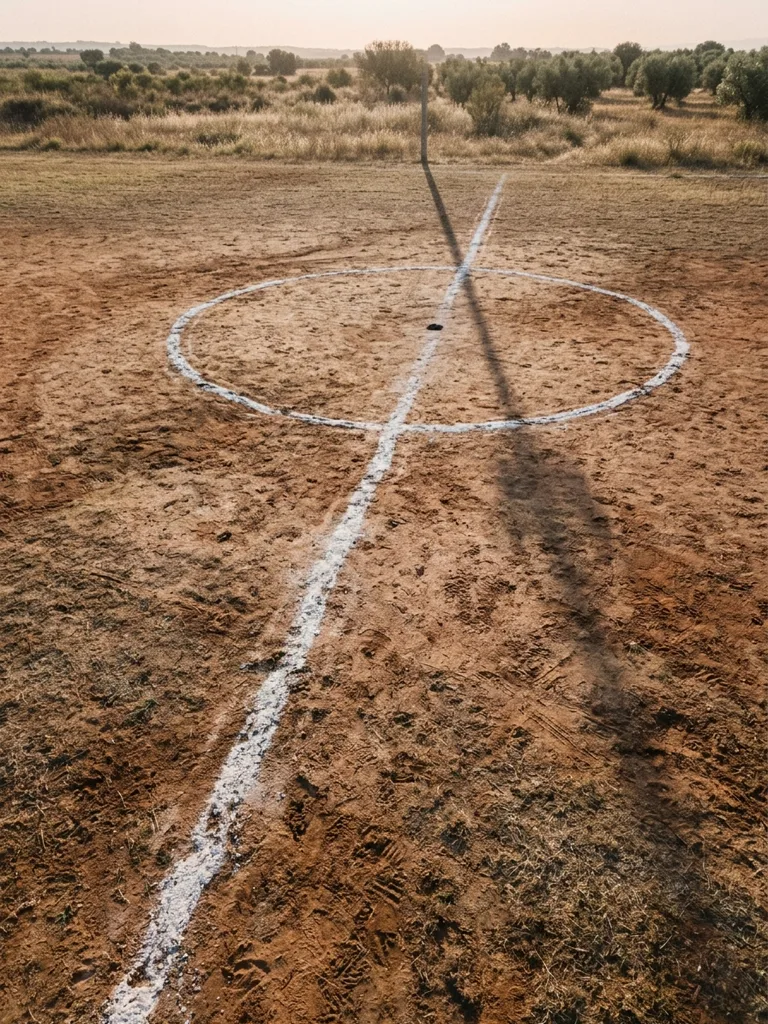
My name is Ramiro Cifuentes, draughtsman Monday to Friday, and that Sunday I ended up refereeing an under-11s match — kids of ten and eleven — because the real referee never showed. At 8:45 I was facing fourteen children kitted out for seven-a-side football and not one person qualified to take charge of them. Some forty parents were gathering behind the fence, and Chencho pressed into my hand a nine-euro whistle that still had the sticker on it.
Chencho, my brother-in-law, spends the week unblocking pipes and Sundays coaching the local team. He took me aside with that discretion coaches use when they are about to ask you for something outrageous in front of the whole village. He said the real referee wasn't answering his phone, the other team had travelled half an hour, and the kids couldn't be left without a game. Before I could answer, he had hung the whistle around my neck.
He gave me two instructions. The first was 'blow for everything you see'. The second, delivered in exactly the same tone, was 'try not to stop the game too much'. I asked how I was meant to follow both. He told me to use my common sense — the very tool I had just abandoned by accepting. I had come to the ground because I'm the coach's brother-in-law and had been promised coffee, not because I knew the rulebook better than anyone present.
The first difficulty was the coin toss. I produced a one-euro coin, flipped it, and we lost it in the grass. All fourteen players set about searching for it with more enthusiasm than they would later show the ball. Two parents jumped the fence to help and Chencho shouted that I was losing authority. I reminded him I was also losing a euro. In the end a boy found a bottle cap and we ruled that the painted side was heads and the rusty side was tails.
The visiting captain won and chose ends. The local captain asked if he could choose the bottle cap. He tucked it into his sock and I declared the first refereeing dispute of my career closed. We hadn't even kicked off and Maribel had already corrected two of my decisions from behind the fence. Maribel, the right-back's mother, files court papers for a living: she had brought a printed copy of the rules and handled it with the assurance of someone who has never once missed a filing deadline.
I blew for kick-off. Within five minutes I discovered that a ball moved around by children travels faster than a thirty-something draughtsman in his good walking shoes. Every time I got near the play, the ball shot off to the other side; if I stayed in the middle, Chencho demanded I move. Maribel quoted articles. One grandfather confined himself to saying 'handball' every time anyone touched the ball with any part of the body.
Twelve minutes in, I blew for my first offside. It never existed. I blew because the visiting striker was through on his own, Chencho raised an arm and four parents shouted at once. I sounded the whistle out of pure social obligation, with such energy that even the boy stopped in surprise. Maribel opened the rulebook and explained from the fence that the pass had come from a local defender.
I tried to keep my dignity by asking her which article that was. She answered with number and subsection. Chencho, who had called for the offside in the first place, then told me not to let the crowd influence me. The visiting coach came over to protest and ended up agreeing with me out of pity. The wronged striker didn't argue: he used the pause to tie a shoelace and asked me whether the bottle cap from the toss had an owner.
The local team scored four goals before half-time. At 4-0, their goalkeeper sat down against a post. He wasn't mocking anyone; he hadn't touched the ball in several minutes and was tired of standing. I went over and told him a goalkeeper couldn't sit down while play was on. He asked me where in the rules it said that. I looked over at Maribel, but for the first time she pretended to be deep in conversation with another mother.
I asked the keeper to stand up for safety reasons. He did, and on the very next play he conceded the visitors' first goal. Chencho asked me why I had broken his goalkeeper's concentration. The boy came to my defence: he said sitting down he wouldn't have reached it either. That was the only ruling of the morning to win the approval of both benches, all forty parents and Maribel.
At half-time a single bag of oranges appeared. It was supposedly for the local team, but someone left it midway between the two groups and the kids started handing round segments without asking which shirt anyone was wearing. While they shared the bag, we adults argued about whether the first half had lasted twenty-five minutes or twenty-seven. I confessed I had forgotten to check the time at the start.
Maribel said the rules fixed the duration. Chencho maintained that in village matches the referee's watch was law. I showed him my wrist: I wasn't wearing one. The visiting coach proposed playing another half hour and then going home for lunch. That was the first decision we took unanimously. Before we went back out, one of the boys offered me the last orange segment because, as he put it, running after them counted as playing too.
The second half went better because I gave up pretending I was in control of anything. When I wasn't sure who had put the ball out, I asked the two nearest kids. They almost always agreed. When they didn't, I pointed in a direction and they carried on playing without the legal symposium we adults would have convened. Maribel went on reciting regulations, but she began doing it with a smile that struck me as less dangerous.
The match ended 4-2. The local goalkeeper celebrated the visitors' second goal because he had saved it first and the rebound only went in afterwards. Chencho explained to him that this was not a cause for celebration. The boy replied that it was the first save he had made all morning. I judged his argument better constructed than any of mine and blew for full time before an adult could appeal it.
Then the match report appeared, folded in four in Chencho's pocket, and nobody had a pen. Maribel lent me one and stayed at my side to make sure I entered the names, the score and the incidents in the correct boxes. She asked me not to add any personal opinions. I told her a draughtsman knows how to respect margins, and she replied that I had respected very few that morning.
I wrote down the 4-2, the coaches signed and I returned the pen. Chencho reclaimed the whistle. I had assumed it was a gift for services rendered, but he clarified that the nine euros had come out of the club's cash box. I handed it over on condition that he never call me to referee again. He put the whistle away and assured me that next Sunday the real referee would turn up.
I thought the story was over until that same afternoon, when Chencho took a copy of the match report to the bar. The owner framed it, because in the remarks section I had disobeyed Maribel's final piece of advice and written a sentence that belongs on no official form.
Under remarks I had put: 'Match played without incident; the only one offside was the referee.'