 Margen
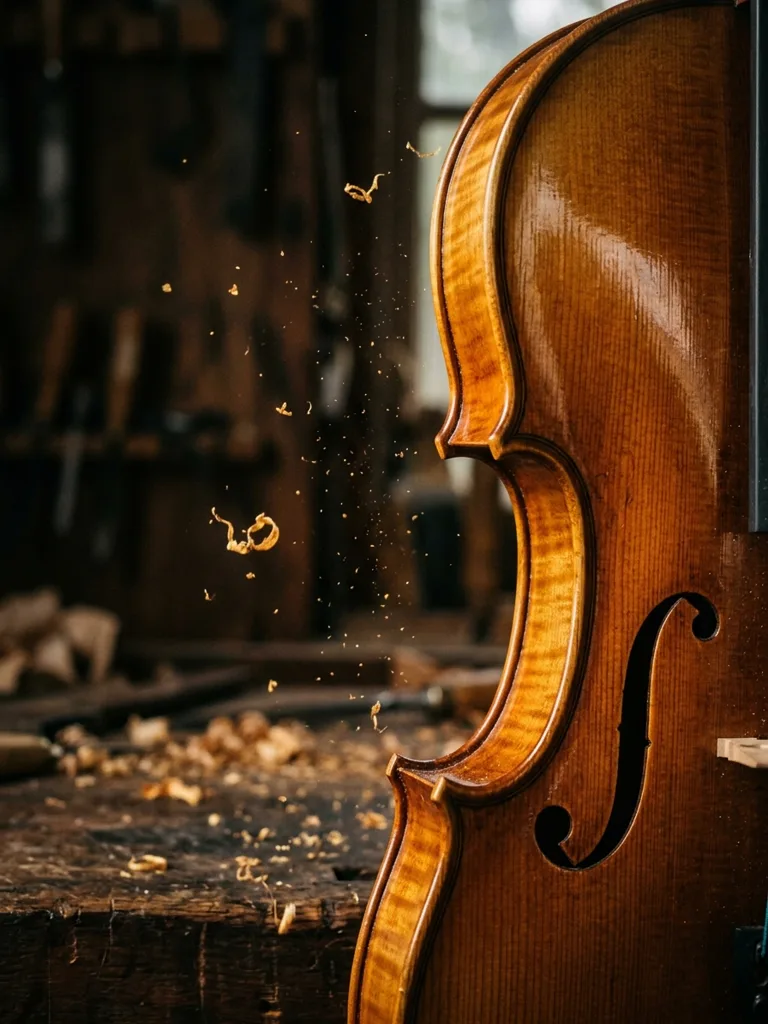
Violin workshop of Estella, a town in Navarre August 30, 2026
The varnish on the three-quarter violin you ordered in October 1996 has been curing for several weeks. This morning I fitted the strings, adjusted the bridge and declared the work finished. Almost thirty years have passed since the top was left half-carved on a shelf.
Mr. Gonzalo Ferrater:
My name is Elías Zubiaurre and I am still the luthier who received you in this workshop. You worked as a civil engineer and came with Irene, your daughter, then nine years old. You were looking for an instrument smaller than a full-size one, suited for her to learn without fighting its dimensions.
You left 40,000 pesetas as a deposit, forty thousand-peseta notes, and I prepared the wood. The top was spruce and the back, maple. I marked out the scroll, the carved spiral of the pegbox, before taking on other commissions. We agreed that I would finish the instrument and that you would return when Irene was ready to receive it.
During that visit, Irene stood counting the violins hanging on the wall. She got to twelve, started over because two were half-hidden by their cases, and asked me whether hers would take the lowest hook. Then she chose a dark green lining for the case because, she said, red was too loud even shut.
Irene stopped playing in 1999, as you told me the last time we spoke. You asked me to keep the work and said "no hurry." Then you stopped answering my calls. I attended to the commissions that did have dates, and this violin went back to the shelf, with the label bearing your surname tied to the mold.
I am not writing to reproach you for those years. I am explaining why it stalled. The top stayed at half thickness, the scroll kept the gouge marks and the maple aged under a cloth. Every time I tidied the workshop I found the label and remembered I had agreed to build an instrument I never delivered.
I am now 67 and retiring. The premises are sold and I must hand over the keys on September 30. Emptying the shelves, I decided I would not carry out of here a box with an unfinished violin. I thinned the top, closed the body and finished the neck. I applied the toasted varnish with time enough for each coat to dry and cure before today's stringing.
The instrument exists and it works. It keeps the three-quarter size you ordered for a nine-year-old girl, though Irene will now be 39. Perhaps she no longer plays. She may keep it, lend it or pass it on to someone else. That is hers to decide; mine was to finish the piece I agreed to build.
The 1996 deposit stands as payment in full. I will not claim the rest, nor turn three decades into an invoice. The hours I have put in this summer are on me: I am finishing the violin because I am closing the workshop and because this debt belongs to my trade, not to you or to Irene.
I am writing to the address on the 1996 label. If you no longer live there, I ask whoever receives this letter to try to pass it on, or to hand it to Irene. I don't know whether the envelope will find either of you, but it is the only contact I keep.
Until I hand over the keys I will be at the workshop every afternoon, from five to seven, until September 30, 2026. The violin will stay in the green-lined case Irene chose. If you come, you can try it here. If you need to arrange another way to collect it, just write to me before that date.
I have left inside the original label with your surname, the year of the commission and Irene's name. I have also kept the four pegs I prepared back then and the scroll I began when your daughter still counted the instruments on the wall again to make sure she hadn't skipped one.
I remember the sentence you spoke as you laid your hand on the wood: "Make it light; Irene's shoulder tires quickly."