 Margen
Serialized book · From the Margen catalogue
Every box has somebody's initials burned into it
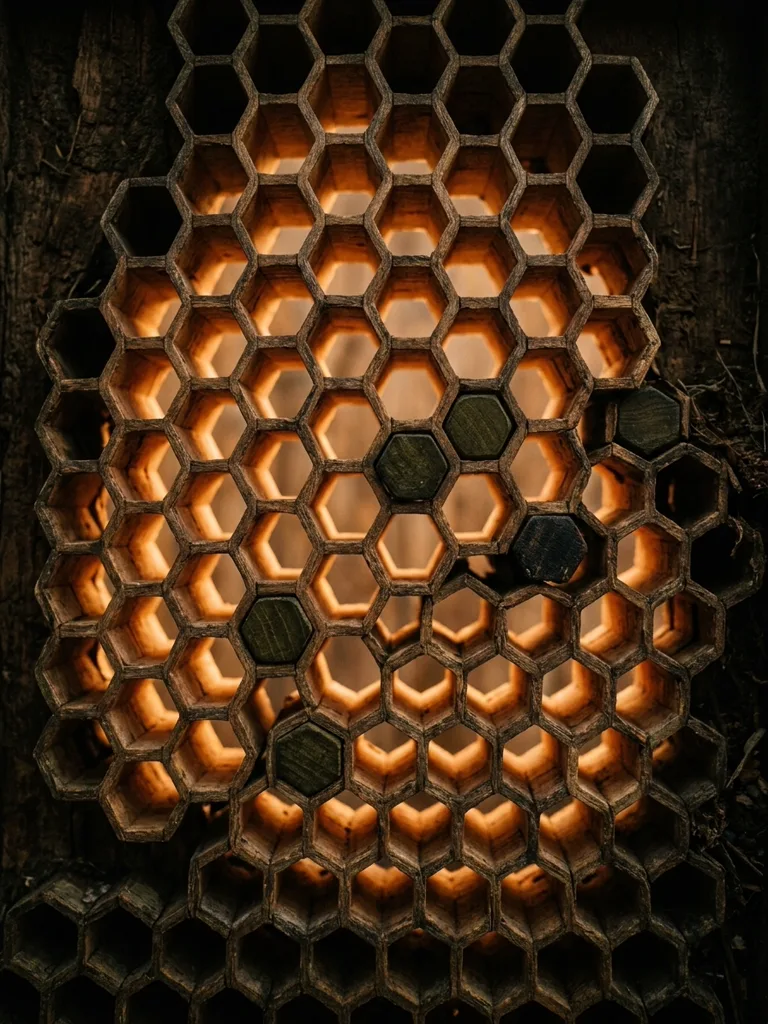
Previously: Elsa Trigo, a beekeeper, inherited 96 hives with eleven seed boxes inside. The lorry takes the hives up to the mountain pasture on the 30th.
Fifty-two hives still to check, and Amaro Cid, the district vet, has come up to the apiary at eight in the morning with his case and a pad of blank movement permits. He didn't call ahead. He leaves the car slewed across the track and walks up the slope without taking off his tie.
"Rosalía tells me you want to take eleven off the lorry," he says.
"I want to take out what's inside eleven of them."
"That's not the same thing."
"I know it isn't. That's why I called you."
Amaro asks to see one. Elsa takes him to the top row, to the hive with a twelve painted on it in brush strokes, and lifts the lid. Below the super there are no frames: there's a wooden box forty centimetres tall, its joints sealed with wax and a Roman numeral punched into it. The bees are working up top, in the super, and from there down the body is taken up by something that is not a hive.
The vet puts on his glasses, crouches and looks for a long while without touching anything.
"This isn't livestock," he says at last.
"And what does that mean?"
"That it isn't on the permit." He stands and dusts off his knees. "A movement permit covers hives, not whatever people put inside them. I signed for ninety-six hives because there are ninety-six hives. If you open them today and take out eleven wooden boxes, there are still ninety-six hives, and my signature still holds. Nobody weighs a lorry full of bees."
Elsa takes a moment to answer. She has spent four days doing sums with the 30th and with October, and it turns out the answer fits into two sentences spoken by a man in a hurry.
"So I can bring them down today?"
"Today, tomorrow or the 29th. They're yours." Amaro points at the stack of new frames she bought herself in June, leaning against the shed. "But don't send them up empty or the colonies will die on you. Take the box out, put in frames with stamped foundation and give them two weeks to draw it out before the trip. You do that better than I do."
It takes them until one. They bring the boxes down two at a time on the quad's trailer, eleven short runs along the upper track, and line them up in the shade of the shed on a stable blanket. They weigh very little. They sound like grain when they move. Eleven pine boxes, all the same height, all with the same brown wax in the joints. Elsa lifts one and shakes it slowly next to her ear: something small and dry rolls inside, and it doesn't roll loose, it's in bags.
Amaro doesn't leave. He doesn't say he's staying: he stays, tie in his pocket, holding the smoker while she closes the eleven hives up with the new frames.
"Did you handle my uncle's paperwork?" she asks him once all eleven are down.
"I've been signing his permits since ninety-six. One a year, in August, to go up to the pass." Amaro sets the smoker on the ground. "Ninety-six hives every year, Elsa. The same number for as long as I've been signing. Not one more, not one less."
"On Monday you asked about me outside the surgery."
"I asked whether you'd been up to the apiary yet."
"Why?"
"Because your uncle spent four years letting nobody up here," Amaro says, "and it struck me as odd that he died in March and nobody turned up until July."
"I didn't know I had an uncle until the notary rang me."
"Right. That struck me as odd too."
At four, with the eleven in a row and the sun come round, Elsa sits on the ground and looks at them one by one. The wax in the joints is intact on every one. The Roman numerals run from I to XI, punched twice into the centre of each lid, and none is repeated.
It's while lifting the third one into the shade that she feels the relief under her fingertips. She turns it over. On the underside of the box, burned in with an iron, there are three letters separated by full stops and a number:
M. C. B. 14.
She puts that one down and picks up the next. The same. And the next. All eleven have it underneath: two or three letters and a figure of one or two digits. H. D. L. 22. A. R. 31. V. N. 8. Never more than three letters. Never the same figure twice.
"Had you seen this?"
"No."
"Amaro."
"No."
Elsa goes into the house and comes back with the folder from the agricultural archive, Thursday morning's: six sheets in her own handwriting, because they don't let you photocopy in there. On the second sheet she copied out in full the list stapled to the 1994 burn order. Eighty-one lines, one per holding. She didn't copy them for the pleasure of it: she copied them because she didn't yet know what she was looking for.
Each line carries a plot number, a sector, a species and a holder.
She finds fourteen with her finger.
Plot 14, sector 3, pear trees, eight fanegas. Holder: Melchor Cabo Braña.
M. C. B.