 Margen
Did you know? · From the Margen catalogue
A village shut itself away in 1665, and nobody knows whom it saved
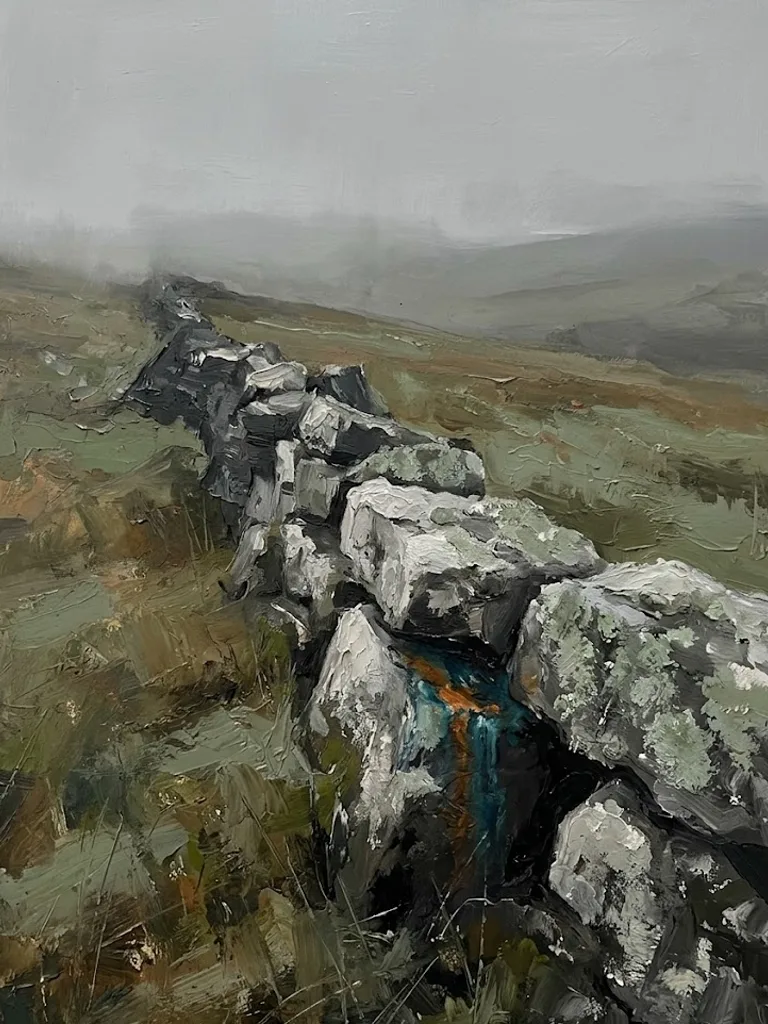
Alexander Hadfield, tailor in the village of Eyam, in the English county of Derbyshire, ordered a bale of cloth from London in the summer of 1665. London had spent months burying its people: bubonic plague was tearing through the capital. The bale arrived damp. It was opened by the tailor's assistant, a man called George Viccars, who spread it out by the fire to dry. He died on 7 September 1665. His name is the first on the list.
Eyam is a village of grey stone set into a hillside, some twenty kilometres south-west of Sheffield and a cart-day from anywhere. In September 1665 the people living in Hadfield's house began to die. Then the people in the houses next door. When winter came the thing seemed to settle, the way plague always settles in the cold, and in the spring of 1666 it came back harder than before. That is when the whole village understood what it had on top of it and asked itself the one reasonable question: leave.
Three hundred and sixty years later, those who have gone back over Eyam with the papers in front of them still do not agree on whether what they did saved anybody. What can be counted, name by name and with dates, is what it cost.
Leaving is what everybody else was doing. Those with means got out of the infected cities and went to the country, and those without stayed. The people of Eyam who could afford it — there were quarrymen, there were lead miners, there were families with land — had villages to go to and relatives who would have taken them in. If they left, they left with the plague on them.
The village rector was William Mompesson, born in 1639, who had come to Eyam in 1664 after serving as chaplain to Sir George Savile. He was twenty-six and had been two years in the post. And he was facing a problem that was not only medical: the man he had replaced, Thomas Stanley, a Puritan clergyman turned out of the pulpit for refusing the new Anglican rite, was still in the village with half the parish behind him. For Eyam to do anything as one body, those two had to appear in agreement in front of people who had spent four years quarrelling on their behalf, and they appeared.
What they proposed, in the spring of 1666, was to shut themselves in from the inside. Nobody out, nobody in. And the lockdown had two sides to it, because Mompesson negotiated it: Mompesson wrote to the Earl of Devonshire, who lived at Chatsworth some eight kilometres away, and told him that if he could count on an adequate supply of necessaries, he had little doubt of prevailing with his people to stay. In other words, he put a price on it. The village would stay and the house of Devonshire would pay for the food.
The cordon worked like this. Stones were marked around the parish boundary — there is still one on the road between Eyam and Stoney Middleton, with the holes visible — and nobody was to cross them in either direction. Merchants from the surrounding villages left goods on those stones and walked away. The people of Eyam collected the goods and left the money in hollows cut into the stone itself, filled with vinegar, because vinegar was believed to disinfect coins. At a well on the outskirts, known today as Mompesson's Well, the same exchange was made using running water. Nobody touched anybody. The money was washed.
Inside, the rules were three, and all three were brutal. Each family buried its own dead, wherever it could, with no procession and no funeral. Church services were taken out of the church, which gathered people under one roof, and held in the open air in a hollow called Cucklett Delph. And nobody crossed the stones.
At Riley, a farm half a mile from the village, lived the Hancock family. In eight days of August 1666, Elizabeth Hancock buried her husband and six of her seven children. She dragged them herself to the field next door and dug herself, because that was the rule and because there was nobody left. She did not catch it. The graves are still there, seven stones and a low enclosure, and they are called the Riley graves.
On 25 August 1666 Catherine Mompesson, the rector's wife, died, having stayed there the whole time: her grave in the churchyard is the only visible one from that year.
And there was one man who took on the impossible trade. Marshall Howe, who was nobody's gravedigger, began burying on his own account the dead of the houses where no one was left to do it, and he took his payment in the belongings of the deceased. He survived. He had had the plague before and believed himself immune, and it turned out he was, or that he was lucky for fourteen months straight. He lost his wife and his son.
The last to die was Abraham Morten, a farm labourer of the village, on 1 November 1666. With him the parish register closes, and fourteen months close with it.
Now, the question.
Inside the cordon something was going on that turns the story around, and it came out in 2016. A study by Lilith Whittles and Didelot himself, published that same year in Proceedings of the Royal Society B, reconstructed Eyam's chain of infection from the parish register, house by house, with a statistical model. The result: around three quarters of the infections passed from person to person, and only a quarter came from the rat flea, which is the classic mechanism of bubonic plague. And they measured something else that is almost always told backwards. Transmission between two people in the same household ran at a rate fifty-six times greater than between two who did not live together; and even so, of all the person-to-person infections, around 82% came from outside the home, because every villager had far more contacts in the village than inside their own house.
Read that alongside the central rule of the cordon. "Nobody crosses the stones" left a whole village living with itself for fourteen months, in an outbreak that travelled from neighbour to neighbour far more than from rat to neighbour. A cordon around a focus that spreads like that does two things at once, and only one of them is good: it protects those outside and leaves those inside exactly where the infection is.
The church record lists 273 plague victims, and the 2016 study counted 257. The two counts are close because they are the same thing: names with dates, one under the other. What is not known is the denominator. The version told throughout the nineteenth century gave the village 350 inhabitants and 83 survivors, which is three deaths for every four villagers. Whittles and Didelot, reconstructing the outbreak from the parish register itself, work with 689 people at risk and 257 deaths: 37%. Between a third and three quarters: that is the margin on how many people the plague killed in Eyam. The names, by contrast, are all there.
The other half of the experiment does not exist. Nobody can measure how many lives the cordon saved outside Eyam, because there is no twin Eyam that did not shut itself in to compare it with. The surrounding villages sent food and no equivalent outbreak is recorded there, but that cannot be credited to the cordon with the papers in hand: the plague of 1665 and 1666 was wildly uneven from one valley to the next for reasons that are still argued over. That is why the question is still in the journals three hundred and sixty years later, and why the title of that 2016 article ends in a question mark.
What is not in doubt is who decided it. There were no troops cutting the roads and no proclamation from the crown: they set the stones themselves, and the bargain with Chatsworth was asked for by letter by their own rector, who by the fourteenth month had buried his wife and was still signing everybody else's burials.