 Margen
Serialized book · From the Margen catalogue
Eleven names with no doctor twenty-two kilometres away
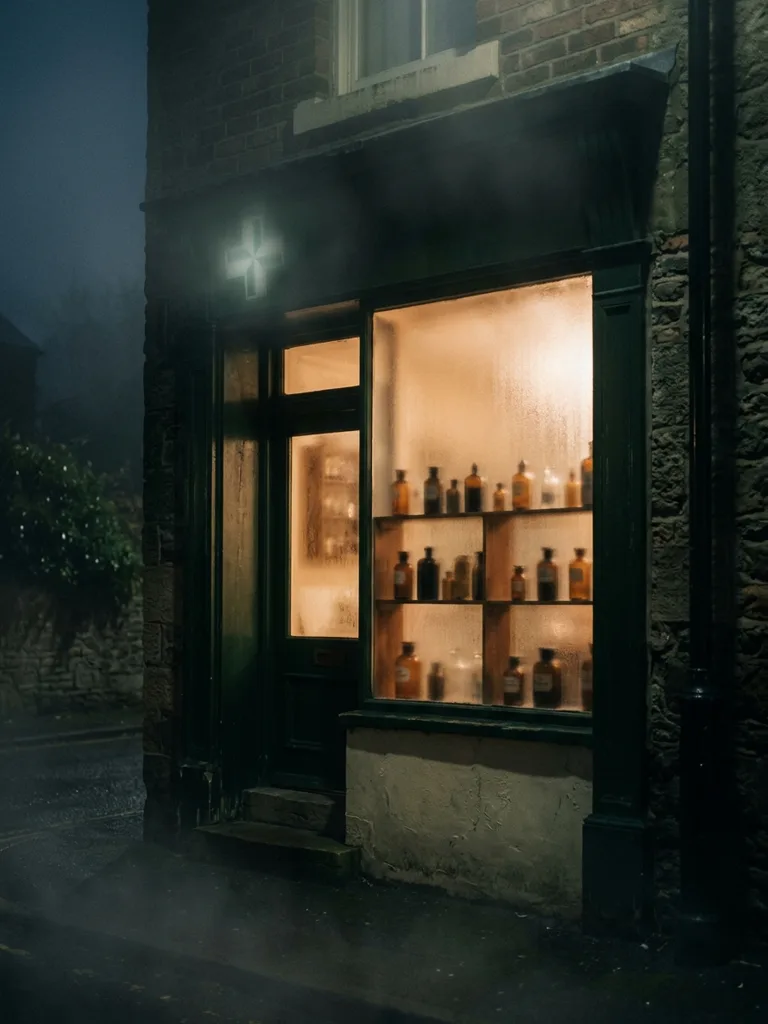
Previously: in Valdecierzo somebody is signing prescriptions in the handwriting of Doctor Sagasti, dead two years. The eleven patients all live alone.
Nine days to the inspection. Águeda Mendioroz, the pharmacist of Valdecierzo, opened at ten on Sunday because it was her turn on call, and by a quarter past she had on the counter the one pair of things she had never looked at side by side: the blue folder with the thirty-one prescriptions, and the pill-box delivery book, a card-covered notebook she and Simón Goñi the baker started three years ago, when they set up taking the boxes up with the bread: which house gets which box on which day.
On Sundays in Valdecierzo the pharmacy opens just in case. Not many people come in, and most of them are asking after somebody.
The first was Celedonio Baraibar. Eighty-one, a sheep-shearer for forty years in the gangs that went down to the Bardenas, a widower, living alone in the house below the pelota court. He came in with his cap in his hand, as if the counter were an office.
“I’ve come for mine,” he said.
His is the anticoagulant. Águeda keeps it on the top shelf, in a box with his name written on it in marker pen because Celedonio cannot read small print well.
“Three quarters,” she said. “Since February.”
“Since February.” Celedonio turned the cap over between his fingers. “They took blood at the district hospital, they looked at that number they look at, and word came down to drop a quarter. Whoever sent that word, I’ve never seen his face in my life.”
“And who renews it for you?”
“You do.”
Águeda said nothing. She took the box, marked the date in the corner of the prescription with the soft pencil she always uses, and filed it in the blue folder, which no longer fitted properly in the second drawer of the back room.
“Celedonio, when was the last time you went to the area doctor?”
“The one twenty-two kilometres away.” He said it in the tone people use for the name of a place they do not go to. “I went the first time. They gave me an appointment through that machine that asks you for your card number, and my card number is on my card, so I had to read it out to the machine. And when I got there, the man asked me what I was taking. I told him what I take. And he wrote it down.”
“And?”
“And Braulio knew that without having to ask me.”
He left with the box and half a dozen sachets of rehydration salts he had not even asked for. Águeda stood looking at the door for longer than was necessary.
The second was Maribel Zubiri, early forties, a geriatric care assistant at the residential home in Tafalla, who comes down at weekends to see her mother. She wanted a cough syrup and was returning a borrowed blood pressure monitor.
“Didn’t you always go to the one out on the main road?” Águeda asked her.
“I do go. It’s open till nine and I park at the door.” Maribel laughed. “Sorry, Águeda, but I park at the door.”
“No, you’re right.”
“My mother isn’t. My mother would sooner walk down to the river than out to the main road.”
Águeda made a note of that too, although at the time she did not yet know why.
At eleven she opened her email on the back-room computer, a desktop that makes a noise like a vacuum cleaner once it has been on for half an hour.
Marcial Beloki, a technician at the health area management office, in the billing department, had written again on Friday at twenty past seven in the evening, a few hours after ringing her himself to tell her about the delivery note with no material on it. The registered letter Águeda sent him on Thursday held the thirty-one serial numbers in a column and two lines asking for the detail of the destruction report for the prescription pads; she passed him the eleven names on Friday by email, as soon as she had them. The report was not there. Something else was.
“Águeda: I’ll tell you about the report next week, legal have it. Meanwhile here’s what I can pull myself: list of Valdecierzo patients on active long-term medication as of today, and the prescriber of each one’s last renewal. There are forty-six. I’m not sending it for fun: have a look yourself, because I’m getting an odd result and I’d rather you told me whether I’m reading it wrong. M.”
The file was one of those spreadsheets that arrive with no formatting, columns squeezed together and surnames in capitals. Forty-six rows. Águeda printed it, because there are things you can only see on paper, and laid it on the counter beside the delivery book.
Forty-six chronic patients in a village of four hundred is the normal figure where half the population is over seventy.
She started with the easy part. In the prescriber column, thirty-five rows carried a name and a registration number Águeda knows by heart because she reads it twenty times a day: the area doctor, the one twenty-two kilometres away, the one who is there two mornings a week. Thirty-five people from Valdecierzo who in these two years and four months have been over there at least once and have come away with their regimen renewed by him.
That left eleven rows.
All eleven had the same number in the prescriber box: 31.0448. Braulio Sagasti’s.
That did not surprise her; she had known it since day one. What she did was cover the name column with her hand and read only the rest: date of birth, medication, address. And then she uncovered it.
BARAIBAR ARANGUREN, CELEDONIO. OCHANDIANO EGUÍA, BALBINA. REDÍN LARRAYA, ANSELMA.
And the other eight.
The same eleven as in the blue folder. Not in the same order, because Marcial’s sheet went by surname and the folder goes by date, but the same ones. One by one.
She did it again slowly, with her finger, the way you cash up a till: read a surname off the sheet, find its prescription in the folder, lay the prescription face down on the right. Eleven times. At the end she had eleven prescriptions face down, not one row without a match and not one name without a row.
Then she opened the delivery book at each of their letters. All eleven houses were in it, with the notes she puts in the margin herself for whoever goes up: Balbina’s with a cross because the bell does not work, Celedonio’s with the time it is worth ringing before climbing up. Balbina’s also carries a note from June: the digoxin went from boxes of thirty tablets to boxes of twenty-eight, two days fewer a month, so every four months a box has to be brought forward to stop her running out over a weekend. There is not one line about that on any sheet from the area management office.
She picked up the pharmacy telephone, which is a landline and has been screwed to the wall since before she was born, and called Anselma Redín. Anselma, eighty-two, schoolmistress in Valdecierzo until they closed the school, on insulin for nine years, living alone since her brother was taken to the home in Tafalla. She is one of those who answer on the second ring.
“Anselma, it’s Águeda. A silly question.”
“Yours never are.”
“Have you ever been to the area health centre? The one twenty-two kilometres away.”
There was a short pause, the kind for arranging an answer that has been given before.
“Love, I don’t drive. I never learned. My brother had the car and my brother is in Tafalla.”
“And is there nobody to take you?”
“Of course there is. And they go down at eight and come back at three, and I inject at one.” She said it without any complaint, like somebody explaining a train timetable. “I did it once. I took my sandwich and my pen in my bag and spent the whole morning with the bag on my knees. And the man who saw me asked three times how you spell Redín.”
“With an accent on the i.”
“That’s what I told him. And he wrote it without the accent.” Anselma did not tell it as a complaint; she told it the way you show an old scar. “Look, I’ve had four hundred children from this district in my classroom and I know every one of their surnames. That man was doing his job. But he didn’t know me, and for insulin that matters, because insulin isn’t a tablet: it’s a fridge, a timetable and a hand that isn’t the hand it used to be.”
Águeda wrote two words in the margin of the printed sheet: *nobody went*.
“Anselma, one last thing. Who brings you the insulin prescription?”
“Well, it gets brought to me.” Two seconds of nothing, the only ones in the whole call. “Águeda, love, I’ve got lunch on the stove.”
And she hung up, which is a way of answering.
Rosalía Sagasti, the retired nurse from the surgery, had said on Saturday in the doorway that she would bring Balbina’s prescription down on Monday. Tomorrow is Monday. Águeda looked at the clock on the wall behind the counter, which has run four minutes fast for as long as she can remember.
Eleven people, all of them in the delivery book, all of them with their last regimen renewed by a doctor who has been two years and four months in the Valdecierzo cemetery, up against the west wall.
The other thirty-five, no. Águeda read them off and put faces to them, which is what twenty years behind the same counter is for: the couple at number 4, who go down in their son’s car; the woman from the bar, who is sixty-two and has a licence; the shepherd from Zabalza, who does the twenty-two kilometres in the feed van and makes the trip pay; the three who work away and stop at the health centre on the way back. People who can afford to lose a whole morning and come home.
The eleven share something that is not on Marcial’s sheet: not one of them drives, not one has children in the village, and not one has anybody who will wait four hours over there to bring them home.
She read Marcial’s line again: *I’m getting an odd result*. She wrote to him at a quarter to twelve, from the computer that sounded like a vacuum cleaner.
“Marcial: you’re not reading it wrong. The eleven with no renewal from the area doctor are exactly the eleven names I sent you on Friday by email. One more question, and sorry it’s Sunday: can you check whether any other pharmacy in the district has billed a single prescription under registration number 31.0448? Thirty-one have come to me here. I need to know whether I’m the only one. Águeda.”
He answered within ten minutes. Marcial Beloki does not rest on Sundays either, whatever he says.
“None. Zero. I’ve gone two years back across the nine pharmacies in the area. Only yours.”
Águeda read that three times. Nine pharmacies in the area, two years of billing, and all thirty-one of Doctor Sagasti’s prescriptions had come through the same door: the door her father painted green in 1996 and that she opens at a quarter to nine.
Because there is a pharmacy out on the main road, nine kilometres away, open until nine at night, with a car park, and knowing nobody in Valdecierzo. Her father lost customers to it every summer and used to get quietly angry about it. Águeda took it for granted that any of the nine pharmacies in the area would have dispensed them without looking twice.
The eleven do not leave their houses: that much has just become clear. But the prescriptions do move, and thirty-one times they have ended up at the same counter. Hers.
She wrote the question on the last page of the squared notebook, under the others, with the same soft pencil she uses on the corners: *why all of them here?*
And underneath, smaller, what she had been turning over since Maribel Zubiri said that thing about the parking: *the patients do not choose a pharmacy: they do not leave the house. Whoever writes them chooses. And whoever writes them could spread them across the whole district and has not done it once.*
Under the two questions there was room for a third, and that one she did not write. On the 26th, Petra Aldunate, the area pharmacy inspector, will sit on the visitors’ stool and ask her why she dispensed thirty-one prescriptions signed by a registration number recorded as dead. The honest answer runs to three lines and not one of the three saves her: that they were brought to her, that the regimens were the right ones, and that if she had not dispensed them Celedonio would have run out of his anticoagulant.
At half past one she pulled the shutter down. Before leaving she did what she has done every day since the 12th: crossed out the 17th on the wall calendar, one of those laboratory ones with a photograph of a lavender field, and counted the squares left to the 26th. Eight.
And still on the counter, the two sheets laid side by side.
Eleven names in the blue folder. Eleven names on the area list with a dead man’s registration number in the prescriber box. The same eleven, not one over and not one missing: the eleven people in Valdecierzo who were left without a doctor when the surgery closed and whom nobody went looking for.