 Margen
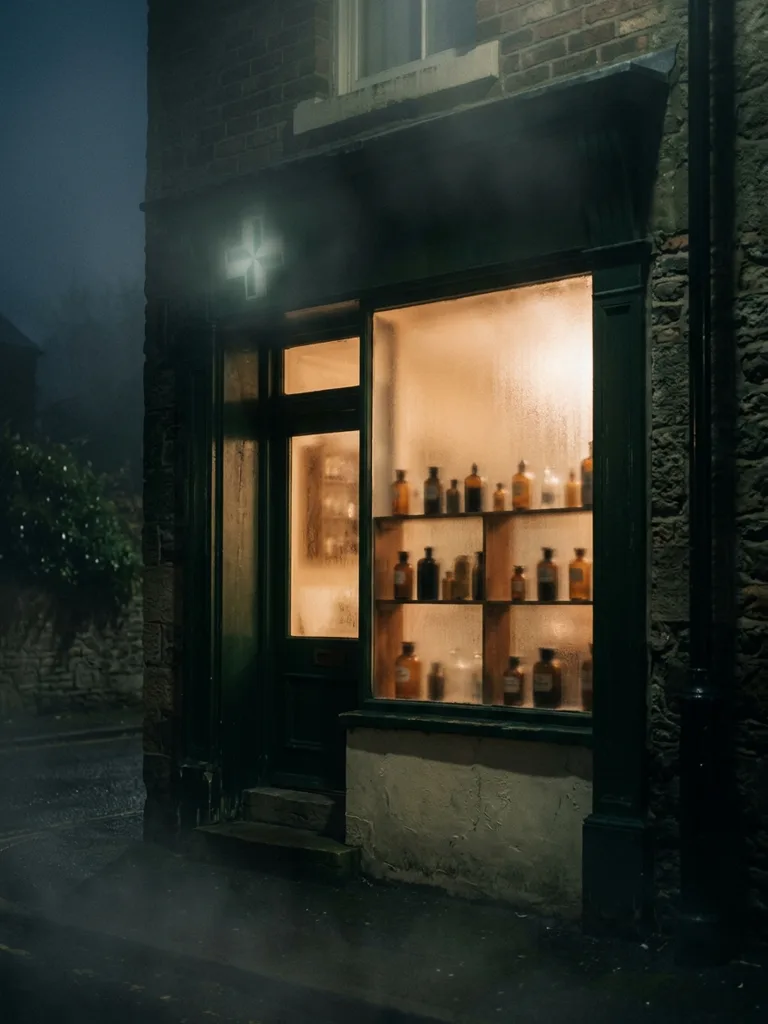
Previously: someone in Valdecierzo is signing in the hand of Doctor Sagasti, dead since 2024. The closed surgery's files are up to date. Ten days left.
On Saturday at two, with ten days to go before the inspection, Águeda Mendioroz, pharmacist in Valdecierzo, pulled down the shutter and walked up to the top of the village with a folder that did not belong to the pharmacy: two squared sheets with eleven names, the receipt for the registered letter she had sent Marcial Beloki and, copied out by hand on Thursday, two lines from two files at the surgery.
Simón Goñi, the baker, was coming down in his van with the trays already empty and braked alongside her.
"Going up to see Rosalía?" he said. "Take her the half loaf, she hasn't come down today."
Águeda took the bread and carried on uphill. Rosalía Sagasti's house is the last one on Calle de la Fuente, right up against the doctor's, the same whitewash and the same old tiled eaves. Rosalía was the nurse at the Valdecierzo surgery for thirty-four years and she retired six months before her brother died. Águeda has known her since the school vaccinations: two stitches in an eyebrow at nine years old, and the nights when the pharmacy opened at three in the morning because Rosalía rang the bell and said a name and a dose, in that order, without saying good morning.
"Come in, the coffee's made," said Rosalía, stepping back from the doorframe without letting go of the handle.
The dining room smelled of coffee and bleach. On the round brazier table there was a checked cloth folded in two, and under the fold something with hard corners. Rosalía put the tray down on top of it.
"I've come about work," said Águeda. "There is an inspection on the twenty-sixth and they will be asking me about the surgery's medicine store. I went in on Thursday with Fermín."
"And there was nothing to inventory."
"I couldn't get into the medicine store." Águeda opened the folder and laid between the cups the sheet with the two lines she had copied out by hand. "I got into the archive. And the archive is up to date."
Rosalía put on her reading glasses, the ones she wears on a shoelace, and read the first copied line unhurriedly, her lips moving like someone checking a dose.
"Ochandiano, Balbina. Digoxin nought point two five, one tablet a day, thirty days." She put the sheet down. "Braulio wrote that in 2019, when he sent her to the cardiologist in Estella. What do you want me to tell you?"
"Read the line underneath."
Rosalía did not pick the sheet up again.
"You read it."
"Underneath it says 'review, unchanged', dated February this year. And on Celedonio Baraibar's it says 'down to three quarters, blood test at the district hospital', February as well. Braulio has been dead two years, Rosalía. Those two lines are written in block capitals, small and upright, the kind you use to fill in forms." Águeda laid her pen on top of the sheet, the way you lay a letter on a table. "Whose handwriting is that?"
Rosalía helped herself to sugar and stirred slowly, two turns.
"The area doctor comes two mornings a week," she said. "Somebody will be taking notes."
"The area doctor holds surgery twenty-two kilometres away and does not have those files. A four-drawer cabinet in a building sealed for two years and four months has them. And that cabinet is the only thing in the whole place with no dust on it. You can see it against the light, Rosalía: the waiting room has an even grey blanket of dust and the cabinet gives back the reflection of the window."
The nurse laid her spoon on the saucer and straightened it, squared up with the edge.
"Then ask whoever has the key."
"I already have. Fermín, the village constable, has the keys, in pigeonhole eleven, and his oilcloth book says 'key', singular. Handed over by the area management on the twelfth of April two thousand and twenty-four, with the secretary's signature across the knot and not untied until Thursday. One key. The one for the main door." Águeda waited for the Ballarenas' tractor to go past in the street. "There is no key for the medicine store in any book in any cupboard. And the medicine store door was locked, with the bolt clean and not a scratch on it."
Rosalía looked at the window for a long moment.
"I had the medicine store key for twenty-five years," she said.
"Twenty-five years."
"Since the works." She stood up, went to the sideboard and came back with a framed photograph: twelve people in front of a scaffolded façade and, in the margin, the year written in marker pen, 1998. In the centre, her brother in his white coat. On the left, a bricklayer with his trowel raised. On the right, herself, twenty-eight years younger, with a cardboard box in her arms. "They extended the surgery at the back, through the yard of the parish house. Braulio asked the provincial council for one thing and they gave it to him: that the medicine store should have its own door onto the washhouse lane. Before that, to give an injection at four in the morning you had to open the whole surgery, put all the lights on and sign the duty book. With that door I went in on my own, took what was needed and came out again. The vaccine fridges came in that way too."
"And the lock is not in the key book."
"The door was put in by a bricklayer from Tafalla called Julián and he was paid in cash. The works are on record, with a file number. The lock is not. They never entered it, because the key book was made in eighty-seven and nobody opened it again until the funeral. In 2011 the locksmith from Tafalla came to grease the bolt, which was sticking with the damp, and nobody wrote that down either."
Águeda did the sum in her head. Twenty-eight years of a lock that exists on no council paper and does exist in a photograph with scaffolding.
The hall telephone rang, one of the old bell ringers. Rosalía got up, leaning on the table, and went out. Águeda heard her say "yes", heard her say "Monday", heard her say "tell her not to skip it". And while she listened, she looked at the fold in the tablecloth.
A corner of grey oilcloth was showing underneath, the kind they used to cover exercise books with at the stationer's in Tafalla. A notebook. On the edge, in ballpoint and half worn away, a row of numbers that was not a date.
Rosalía came back, hung up and, without sitting down, put her hand under the cloth, pulled out the grey notebook and left it in the drawer of the table. She pushed it to the back with two fingers.
"That's mine," she said.
"I didn't ask."
"I'm telling you anyway."
"Rosalía." Águeda did not get up. "Show me the door."
The nurse stood looking at her. Then she took her cardigan off the back of the chair.
"Bring the bread, your coffee's going cold anyway."
The two of them went down Calle de la Fuente, past the pharmacy with its shutter down, and followed the washhouse road to the lane that separates the yard of the parish house from the back wall of the surgery. It is a passage a metre and a half wide, with grass down the middle and the ruts of a cart that no longer exists.
The medicine store door is halfway along: metal, painted the same slat green as the bars and the blinds, with no number and no letterbox. Águeda had walked past it a thousand times without looking at it, just as she had seen it from inside on Thursday, from the corridor. What she had never seen was the step.
She crouched down. The block of stone at the entrance, a hand's width deep, had been swept. Not scrubbed: swept, with the grass cut flush right in front of it and the walnut leaves piled to one side, not on top. In a building shut for two years and four months, with pigeons getting in through the roof of the yard, that step had been swept. And in the mouth of the bolt, when the light caught it sideways, there was no cobweb.
"And who sweeps it?"
"The wind," said Rosalía.
"Rosalía."
"Águeda, you remember what this place was like." The nurse had turned to face the wall and was talking towards the door, not towards her. "On Thursdays thirty people came from seven villages. Braulio went out at nine and came back at nine. Now you have to book through a machine that asks you for your card number."
"I know all that."
"Well, that's all there is."
They walked back up without talking. In the doorway Rosalía wrapped half a dozen walnuts in brown paper and put them in Águeda's coat pocket, the way she used to with the young mothers who came out of the surgery with a child in their arms and the face of someone who hadn't slept.
"I'll bring Balbina's prescription down to you on Monday," she said.
"I've got a delivery at eight on Monday."
"Eight, then."
Águeda put Monday away where you put the things you have to look at closely.
She bent down to move a flowerpot so the door would not knock against it. And as she bent down, Águeda saw what was behind her.
The hallway has a small cork board, the sort butchers use, with four keys hanging from their hooks. The street door. Braulio's house, with a red ring. A piece of land, with a length of twine. And the fourth, shorter, flat and notched along both edges, the kind for a security lock, with a yellow card label tied on with string.
Águeda read it from where she stood, without taking a step, with the reading glasses she also wears round her neck.
It said MEDICINE STORE and, underneath, in the same blue ink as the margin of the photograph, 1998.