 Margen
Serialized book · From the Margen catalogue
Simón sees the woman at the letterbox at dawn on Mondays
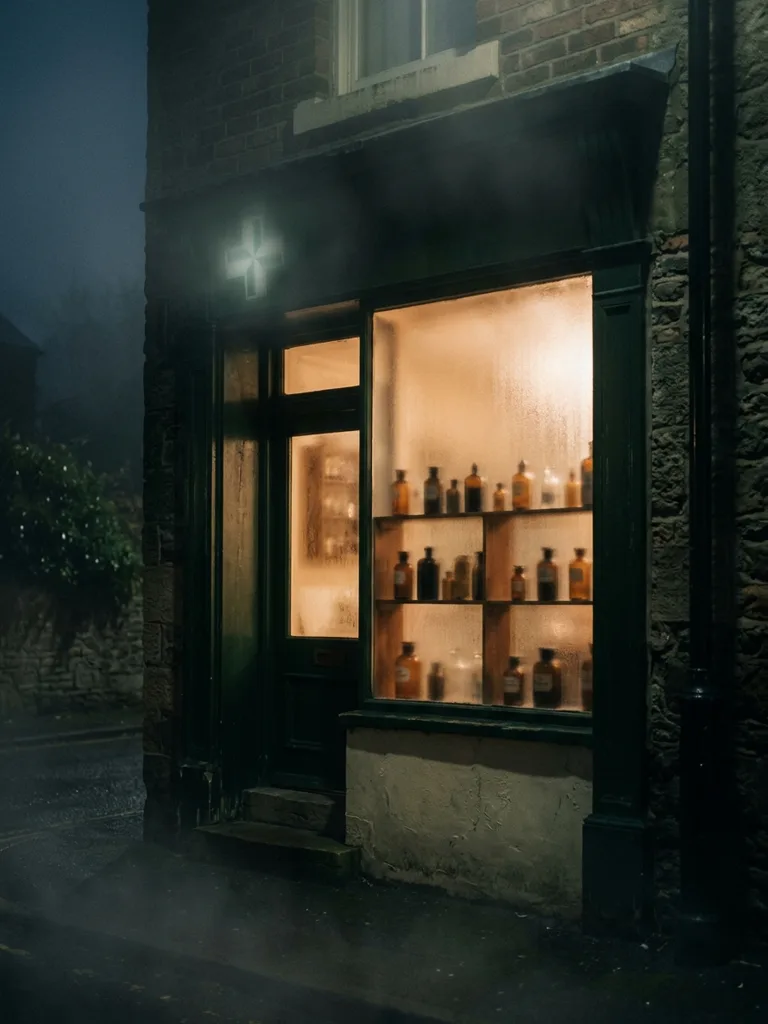
Previously: on Tuesday Águeda learned that sixteen of the envelopes holding Sagasti's prescriptions had been dropped by hand into her shutter letterbox, thirteen of them on a Monday.
On Thursday, at twenty to five, five days were left before the inspection and Águeda Mendioroz crossed the street in her slippers. Across the way, in the bakehouse, the light was on. It had been on every early morning of her twenty years behind the counter and she had never once looked at it with any interest.
Simón Goñi, baker, was kneading with his back to the door. He was forty-seven, his hands white to the wrist, and a small radio was playing on top of the flour bin.
"We're not open," he said without turning round. "No bread until seven."
"I'm not here for bread."
Then he did turn round. He wiped one hand on his apron and offered her the back of it, which is how you shake hands when you are in the dough.
"Is something wrong with your father?"
"My father's fine. I've come about the window."
Simón looked at the window as though he weren't sure which one he had. It is a high, narrow window, the kind that airs a bakehouse, and it faces straight across: onto the pharmacy front, onto the green door Águeda's father painted in 1996, and onto the letterbox slot cut into the metal shutter at chest height, so people can post their prescriptions when the place is shut.
"That window faces your house," he said.
"It faces my letterbox."
Simón went back to the dough. He turned it out onto the marble, folded it twice and cut it into equal pieces with the scraper without looking at the scales.
"At five in the morning I don't look at the street, Águeda. I look at the clock and the oven."
"Right. And without looking at the street, how many times have you seen somebody post something through that slot?"
He didn't answer. He set the pieces on the board, covered them with a cloth and washed his hands more slowly than he needed to.
Águeda had brought the round book. They made it between them three years ago, when she started making up the weekly pill organisers and he was already going to the same doors with the bread: one page per house, the good hour to call, a cross on Balbina Ochandiano's because the doorbell doesn't work. There is no official paper anywhere with that information. They put it together themselves without asking anyone's permission and without it being recorded anywhere, which was exactly what frightened her now.
"Look," she said, and opened the book at the back cover, where since Tuesday she had been keeping a list in pencil. "Thirty-one prescriptions. Six reached the houses by post, stamped. Twenty-five came here. Of those twenty-five, nine by post. And sixteen by hand, unstamped, through the slot. Thirteen of those sixteen turned up on a Monday."
"I wouldn't know about that."
"Neither did I on Friday. I know it because I've been pencilling the date on the corner of every prescription for two years, and until Tuesday that meant nothing."
Simón dried his hands on the cloth and for the first time looked straight at her.
"And what do you want me to tell you?"
"I want you to tell me if you've seen anyone."
"And if I say no."
"Then I go home, and next Monday I'll be the one standing behind that shutter, which is what I should have done a month ago."
The oven made the noise an oven makes when it comes up to temperature, a dry click, and Simón went to open it so he wouldn't have to answer straight away. He put the empty peel in, took it out, put it back in. Águeda waited on her feet, the round book held shut against her chest.
"An inspector is coming next Tuesday," she said. "Petra Aldunate. That's her name and she comes on the twenty-sixth. She is going to ask me why I dispensed thirty-one prescriptions signed by a practitioner on record as dead since 2024. And so far the only answer I have is that I don't know."
"So tell her that."
"Simón, this is my father's pharmacy."
He shut the oven. He stood there holding the peel.
"Go and open up," he said. "I've got bread to get out."
At a quarter to nine Águeda raised the shutter. The clock on the counter said eleven minutes to nine, because it runs four minutes fast and has done for as long as she can remember and nobody has ever fixed it. Nothing had come through the slot.
Thursdays are delivery day, so she did what she does every Thursday. She took out the seven-day boxes for half a dozen houses up in the top quarter and filled them on the counter, compartment by compartment, out loud, which is the only way not to make a mistake. Balbina Ochandiano's she left to one side, on top of the round book, for Simón to take up with the bread: Balbina is eighty-four, has two flights of stairs and a doorbell that doesn't ring, and for three years now that pill organiser hasn't come down, it goes up.
While she was counting out the digoxin —one box brought forward every four months ever since the pack went from thirty tablets to twenty-eight— she realised something that had been in front of her for two days and that she hadn't looked at: Simón goes into those houses. He doesn't ring, he doesn't wait, he leaves the bread and the pill organiser on the ledge and carries on. Nine years leaving bread at those doors, three of them taking the pill organiser as well. In Valdecierzo, which has four hundred people in winter, nobody stands in more doorways at more hours than the baker.
At twenty past twelve Marcial Beloki rang. He is the prescription-billing officer at the area management office, twenty-two kilometres away, and he and Águeda have been on first-name terms since day one.
"I'm sending you the detail on the destruction record," he said. "It took me a week to prise it out of legal, so don't thank me too warmly."
"Go on."
"The record for the route of the eighteenth of April 2024 goes by batch and by weight. A hundred and forty-two kilos of paper for the whole route, six stops. It doesn't list serial numbers for anything. That's why the destruction certificate on the file is good for the file and no good at all for your prescription pads."
"We knew that already."
"We did. And there's another thing, though I don't know whether it's a thing."
Águeda picked up the pencil.
"Tell me."
"Your inspection file doesn't start the way the ones I see all year start. The ones that reach me have a reference beginning with PA. Yours begins with RQ."
"Meaning what?"
"I've no idea. It may mean nothing: they change the codes every five minutes and nobody sends me the table. I asked in writing this morning. If they answer, I'll tell you."
"And in the meantime?"
"In the meantime you get the papers you do have in order and you don't tie yourself in knots over two letters."
He hung up. Águeda wrote the two letters in the corner of a page of the round book, RQ, and looked at them for a long while. Until that morning she had taken it for granted that the inspection was coming because it was due: two years without setting foot in Valdecierzo, paperwork behind, a list of rural pharmacies and a finger going down the list. That was what she had been telling herself since the letter arrived, and it was a comfortable explanation.
Underneath the two letters, without noticing, she wrote eleven names. They are the ones she knows by heart.
In Valdecierzo everybody knows something; what is rare is knowing enough to write to anyone. Águeda counted up who has been close to this in two years: herself, Marcial, Fermín Ozaeta the town constable, Charo at the post office, Itziar Lizarraga out at the junction, Maribel Zubiri —who took two prescriptions down to the junction and watched them being refused— and Rosalía. Seven people and whoever is signing. She shut the round book without writing the list down.
At five, with the street empty, she took the blue folder out of the second drawer in the back room. On Tuesday she had sorted the envelopes by how they had arrived. Today she put them up against each other.
She had kept all of them: her father taught her never to throw away the wrapping of anything that might be argued over later. That the paper looked alike she had known since the first envelope. What she had never done was lay them out on the counter and measure them.
She laid them out on the counter in three piles.
Six envelopes were the ones that had gone to the houses, stamped, all of them in the first eight months and none since. They were white, ordinary, folded-letter size, and no two were alike: one had a blue lining, another had come from a bank with the logo crossed out in biro.
Nine envelopes were the ones that had come by post. Those were identical to each other: small, rough paper, the back lined in grey.
And sixteen were the ones from the slot. Identical to the nine. Rough paper, back lined in grey, the same gummed flap, exactly the same size. She stacked them one on top of another and they fitted together as though they had come off the same pile.
Águeda stood looking at the two piles side by side, twenty-five envelopes off the same pad, and understood something she had taken for granted all this time for no reason whatsoever: whoever bought the stamped ones and whoever posted the ones through the slot had bought them in the same shop, probably on the same day. They were not two routes. They were one, sometimes with a stamp and sometimes by hand.
And if it was one route, the question shrank. There was no longer any need to work out who posted sixteen envelopes and who sent nine. What she had to work out was who bought a pad of cheap envelopes two years ago and still has some left.
She wrote it under Marcial's two letters and stayed there a while with the three piles in front of her, not touching them.
At ten to eight, as she was bringing the shutter down, Simón Goñi crossed the street without taking off his apron. His hands were clean, which in a baker at that hour is a decision.
"Can I come in?"
Águeda raised the shutter half a metre and he ducked under.
He stayed on his feet by the hand-cream stand, which is where people stand when they don't want to sit down.
"I've been turning it over all day," he said. "And I very nearly didn't come."
"I know."
"No, you don't. I've been leaving that person's bread at the door for nine years. At the door, without knocking, because she doesn't like being seen in her dressing gown." He stopped. "And she pays me on the first of every month, into my hand, without my asking. What I'm about to tell you, you tell the inspector and you leave me out of it."
"I'm not going to put you in it."
"Twice," said Simón. "Both times on a Monday. Once in winter, with frost on the cars, and the other this summer, when it gets light earlier, and that's why I saw her properly. Around a quarter past six. She comes down the pavement on your side, doesn't cross, doesn't look either way. Long coat both times, even in summer, and no walking stick."
"Go on."
"She stops in front of your shutter, moves her bag to the other hand, takes out an envelope and posts it through the slot. She pushes it in with two fingers, because the metal catches. And she carries on as far as the corner by the pelota court, which is where you go up to her street."
Águeda didn't move.
"The second time I stood watching her from the window until she turned the corner," he said. "On Mondays I don't open, but I come down anyway to refresh the starter and clean the oven, so I was there. And I remembered it was a Monday, and that on Mondays I don't take her bread. So she wasn't coming down for anything of mine."
"Simón."
"It's the sound I know," he said. "It's the shoes. There's nobody in the street at that hour, and those shoes have hard soles and they sound different from mine and from everybody else's. I heard those shoes come into the bakehouse for the surgery's bread from when I was a boy and my father was the one kneading, and I stopped hearing them three years ago, when she retired."
He looked up.
"It's Rosalía. Rosalía Sagasti, the nurse. And both times she had the grey notebook in her other hand."