 Margen
Did you know? · From the Margen catalogue
How do you get an entire library out of an occupied city?
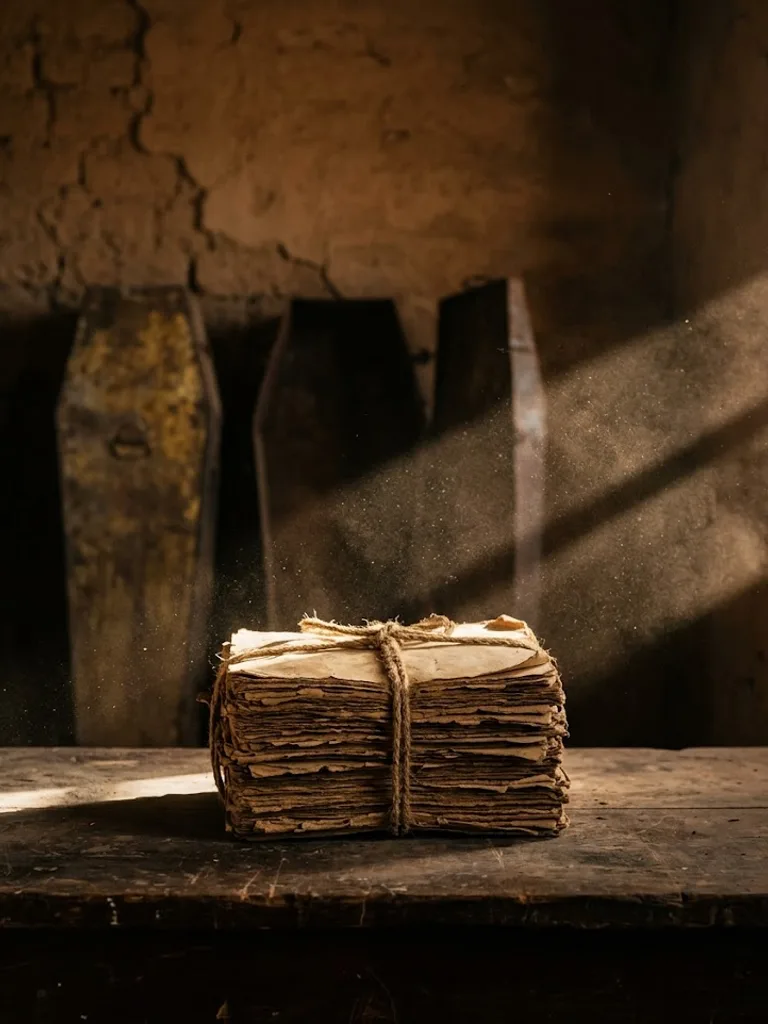
In April 2012, when armed groups entered Timbuktu, the city in northern Mali held one of the oldest libraries in the world, scattered across private houses. It was not a library in the sense of a building with a desk: it was dozens of family libraries, trunks under beds, mud-brick cupboards, unventilated rooms where a family had kept for generations the books an ancestor had copied or bought. Astronomy treatises with eclipse tables, medical manuals, rulings in Islamic law, contracts for the sale of salt, letters of credit, love poetry, arguments about whether smoking is permitted. Italian paper, goatskin, soot ink. The oldest date from the thirteenth century; the most recent from a hundred years ago.
There was a reason they were under beds and not on shelves: through the twentieth century many families hid their manuscripts from the French colonial administration and later from the officials of the new state, afraid they would be requisitioned for museums and universities. The mistrust went back a long way and it was reasonable. That is why in 2012 the problem was not only transport: it was that somebody with a name and a face had to have permission to open those cupboards.
The figure that gets repeated is 377,000 manuscripts, the count kept by the very network that moved them; other estimates say between 300,000 and 400,000, spread across some forty-five libraries in the city and around it. In either version the problem is the same, and it is a logistics problem: how do you get that out of an occupied city, with no lorries, no escort and without the occupiers noticing?
Abdel Kader Haidara had spent the 1980s and 1990s travelling by canoe through the villages of the river Niger, persuading families to entrust their manuscripts to the Ahmed Baba Institute, Timbuktu's public research centre. He knew the owners one by one, which is exactly the capital the job required. In 1996 he founded SAVAMA-DCI, an association of private libraries, and in 2012, with the city occupied, he used that address book for something no statute had foreseen. His answer consisted of splitting the library into thousands of anonymous packages and moving them one at a time.
The plan had three rules. First: no convoys. The manuscripts were wrapped and packed into the metal footlockers sold in any Sahel market for storing clothes. When the market ran out of them, more were ordered from the city's metalworkers. Second rule: move inwards first. Before anything left Timbuktu, the trunks left the known libraries and were distributed among ordinary houses in the city itself, at night, on donkey carts and in four-wheel drives, so that a search at the address of a famous library would find nothing. Third: every trunk travels alone, mixed in with the luggage of people travelling for other reasons.
That was how the trickle south began. Some thousand kilometres by road to Bamako, the capital, in shared taxis, on scheduled buses, in the cars of families who were leaving. Hundreds of trips between mid-2012 and January 2013, each with a few trunks, each with its checkpoints: the occupiers' on the way out and the Malian army's on the way in, seeing closed boxes and wanting to know what was inside. Trunks were opened, tips were paid, drivers turned back. When the road became impassable, the river: pinasses loaded and sent down the Niger, with the risk that adds, which is the water and the people who live by robbing boats.
None of it was free. The Prince Claus Fund, a Dutch foundation, put up money for the evacuation. Later, with the manuscripts already in Bamako, Haidara and Stephanie Diakité — an American lawyer and conservator, co-founder with him of the T160K initiative — launched a crowdfunding campaign called Libraries in Exile: it raised more than 67,000 dollars in a month from 1,257 donors to buy conservation boxes and silica gel. The stated goal was to house 280,000 manuscripts, because the rescue had created a new problem: the books were crammed inside sheet-metal trunks, with no wrapper or folder, and the humid heat of the south is the worst thing that can happen to paper that had spent six centuries in the desert.
In January 2013 French paratroopers entered Timbuktu. As they withdrew, the occupiers set fire to the Ahmed Baba Institute, the new building that held tens of thousands of manuscripts. For two days the news that went round the world was that the library of Timbuktu had burned. It was true that the building had burned; the rest was not. What burned, according to later counts, was some 4,000 documents: the ones that had not got out in time. The rest was in Bamako, in more than 1,400 metal boxes holding manuscripts from more than thirty family libraries, stacked in rented flats in the capital.
What could not be packed into a trunk was lost. In the summer of 2012 the occupiers tore down the city's mud mausoleums with picks and shovels — the graves of scholars, visited for centuries. On 27 September 2016 the International Criminal Court sentenced Ahmad al-Faqi al-Mahdi, who had directed those demolitions, to nine years in prison: he picked the men, picked the buildings and handed out the tools. It was that court's first ruling on an attack against cultural heritage, and the first in which a defendant pleaded guilty. The fourteen mausoleums were put up again in earth by the masons' guild of Timbuktu under the umbrella of UNESCO; they were consecrated in February 2016.
That there were so many books on the edge of the desert is neither coincidence nor legend. In the fifteenth and sixteenth centuries Timbuktu was the customs house where Saharan salt was traded for gold from the south, and where the caravans from Fez and Cairo stopped. The traveller Leo Africanus, who passed through the city in that century, wrote that books brought from the north sold there at a better profit than any other merchandise. Copying texts was a trade with a price list, like blacksmithing. The families who commissioned those copies were the same ones still keeping them in 2012.
The library of Timbuktu had already been emptied once by force. In the 1590s the army of the sultan of Morocco took the city and carried the scholar Ahmad Baba, born in 1556 and author of dozens of treatises, off to Marrakesh. He spent twelve years in exile. When he was allowed back, in 1607, he asked for his books: 1,600 volumes seized by the soldiers, and he left it on record that his was the smallest library of all his friends. The institute that burned that January carries his name.
A wet manuscript cannot be restored like a printed book: soot ink runs and leather swells. Since 2014 the Hill Museum and Manuscript Library, a centre in Minnesota that specialises in photographing endangered libraries, has been running digitisation studios in Bamako with SAVAMA-DCI, working with the Arcadia Fund, the Juma Al-Majid Centre in Dubai and the University of Hamburg. They do not restore: they photograph page by page. And there is the question of going back: the manuscripts belong to families who are still in Timbuktu, but security there is not guaranteed, and in Bamako the climate is ruining them. Every year someone has to pay the rent on the premises where they sit.
Of the 377,000, the Minnesota centre has photographed more than 292,000 since 2014. The originals are still in the capital, in boxes with silica gel, a thousand kilometres from the desert that had kept them for six centuries.